
4,000-Year-Old Grave Unveils Life in Ancient Nubia’s Desert
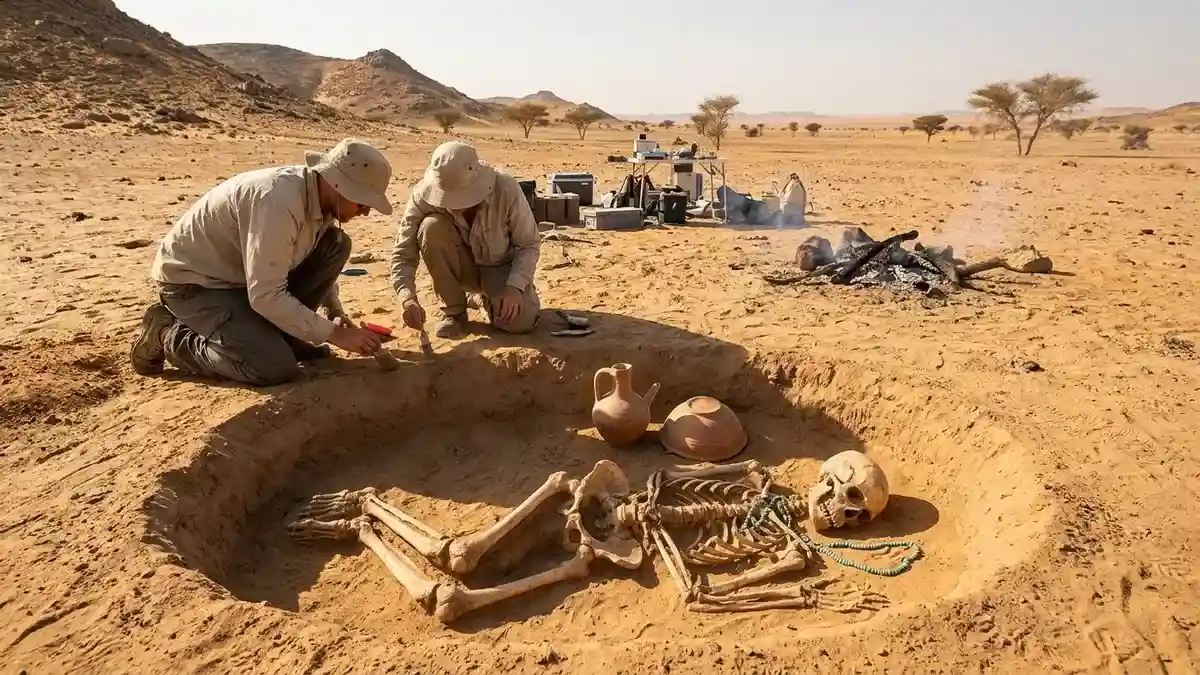
Deep within the arid expanse of Sudan’s Bayuda Desert, a team of Polish archaeologists has unearthed a perfectly preserved time capsule from the Kerma period. Dating back 4,000 years, this ancient grave offers a rare, high-resolution look at the life and death of a man who lived in the shadow of one of the Nile Valley’s most powerful kingdoms.
4,000-Year-Old Grave Unveils Life in Ancient Nubia’s Desert
A Life of Labor in a Changing Landscape
The skeletal remains belong to a man who lived between 30 and 40 years of age. Standing approximately 164 centimeters (about 5’4”) tall, his osteological profile tells a story of a grueling, physically demanding life. His bones reveal robust muscular development and signs of severe physical strain, indicative of a life spent performing heavy labor under the harsh conditions of a semi-desert environment.
This labor was likely tied to a nomadic or semi-nomadic existence centered on animal husbandry. The burial site contained significant animal remains, suggesting that the deceased had a close, lifelong relationship with livestock.
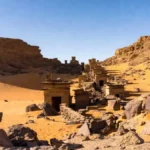
Interestingly, environmental studies of the Bayuda Desert reveal that this region was not always the parched wasteland seen today. Around 2000 BCE, the area was a lush savannah, home to scattered trees, shrubs, and hardy grasses. This greener past supported the pastoral communities that thrived here during the height of the Kerma kingdom, which dominated the region from 2500 to 1500 BCE.
Burial Customs and Ritualized Offerings
The burial itself follows the traditional, highly ritualized customs of the Kerma culture. The man was placed in a shallow, oval-shaped pit, his body oriented to face east-northeast, with his legs tightly bent in a posture characteristic of the era.
Behind the body, archaeologists discovered two handmade ceramic vessels: a spouted jug and an inverted bowl. The placement and condition of these vessels are central to understanding Kerma funerary rites. In Nubian tradition, pottery was not just for storage; it was a ritual object. The practice of turning a bowl upside down or placing vessels in the grave signaled the end of their “earthly” function, symbolically tethering the objects to the deceased.
 Zīrid Ifrīqiya and the Islamic world in the 10th–12th centuries: an international conference at UCL
The Mystery of the Funeral Feast
Perhaps the most intriguing find was contained within the spouted jug. Inside, researchers discovered a collection of charred plant remains, animal bone fragments, and beetle parts. The jug itself showed no signs of heat, which led the team to a fascinating conclusion: the contents were the remnants of a funeral meal. The participants likely cooked a feast, threw the leftovers into a fire, and then collected the “sacred” debris to be buried alongside the man as a final offering.
Adorning the man’s neck were 82 faience beads, a testament to his social standing. These beads, likely worn as a necklace, provide a touch of personal artistry amidst the stark reality of the grave.
Reconstructing Ancient Nubia
For decades, the Bayuda Desert was considered a blank space on the archaeological map, with research limited to sporadic surveys in the mid-20th century. This new excavation, led by the Polish Centre of Mediterranean Archaeology at the University of Warsaw, changes that. By synthesizing biological analysis, environmental mapping, and material culture, the team has managed to reconstruct the entire cycle of a man’s life—from his daily struggles in the savannah to the final, ceremonial feast held in his honor.
This burial is more than just a site of historical interest; it is a vital reminder of the complexity of the Kerma kingdom. It reveals a society that was deeply connected to its animals, highly aware of its changing climate, and committed to sophisticated ritual practices that honored the departed with care and precision.
Frequently Asked Questions
What was the Kerma period?
The Kerma period (c. 2500–1500 BCE) was a sophisticated Nubian kingdom that flourished in the Nile Valley. It was a major regional power that traded extensively and maintained distinct funerary and cultural traditions.
How did researchers know it was a “funeral meal”?
The jug contained charred plant and animal remains, but the jug itself was not burned. This indicates the food was prepared and charred elsewhere (likely at a hearth), then gathered and placed in the jug as an offering for the deceased.
What do the beads tell us about the man?
The 82 faience beads indicate that even individuals living a life of intense physical labor were adorned with symbolic jewelry, reflecting the cultural importance of personal appearance and social status in Kerma society.
Why is the Bayuda Desert important for archaeology?
Once thought to be an empty desert, the Bayuda is revealing itself to be a crucial corridor for ancient pastoralist communities. It holds the evidence of how people adapted to the transition from a green savannah to the desert environment we see today.
What does the burial posture signify?
The tightly bent legs and specific orientation of the body (facing east) were standard Kerma funerary customs. Following these specific traditions shows that the deceased was buried by a community that adhered to a shared, standardized set of religious beliefs.