
Sunken Treasure Rewrites Singapore’s Precolonial History
For years, a pervasive historical myth suggested that precolonial Singapore was little more than a sleepy, isolated fishing village before the arrival of Sir Stamford Raffles in 1819. However, a monumental underwater excavation off the coast of Singapore has officially shattered that narrative. The discovery of the “Temasek Wreck”—the oldest shipwreck ever found in Singaporean waters—reveals that by the mid-14th century, the island was already a bustling, sophisticated international trading hub.
Sunken Treasure Rewrites Singapore’s Precolonial History
A Massive Ceramic Time Capsule
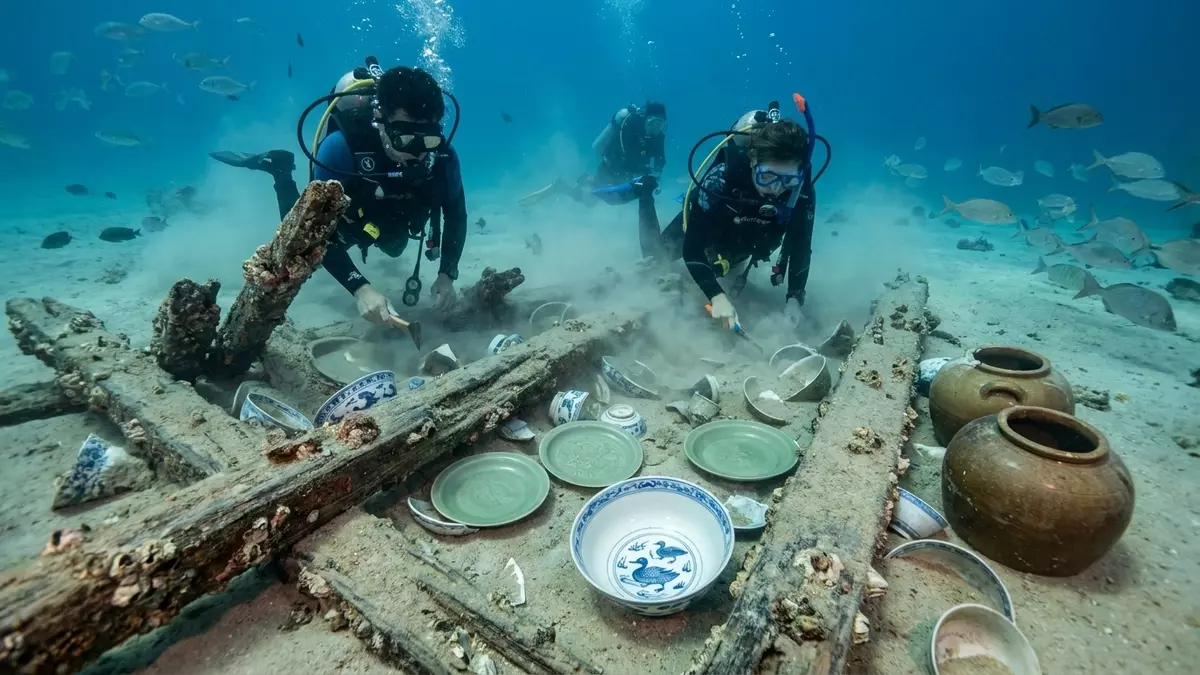
Between 2016 and 2019, a dedicated maritime archaeology team conducted an exhaustive excavation on the seabed, ultimately recovering a staggering 3.5 tonnes of ceramic cargo. While the sea had claimed the vessel’s wooden hull, the indestructible nature of its primary cargo—high-quality Chinese ceramics—remained largely intact.
The haul is nothing short of extraordinary for researchers. It includes:

Unprecedented Porcelain: The wreck yielded approximately 136 kilograms of blue-and-white porcelain from the famous kilns of Jingdezhen. This represents the largest concentration of such material ever recovered from a single shipwreck.
Diverse Varieties: Beyond the blue-and-white ware, the ship was packed with Longquan celadon, “qingbai” and “shufu” wares, fine whiteware from Dehua, and sturdy brown stoneware jars from Cizao kilns.
Merchant Logistics: The inventory suggests a vessel carrying a strategic blend of high-end luxury tableware for elite consumption and large, durable stoneware jars intended for the transport of bulk commodities.

Pinpointing the Sinking: The Yuan Dynasty Connection
Dr. Michael Flecker, who spearheaded the analysis of the assemblage, utilized the specific decorative motifs on the ceramics to create a precise timeline. Several bowls recovered from the site feature intricate designs of mandarin ducks swimming in lotus ponds. Historical production records indicate that this specific motif was produced during a very brief window under the Yuan dynasty before political unrest forced local kilns to cease operations.
Based on this evidence and other decorative styles, researchers have narrowed the vessel’s final voyage to between 1340 and 1352. This precise dating provides a rare, “tight” chronological snapshot of the goods that defined 14th-century Southeast Asian maritime commerce.
Singapore’s Role as a Vital Entrepot
Perhaps the most significant aspect of the Temasek Wreck is what it proves about the island’s economic status. By comparing the ceramics on the wreck to fragments previously unearthed at land sites like Fort Canning, archaeologists have confirmed that the vessel was not merely passing through—it was headed directly for Temasek.

The absence of larger, 40-to-50-centimeter platters, which were standard exports for the Middle Eastern and Indian markets at the time, is the “smoking gun.” The cargo was curated specifically for the local market in Temasek, indicating that the island possessed a wealthy consumer base capable of purchasing high-grade porcelain.
This discovery serves as a powerful corrective to the “fishing village” myth. A vessel loaded with several tonnes of luxury ceramics would never have set sail for a backwater settlement. Instead, the Temasek Wreck proves that Singapore was a vital entrepot—a thriving center of exchange integrated into the vast maritime networks of the medieval world, long before the modern colonial era.
The Future of Maritime Archaeology in Singapore
The Temasek Wreck now serves as a foundational reference collection for maritime scholars. Because the entire assemblage comes from a single, tightly dated shipment, it provides a benchmark for identifying less-provenanced finds at other historical sites across Southeast Asia.
This shipwreck is more than just a collection of antiques; it is a physical link to a past that was cosmopolitan, commercially vibrant, and internationally connected. As researchers continue to process the findings, the Temasek Wreck stands as a definitive testament to Singapore’s status as a historic crossroads of the sea.
Frequently Asked Questions
Why is this considered the most important shipwreck in Singapore?
It is the earliest shipwreck ever discovered in Singaporean waters. Its cargo provides definitive evidence that Singapore (then known as Temasek) was an active, wealthy trading port in the 14th century, contradicting the myth that it was just a small fishing village.
What was the ship carrying?
The ship was carrying a massive cargo of Chinese ceramics, totaling about 3.5 tonnes. This included high-value blue-and-white porcelain, celadon, whiteware, and bulk-storage stoneware jars.
How did archaeologists date the wreck so precisely?
By identifying specific decorative patterns, such as the “mandarin ducks in a lotus pond” motif, which were only produced during a short period under China’s Yuan dynasty, researchers were able to pinpoint the sinking to the mid-14th century (1340–1352).
Was the ship meant for Singapore or another destination?
The ship was almost certainly destined for Temasek. The specific sizes and types of ceramics matched fragments found at land-based excavations in Singapore, and the absence of larger platters intended for the Indian or Middle Eastern markets confirms it was a local shipment.
What happened to the wooden part of the ship?
Unfortunately, time and the tropical marine environment have destroyed the wooden hull. Archaeologists were only able to recover the ceramic cargo, which had survived the centuries on the seabed.