
Historic Iron Cannon Unearthed During Hull’s Queen’s Gardens Project
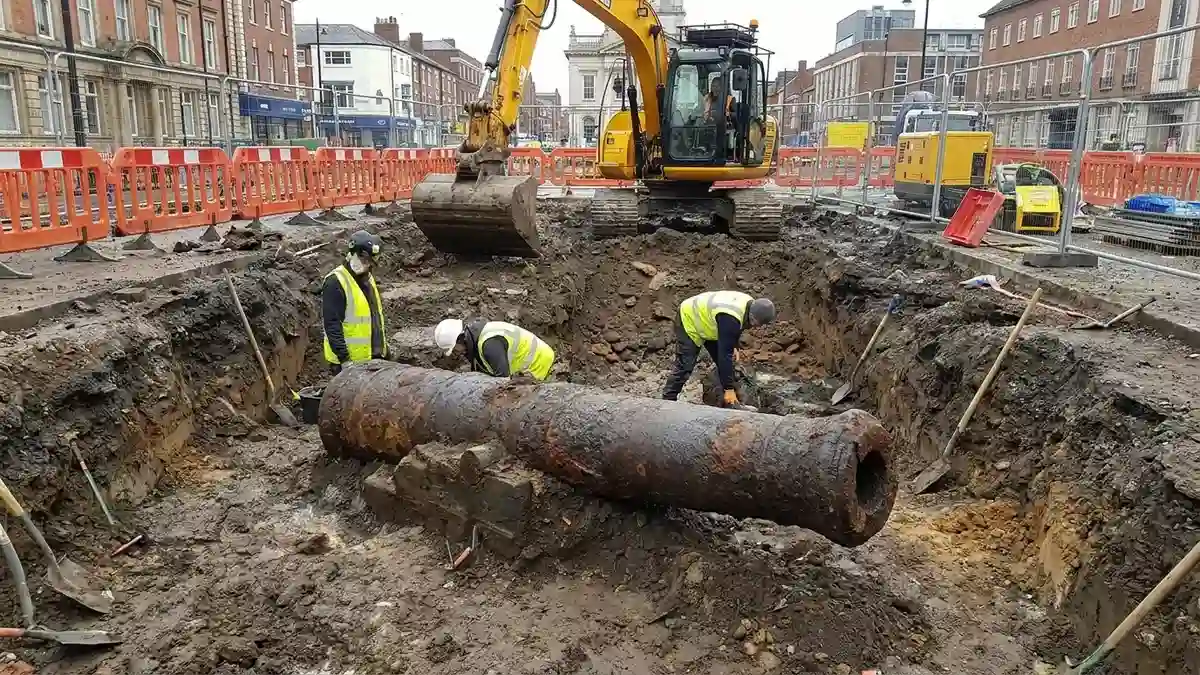
A routine construction project in Hull, England, has taken an unexpected turn into the past. While excavating for a new water storage tank during the ongoing restoration of Queen’s Gardens, contractors from CR Reynolds made a striking discovery: a massive, 17th-to-18th-century cast-iron cannon buried nearly five feet beneath the modern city surface.
Historic Iron Cannon Unearthed During Hull’s Queen’s Gardens Project
A Tense Discovery
The find occurred on February 13, when a mechanical digger reached a depth of approximately 1.5 meters (roughly 5 feet) and struck a large, solid mass. Given the history of the region, the initial reaction was one of extreme caution.
“The team didn’t immediately know what they had hit,” a site spokesperson noted. “Given Hull’s exposure to heavy bombardment during the Second World War, the immediate concern was that it might be an unexploded ordnance.”

However, after a careful inspection of the object, the crew identified the telltale rings of a cannon barrel, instantly shifting the site from a potential bomb-disposal operation to an active archaeological dig.
From Naval Defense to Dockside Mooring
The artifact is an impressive piece of maritime engineering, measuring 2.6 meters (8.5 feet) in length and tipping the scales at over one ton. Specialists from Humber Field Archaeology have been brought in to conduct a full assessment, and their preliminary findings reveal a fascinating “second life” for the weapon.
While the cannon was originally designed for defensive military use—likely mounted on a warship or stationed along the port’s perimeter—it was eventually decommissioned. Analysis of the cannon’s end, which has been capped, confirms that it was purposefully rendered inert before being repurposed.

Researchers believe the cannon was moved to the city’s docklands in the late 19th or early 20th century. During this era, it was common practice in maritime hubs like Hull to take decommissioned, heavy artillery and bury them upright in the ground to serve as reinforced mooring posts for ships. It is likely that the cannon remained in this role until the 1930s, when the specific dock area was filled in, effectively burying the weapon and turning it into a silent time capsule of Hull’s industrial past.
Hull’s Maritime Legacy
This discovery is the third of its kind to be recovered from archaeological work in Hull, underscoring the city’s deep-rooted connection to naval defense and trade. The cannon is currently being prepared for removal so that it can undergo a rigorous process of professional recording and conservation.
“Hull has an incredibly rich maritime history,” an official from the Hull City Council remarked. “Finding an object like this reminds us that the city is built on layers of history. We are working closely with the archaeological team to ensure this find is properly documented, conserved, and eventually shared with the public.”

As the Queen’s Gardens restoration continues, archaeologists remain hopeful that the site may yield further clues regarding the city’s historic docks and early defensive infrastructure. For now, the cannon stands as a powerful testament to the transition of Hull from a fortified port to a bustling center of international commerce.
Frequently Asked Questions
What was the initial reaction to finding the cannon?
The construction team initially feared they had unearthed an unexploded Second World War bomb. They paused all work and conducted a cautious inspection until they were able to identify the object as a historic cannon barrel rather than active ordnance.
Why was a cannon used as a mooring post?
In the 19th and early 20th centuries, decommissioned cannons were made of high-quality, durable cast iron. They were strong, heavy, and already available in port cities, making them ideal “ready-made” bollards for securing ships at the dockside.
How old is the cannon?
Archaeologists currently date the cannon to the late 17th or 18th century. Further analysis is required to narrow down the exact decade of its manufacture and its specific origin.
Is this a rare find in Hull?
While it is the third cannon found in Hull’s archaeological record, such finds are always considered significant. They provide physical evidence of the city’s historical role as a defensive port and help historians map out how the city’s waterfront infrastructure has evolved over the last 300 years.
What will happen to the cannon now?
The cannon is being cleared for removal from the site. Once moved, it will undergo detailed cleaning and conservation work by specialists to prevent the iron from deteriorating, after which it will likely be considered for public display or archival storage.