
Table of Contents
- 1. The Grim Discovery Inside El Mirador Cave
- 2. Deciphering the Forensic Evidence of Consumption
- 2.1. 1. Flaying and Defleshing
- 2.2. 2. Disarticulation and Skeletal Fracturing
- 2.3. 3. Thermal Exposure and Consumption
- 3. Conflict vs. Starvation: Isolating the True Context
- 4. Mapping Prehistoric Massacres Across Europe
- 5. The Complex, Layered History of El Mirador
- 6. Conclusion
- 7. Frequently Asked Questions
- 7.1. 1. What exactly did researchers find inside El Mirador cave?
- 7.2. 2. How did scientists prove that this was an act of cannibalism rather than a burial ritual?
- 7.3. 3. Was this cannibalism caused by a severe famine or starvation?
- 7.4. 4. Who were the victims and who attacked them?
- 7.5. 5. Why did ancient groups consume their enemies after a conflict?
11 Skeletons Reveal Dark Truth of Neolithic Warfare 5,700 Years Ago
The transition to the Neolithic period is often celebrated as a monumental leap forward for human civilization. It marks the era when our ancestors abandoned the volatile lifestyle of hunting and gathering to settle down, domesticate animals, and cultivate crops. For decades, early historical narratives romanticized these early farming and herding communities as peaceful societies coexisting harmoniously with nature. However, a stunning forensic breakthrough in northern Spain is shattering this idyllic myth, revealing that the dawn of agriculture also brought about intense, organized intergroup competition and unprecedented acts of societal violence.
Deep within a prehistoric cavern, international researchers have uncovered the clear physical remnants of a brutal Late Neolithic conflict. The skeletal remains of an entire family group show clear evidence of systematic processing, cooking, and consumption by their rivals. This remarkable discovery provides an intimate, chilling window into how early human societies handled resource stress, territorial disputes, and the total eradication of competing bloodlines.
11 Skeletons Reveal Dark Truth of Neolithic Warfare 5,700 Years Ago

The Grim Discovery Inside El Mirador Cave
The site of this profound archaeological breakthrough is El Mirador cave, nestled within the famous Sierra de Atapuerca region near Burgos, Spain. This geographical area is celebrated globally for its deeply layered archaeological strata, which have provided scientists with clues about human evolution and prehistoric life spanning hundreds of thousands of years.
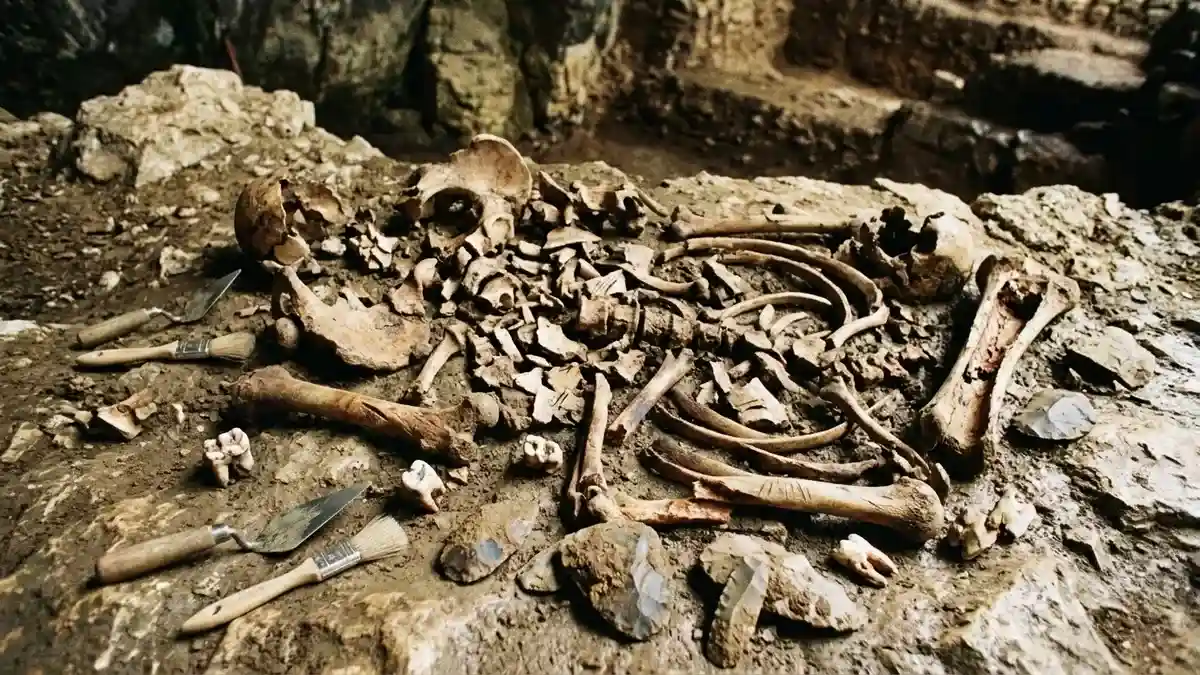
During recent targeted excavations at El Mirador, a specialized research team uncovered an un-interred cluster of human bones that stood out drastically from standard ancient burial sites. The team recovered the fragmented skeletal remains of at least eleven individuals. Forensic analysis revealed a diverse demographic spread within the victim group, proving that the tragedy did not just claim battlefield combatants:
Young Children: Vulnerable infants and toddlers who were entirely dependent on parental protection.
Adolescents: Teenagers caught in the crossfire of the regional dispute.
Adults: Mature men and women who formed the protective core of the family unit.

The physical condition of these bones was remarkably well-preserved, allowing taphonomic experts—scientists who study what happens to an organism’s remains after death—to reconstruct the final hours of these individuals with terrifying precision. The bones were not laid out with care or accompanied by grave goods. Instead, they were heavily fragmented, scattered, and bore unmistakable physical modifications that pointed directly to systematic human consumption.

Deciphering the Forensic Evidence of Consumption
Interpreting cannibalism in the archaeological record is an incredibly complex task. Scientists must approach the data with extreme scrupulousness to avoid projecting modern cultural biases or jumping to sensationalist conclusions. To establish an ironclad case for consumption, the research team subjected the El Mirador bones to rigorous macroscopic and microscopic structural analysis.
The taphonomic results uncovered an intentional, step-by-step sequence of processing that closely mirrors how prehistoric hunters butchered large game animals:
1. Flaying and Defleshing
The surfaces of the bones are covered in fine, deep, parallel cut marks inflicted by razor-sharp flint tools. These marks are concentrated precisely at the anatomical locations where major muscles and tendons attach to the skeleton, indicating that the perpetrators carefully stripped away the skin and muscle tissue immediately after the victims were killed.
2. Disarticulation and Skeletal Fracturing
The joints of the limbs were systematically wrenched apart, and the long bones—such as the femurs and humeri—exhibited significant percussion impact fractures. These deliberate breaks were executed using heavy stone hammers to expose and extract the nutrient-rich bone marrow inside.
3. Thermal Exposure and Consumption
Many of the bone fragments display distinct coloration patterns and heat-induced cracking consistent with being boiled or roasted over an open fire. Most convincingly, the forensic team identified clear human bite marks etched directly into the bone surfaces, leaving behind an undeniable physical signature of mastication.
Conflict vs. Starvation: Isolating the True Context
When evidence of cannibalism surfaces in prehistory, it is traditionally attributed to one of two primary catalysts: extreme famine (survival cannibalism) or elaborate religious funeral practices (ritual endocannibalism). However, the El Mirador research team successfully ruled out both of these scenarios, pointing instead to a much darker reality.
[Territorial/Resource Strain] ➔ [Sudden Violent Attack] ➔ [Systematic Group Elimination & Consumption]
To determine who the victims were and where they came from, scientists utilized advanced strontium isotope analysis ($^{87}\text{Sr}/^{86}\text{Sr}$). As humans grow, the local groundwater and soil chemistry imprint a unique isotopic signature into their tooth enamel and skeletal structure. The testing revealed that the eleven individuals were completely local to the Burgos region. They were not wandering outsiders or invading forces, but a resident herding family that had lived and worked the local landscape for generations.
The sheer speed and systematic nature of the processing indicate that this was a rapid, coordinated act of extreme violence. The evidence points to a catastrophic clash between neighboring, competing Late Neolithic farming and herding communities. During this period, the stabilization of agricultural territories created intense competition for arable land, reliable water sources, and livestock grazing rights.
The researchers assert that this event represents the ultimate elimination of an enemy group. By executing every member of the family unit—from the youngest infants to the adults—and subsequently consuming them, the attackers did not just win a territorial skirmish; they permanently erased a competing bloodline from the landscape, completely absorbing their resources while sending a terrifying psychological message to surrounding communities.
Mapping Prehistoric Massacres Across Europe
The horrifying events at El Mirador are not entirely unique, but they hold a distinct position when compared to other recognized prehistoric massacres across the European continent. The Late Neolithic was an era characterized by periodic outbreaks of intense intergroup cruelty.
| Archaeological Site | Geographic Location | Core Analytical Findings |
| Talheim | Germany | A mass grave containing victims of execution-style head trauma; no signs of processing or consumption. |
| Els Trocs | Spain | A brutal massacre of a herding community showing localized torture, but lacking signs of cannibalism. |
| Fontbrégoua Cave | France | Clear evidence of systematic butchery and consumption patterns matching El Mirador. |
| Herxheim | Germany | A massive, structured ritual site featuring the processing and consumption of hundreds of individuals. |
While sites like Talheim and Els Trocs provide undeniable proof of prehistoric warfare and mass executions, El Mirador stands alongside Fontbrégoua and Herxheim as a rare example of systematic, non-ritualistic consumption following a battlefield victory. The level of meticulous processing found in the Spanish cave proves that the consumption of enemies was an established tactical component of total warfare among certain Neolithic groups.
The Complex, Layered History of El Mirador
What makes El Mirador cave uniquely vital to the study of ancient human behavior is its long history of recurring trauma. The site was not a one-time location for tragedy. Interestingly, previous excavations at the cave had already documented a separate case of cannibalism dating to the Bronze Age, roughly 4,600 to 4,100 years ago.
This new discovery proves that the practice of human consumption occurred much earlier in the site’s history, during the Late Neolithic period between 5,700 and 5,570 years ago. Shortly after this violent massacre took place, the local population shifted their relationship with the space, converting the cave into a formalized, sacred funerary cavern for traditional burials.
The recurring nature of these intense practices across different archaeological eras establishes El Mirador as an essential epicenter for studying how prehistoric humans viewed death, territorial defense, and the physical boundaries of the human body.
Conclusion
The exceptional research coming out of the Sierra de Atapuerca challenges us to look past modern cultural biases and confront the raw complexities of human prehistory. Conflict, territorial defense, and the development of extreme strategies to eradicate competitors have unfortunately always been a part of the broader human story. By uncovering the true narrative behind these 5,700-year-old bones, archaeological science has lifted the veil on the dark realities of the Neolithic transition, proving that the march toward modern civilization was paved with both incredible innovation and profound violence.
Frequently Asked Questions
1. What exactly did researchers find inside El Mirador cave?
Archaeologists discovered the extraordinarily well-preserved skeletal remains of at least eleven individuals, including young children, teenagers, and adults. The bones exhibited definitive, systematic physical modifications proving they were skinned, defleshed, broken open for marrow, cooked, and consumed approximately 5,700 years ago.
2. How did scientists prove that this was an act of cannibalism rather than a burial ritual?
The identification of cannibalism was verified through detailed taphonomic analysis. The bones contained precise tool cut marks at muscle attachment points, impact fractures designed to extract bone marrow, alterations from thermal cooking over fire, and distinct human bite marks etched directly into the bone surfaces.
3. Was this cannibalism caused by a severe famine or starvation?
No. The research team ruled out starvation because of the rapid, highly systematic nature of the butchery and the overall archaeological context. There were no signs of long-term nutritional deprivation in the bone structures, indicating the event was the direct result of a sudden, violent conflict rather than a desperate response to a lack of food.
4. Who were the victims and who attacked them?
Strontium isotope testing confirmed that the victims were local herders and farmers who lived in the immediate region. Researchers deduce that the perpetrators were likely a competing neighboring community or a group of newcomers clashing over vital Late Neolithic resources, such as livestock grazing territory, water access, and fertile land.
5. Why did ancient groups consume their enemies after a conflict?
In small-scale, prehistoric societies, consuming an enemy group served as the ultimate form of physical and social elimination. By killing and consuming an entire family unit, the attackers permanently wiped out a competing genetic line, asserted total dominance over the disputed territory, and utilized the victims’ resources to reinforce their own survival.