
Table of Contents
- 1. The Cataclysm at Heraclea Sintica
- 2. Unearthing the Tragedy Inside the Roman Forum
- 2.1. The Mystery of the Sixth Skeleton
- 2.2. Forensic Evidence of Sudden Impact
- 3. Overturning Stereotypes: The Story of Skeleton 2N
- 3.1. Proof of Lifelong Community Care
- 3.2. A Genetic Link to a Second Victim?
- 4. The Abandonment of an Ancient City
- 5. Why This Discovery Alters Our Understanding of History
- 6. Conclusion
- 7. Frequently Asked Questions
- 7.1. 1. Where is Heraclea Sintica located and why was it important?
- 7.2. 2. What is Apert syndrome and how did it affect the ancient victim?
- 7.3. 3. Why does this discovery prove the Romans cared for the disabled?
- 7.4. 4. What happened to the victims during the 4th-century earthquake?
- 7.5. 5. Why weren’t the bodies ever dug up and buried by their families?
6 Ancient Skeletons Reveal Roman Compassion in the 4th Century
When modern audiences look back at the Roman Empire, the mental images that usually come to mind are those of grand stone amphitheaters, sweeping military conquests, and a rigid societal structure that left little room for weakness. Historical narratives frequently paint ancient Roman culture as harsh, unforgiving, and hyper-focused on physical utility. However, a remarkable archaeological discovery in southwestern Bulgaria is challenging these deep-seated stereotypes, offering a poignant look at the internal life, empathy, and community care present within the ancient world.
By excavating the tragic casualties of a sudden natural disaster, researchers have uncovered unexpected bioarchaeological proof that severely disabled individuals were not discarded or ignored by Roman society. Instead, they were nurtured, protected, and integrated into their families and communities from birth all the way into adulthood.
6 Ancient Skeletons Reveal Roman Compassion in the 4th Century
The Cataclysm at Heraclea Sintica
Centuries ago, the ancient city of Heraclea Sintica was a vibrant, prosperous urban hub. Situated in what is now southwestern Bulgaria, near the fertile banks of the Struma River and nestled against the striking Kozhuh highlands, the city thrived for generations. It originally developed under ancient Greek influence before transitioning into a prominent Roman municipality, complete with a sprawling forum that served as the beating heart of civic, economic, and religious life.
The forum was surrounded by monumental public buildings, bustling porticoes, and sophisticated infrastructure, including massive brick-vaulted cisterns designed to manage the city’s water supply. However, this prosperity came to a sudden, violent halt during the late fourth century CE.
During this period, a series of powerful seismic shocks tore through the eastern Mediterranean. One particularly devastating earthquake struck Heraclea Sintica with immense force. The ground tremors caused widespread architectural failure across the urban center, including the catastrophic collapse of the heavy brick-vaulted water cisterns flanking the forum. As the roofs caved in, they trapped several individuals beneath tons of stone and soil, sealing a tragic moment in time for nearly two millennia.
Unearthing the Tragedy Inside the Roman Forum
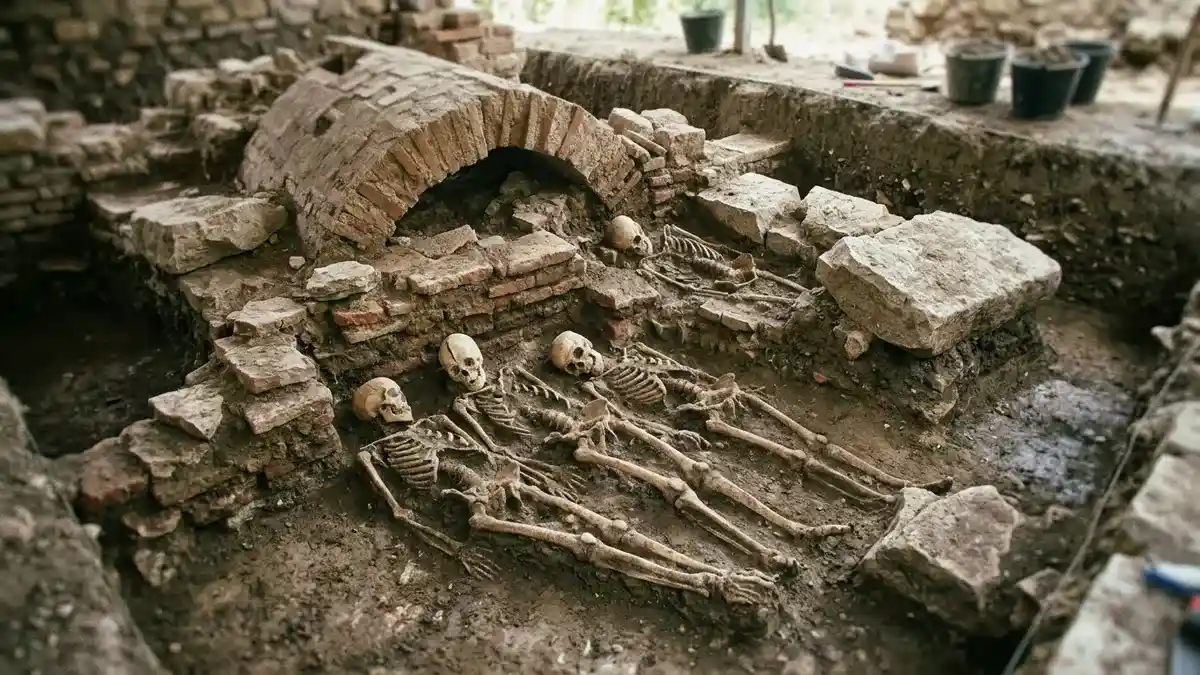
In a recent excavation, an archaeological team targeted the southwestern corner of Heraclea Sintica’s forum, digging down roughly six meters (nearly 20 feet) below the modern surface level. Deep beneath the heavy architectural debris of a ruined portico and a collapsed water cistern, researchers uncovered the preserved skeletal remains of five men.
Labeled by scientists as 2N, 3N, 1S, 2S, and 3S, these five individuals were found lying flat on their backs amidst the dense structural rubble. The positions of their bodies indicate they were caught completely off guard by the building’s sudden failure, leaving them with no time to escape the falling masonry.
The Mystery of the Sixth Skeleton
Intriguingly, the excavation revealed a sixth skeleton, designated as 1N, located at a distinct, higher stratigraphical level. Separated from the other five bodies by a substantial layer of soil and fallen debris, skeleton 1N presents a compelling historical mystery.
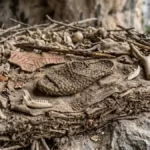
Archaeologists hypothesize that this individual was either positioned on an upper level or a separate structure when the earthquake hit, or he was a brave bystander who rushed into the ruins immediately after the initial shock wave to provide emergency aid, only to be crushed himself when a secondary vault came crashing down.
Forensic Evidence of Sudden Impact
A detailed osteological analysis conducted by physical anthropologists Vanya Russeva and Lilia Manoilova from the Institute of Experimental Morphology, Pathology, and Anthropology at the Bulgarian Academy of Sciences provided a clear picture of who these victims were.
Age Profile: All six victims were young men, ranging in age from 18 to 35 years old—the demographic typically responsible for heavy labor, civic defense, or infrastructure maintenance.
Trauma Analysis: The bones exhibited severe, unhealed injuries, including crushing skull fractures, broken ribs, and extensive damage to the long bones of the arms and legs.
Cause of Death: The nature of these skeletal injuries is entirely consistent with instantaneous or near-instantaneous death caused by the direct impact of heavy falling objects or a severe fall from a significant height during the structural collapse.
Overturning Stereotypes: The Story of Skeleton 2N
While the discovery of multiple earthquake victims in a single location is an archaeologically significant event, it was the unique physical condition of one specific skeleton that completely reframed the historical importance of the site.
When researchers examined the remains of skeleton 2N—a young man estimated to have been between 18 and 25 years old at the time of his death—they discovered a series of profound skeletal anomalies. The forensic data indicated that this individual suffered from Apert syndrome, a rare congenital genetic disorder.
[Apert Syndrome Congenital Features]
   ├── Misshapen, premature cranial fusion (craniosynostosis)
   ├── Severe cleft palate
   └── Specialized skeletal and limb anomalies
Apert syndrome drastically alters physical development from the womb. It causes the bones of the skull to fuse prematurely, preventing normal brain expansion and resulting in a severely misshapen head and distorted facial features. It is routinely accompanied by a cleft palate and other complex anomalies of the hands and feet. In the ancient world, this condition would have resulted in obvious physical deformities, significant eating and breathing difficulties, and potentially severe intellectual and developmental challenges.
Proof of Lifelong Community Care
An individual born with Apert syndrome in the fourth century CE would have been entirely incapable of surviving independently. From the moment of birth, this young man would have required around-the-clock specialized care, assistance with basic feeding, and continuous protection from his family and community.
The fact that this individual survived into his late teens or early twenties is a profound historical revelation. It demonstrates that his household did not view his severe cognitive and physical disabilities as a burden worthy of abandonment. Instead, they invested precious resources, time, and deep empathy to ensure he lived a full, dignified life into young adulthood. This finding stands as tangible proof of a supportive social structure operating within the late Roman Empire.
A Genetic Link to a Second Victim?
The plot thickened when anthropologists examined the remains of a second victim found in the immediate vicinity, labeled skull 2_3N. Remarkably, this second individual also exhibited a distinct cleft palate.
The presence of this shared physical trait raises the strong possibility of a close familial relationship between the two men. If upcoming ancient DNA testing confirms a genetic link, it will tell a deeply moving story of an ancient family unit navigating genetic vulnerabilities together, supporting both a disabled child and his relatives through the daily realities of life in the Roman provinces.
The Abandonment of an Ancient City
Despite the immense human tragedy that occurred within the forum, the archaeological context reveals that the bodies of these six men were never retrieved or given a formal burial. No personal belongings, tools, coins, or remnants of clothing apparel were discovered on or near the skeletons, leaving their exact social status and daily occupations an unsolved mystery.
The lack of an attempt to clear the rubble and recover the dead suggests that the remaining citizens of Heraclea Sintica may have been entirely unaware that anyone was trapped inside the collapsed water cistern. Alternatively, the scale of the destruction may have overwhelmed the surviving population’s ability to safely clear the heavy masonry.
Following this devastating earthquake, the population of Heraclea Sintica dwindled dramatically. The damaged forum never fully recovered its former glory. The final blow came in the fifth century CE, when another massive seismic event struck the region, forcing the remaining residents to permanently abandon the site and allowing the ruins to swallow the stories of its citizens for centuries.
Why This Discovery Alters Our Understanding of History
Most archaeological reports dealing with ancient natural disasters naturally focus on the destruction of material culture—the mapping of cracked foundations, shattered columns, and ruined porticoes. The unique discovery at Heraclea Sintica is a rare exception because it preserves an undisturbed group of human casualties in a single, well-defined disaster context.
The findings, published in the peer-reviewed journal Journal of Archaeological Science: Reports, provide a much-needed balance to traditional historical texts. While literary sources from the Roman era often highlight a cultural obsession with physical perfection, strength, and military utility, the bones of Heraclea Sintica tell a parallel story of quiet, domestic compassion. The young man with Apert syndrome survived because he was loved, valued, and cared for by the people around him, showing that human empathy is an enduring force that transcends centuries.
Conclusion
The ruins of Heraclea Sintica have provided the historical community with far more than an architectural timeline of an ancient city’s decline. Locked within the tragic remains of a fourth-century earthquake is a timeless testament to human kindness. By preserving the life story of a young man who beat the odds of a severe congenital disorder, this discovery reminds us that even within the rigid confines of the Roman Empire, compassion and family devotion were foundational elements of daily life.
Frequently Asked Questions
1. Where is Heraclea Sintica located and why was it important?
Heraclea Sintica is an ancient Roman and Greek city located in southwestern Bulgaria, near the Struma River and the Kozhuh highlands. It was an important regional urban and economic hub featuring a massive civic forum, monumental public buildings, and complex infrastructure that allowed it to thrive for centuries before its eventual abandonment.
2. What is Apert syndrome and how did it affect the ancient victim?
Apert syndrome is a rare genetic disorder characterized by the premature fusion of skull bones, leading to a distorted head shape, facial anomalies, a cleft palate, and physical malformations of the limbs. In the ancient world, this condition would have caused noticeable physical deformities and severe developmental challenges, requiring constant, lifelong assistance from others to survive.
3. Why does this discovery prove the Romans cared for the disabled?
Because the young man with Apert syndrome survived into his late teens or early twenties, it provides definitive material proof that he was consistently fed, protected, and cared for by his community. Without continuous, daily support from a dedicated family or social network, an individual with such severe physical and intellectual limitations could not have survived to adulthood in antiquity.
4. What happened to the victims during the 4th-century earthquake?
The six young men were caught in the southwestern corner of the city’s forum when a massive earthquake struck. Five of the men were instantly crushed and buried six meters underground by the collapse of two heavy, brick-vaulted water cisterns. A sixth individual was caught in a higher layer of the collapse, possibly while attempting a rescue.
5. Why weren’t the bodies ever dug up and buried by their families?
The bodies were found undisturbed in their exact death positions, meaning they were never recovered. Archaeologists believe that either the surviving population was completely unaware that these specific men were inside the cistern when it caved in, or the overall destruction of the city was so severe that the community lacked the resources to clear the heavy structural rubble.