

Table of Contents
- 1. Inside the Ancient Mega-Structure
- 1.1. Evidence of Ancient Assembly Lines
- 2. A Snapshot Frozen in Time: The Artifacts
- 3. How Climate Shifts Preserved History
- 3.1. From Hiker’s Discovery to State Protection
- 4. The Race Against Time in High-Tech Labs
- 5. Frequently Asked Questions
- 5.1. What exactly was discovered in the mountains of Norway?
- 5.2. How did the ancient reindeer trap function?
- 5.3. Why are the wooden logs and artifacts so well preserved?
- 5.4. What kind of artifacts were found alongside the wooden trap?
- 5.5. What happens to the artifacts after they melt out of the ice?
An Unprecedented Archaeological Find Reorients Our Understanding of Ancient Hunting Technology
A sweeping discovery high on the Aurlandsfjellet mountain plateau in Vestland County, Norway, has provided researchers with an astonishing glimpse into ancient European hunting tactics. A team of archaeologists from the Vestland County Council and the University Museum of Bergen has uncovered a remarkably well-preserved, 1,500-year-old reindeer trapping system. The massive installation was exposed entirely by melting mountain ice.
This find represents a major milestone in high-altitude archaeology. It is the first large-scale wooden trapping structure ever recovered from an ice patch in Norway—and potentially anywhere in Europe. The site sheds new light on the sophistication of Iron Age engineering, community-driven hunting efforts, and the dramatic climate shifts that froze this ancient landscape in time.

An Unprecedented Archaeological Find Reorients Our Understanding of Ancient Hunting Technology
Inside the Ancient Mega-Structure
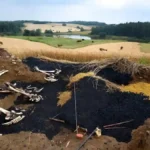
The scale of the hunting system is staggering, consisting of hundreds of meticulously carved wooden logs. Far from a simple pitfall or rudimentary blind, this was a highly calculated mass-hunting machine.
The structure features two long, converging wooden fences that taper into a large, heavy-timber enclosure. Hunters would wait for migrating reindeer herds, then use the natural topography and the artificial fencing to funnel the panicked animals down the narrowing corridor. Once trapped inside the heavy timber corral, the reindeer could be systematically culled at close range.
Evidence of Ancient Assembly Lines
The theory that this was a site for industrialized mass hunting is supported by neighboring finds. Just outside the main enclosure, archaeologists uncovered a massive cache containing hundreds of discarded reindeer antlers.

Crucially, many of these antlers bear deep, identical cut marks. These signatures show that the animals were processed, butchered, and stripped of valuable resources immediately after capture. This degree of organization indicates a highly coordinated community effort, requiring dozens of skilled individuals to execute the hunt, handle the slaughter, and pack the meat and hides down the mountain.
A Snapshot Frozen in Time: The Artifacts
Because the site was encased in solid ice for over fifteen centuries, the preservation of organic materials is near-flawless. Alongside the structural timber, the archaeological team recovered a treasure trove of hunting weaponry and personal items, including:
Weaponry: Perfectly preserved iron spearheads, fragments of wooden bows, and ancient arrow shafts.
Personal Belongings: A beautifully crafted dress pin carved entirely from antler, likely lost by a hunter during the chaos of a drive.
Mysterious Objects: Several wooden paddles featuring delicate, intentional ornamentation.

The presence of decorated paddles at a high-altitude mountain hunting site has left researchers scratching their heads. Because they have no obvious functional utility in a terrestrial reindeer hunt, experts are investigating whether these items carried deep ritualistic or symbolic meaning for the hunting parties.
How Climate Shifts Preserved History
The historical timeline of the Aurlandsfjellet trapping system is deeply tied to the region’s ancient climate. Radiocarbon analysis dates the construction and active use of the installation to the mid-sixth century CE.
Shortly after the system was built, Scandinavia entered a severe, prolonged cooling phase. Rapidly accumulating snow and advancing ice sheets covered the mountain plateau, sealing the entire valley before the wooden logs could rot or the iron weapons could rust. This freezing, stable, and slightly humid environment acted as a natural time capsule, shielding the organic materials from bacteria and decay for over a millennium. Only now, under the influence of modern global warming, are these ancient timbers finally breaking through the surface.
From Hiker’s Discovery to State Protection
The story of the recovery began when a local hiker and historic enthusiast, Helge Titland, noticed unusual pieces of carved wood emerging from a receding ice patch. After documenting his findings, he alerted regional authorities.
When archaeologists returned to the site with Titland the following season, the ice had retreated significantly further, exposing the true, massive scale of the structural fences. Recognizing the vulnerability of the exposed site, the Norwegian government immediately placed the mountain area under the strict protection of Norway’s Cultural Heritage Act to safeguard the remains from environmental degradation and potential looters.
The Race Against Time in High-Tech Labs
Now that these artifacts have been pulled from their icy tomb, a new battle has begun to keep them from disintegrating. When organic materials like ancient wood and antler dry out too quickly in the open air, they warp, crack, and turn to dust.
All recovered items have been transported to the specialized conservation department at the University Museum in Bergen. There, experts are executing a meticulous stabilization process:
Slow Drying: The ancient structural wood is kept in climate-controlled environments to slowly remove moisture without compromising cellular structure.
Chemical Stabilization: Iron objects and spearheads are undergoing advanced anti-corrosion treatments to halt oxidation.
Digital Mapping: Researchers are utilizing advanced imaging to study the tool marks on the timber to determine what types of axes and chisels were used to shape the system.
As mountain ice continues to melt globally at an accelerated pace, archaeologists warn that thousands of ancient artifacts are at immediate risk of rotting away before they can be discovered. The team hopes that the Aurlandsfjellet find will serve as a foundational study for future ice patch archaeology, eventually culminating in a permanent museum exhibition to tell the stories of Norway’s ancient ice trappers.
Frequently Asked Questions
What exactly was discovered in the mountains of Norway?
Archaeologists uncovered a highly sophisticated, 1,500-year-old mass-hunting system designed to trap reindeer. Made of hundreds of carved wooden logs, it is the first large-scale wooden trapping installation ever found melting out of the ice in Europe.
How did the ancient reindeer trap function?
The system utilized two long, converging wooden fences that funneled migrating reindeer herds into a central, heavy-timber enclosure. Once trapped inside the corral, the animals could be easily killed by waiting hunters.
Why are the wooden logs and artifacts so well preserved?
The trapping system was built in the mid-sixth century CE, right before a major regional cooling phase. Rapid snow accumulation completely encased the structure in solid ice, protecting the wood, iron, and antler from decay for 1,500 years.
What kind of artifacts were found alongside the wooden trap?
In addition to the structural logs, the team recovered iron spearheads, fragments of bows and arrows, an ornate dress pin made of antler, a massive cache of cut reindeer antlers, and mysteriously decorated wooden paddles.
What happens to the artifacts after they melt out of the ice?
Exposed ancient wood and iron deteriorate rapidly when exposed to air. All recovered materials are currently at the University Museum in Bergen, where conservation specialists are using slow-drying techniques and anti-corrosion treatments to stabilize them.