
Table of Contents
- 1. The Bärenfels Discovery: Unearthing 2,000-Year-Old Wealth
- 2. From Macedonian Mercenaries to Celtic Minting
- 2.1. Mediterranean Motifs with a Tribal Twist
- 3. Prestige Items or Divine Tolls? The Ritual Purpose of the Bog
- 3.1. The Power of Liminal Landscapes
- 4. Preserving Switzerland’s Ancient Heritage
- 5. Frequently Asked Questions
- 5.1. Why are these Celtic gold coins historically significant?
- 5.2. What is a triskele, and why is it on the coin?
- 5.3. How did the Celts learn about minting coins?
- 5.4. What evidence suggests the coins were a religious offering?
- 5.5. Where can the public see the Arisdorf Celtic coins?
2 Rare Celtic Gold Coins Found in Swiss Bog Rewrite History
A spectacular archaeological discovery in northwestern Switzerland is shedding new light on the mysterious religious rituals and economic dawn of the ancient Celtic world. Volunteer researchers exploring a woodland area near Arisdorf have unearthed two incredibly rare Celtic gold coins dating back more than 2,200 years. Submerged for centuries in a murky, water-filled sinkhole, these glittering artifacts do far more than demonstrate ancient wealth—they provide tangible evidence of sacred tribal offerings left for the gods.
Discovered at a site known as Bärenfels, the coins represent some of the earliest examples of indigenous coinage ever recovered in Swiss territory. Their precise location within a marshy, liminal landscape adds weight to the theory that the ancient Celts viewed wetlands as spiritual portals connecting the physical world with the divine.
2 Rare Celtic Gold Coins Found in Swiss Bog Rewrite History
The Bärenfels Discovery: Unearthing 2,000-Year-Old Wealth
The journey to this remarkable find began in 2023, when a team of passionate volunteer archaeologists collaborating with Archaeology Baselland uncovered a hidden hoard of 34 Celtic silver coins at the Bärenfels site. Those initial silver pieces, minted around 80–70 BCE, hinted that the region held deep historical significance.

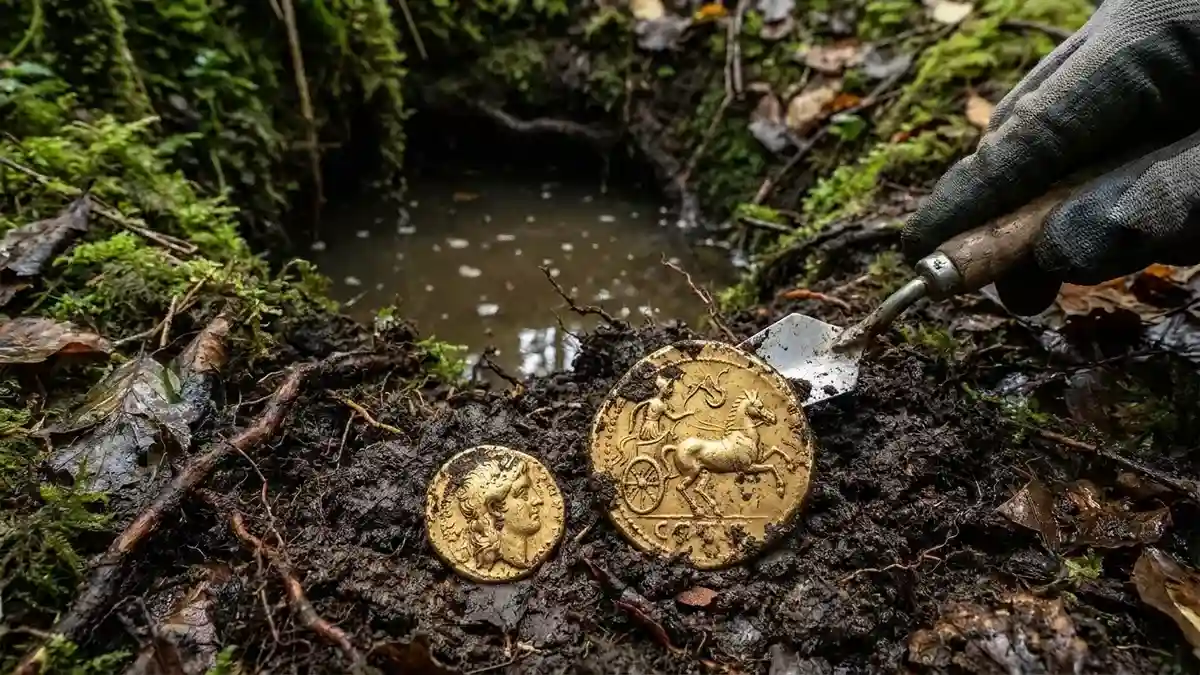
Driven by the success of the 2023 excavation, researchers expanded their survey into the surrounding topography in the spring of 2025. This strategic decision paid off immensely. Navigating a landscape dimpled with marshy ground and natural sinkholes, the team detected two distinct gold specimens lying close to the original silver cache:
The Full Stater: A robust gold coin weighing 7.8 grams.
The Quarter Stater: A smaller, delicate fractional coin weighing 1.86 grams.
Dating back to the middle and late 3rd century BCE, these two items predate the nearby silver hoard by more than a century. They belong to an elite tier of Swiss archaeology; across the entire country, just over 20 examples of early Celtic gold coinage have ever been recorded.
From Macedonian Mercenaries to Celtic Minting
To understand the historical weight of the Arisdorf coins, one must look south toward the Mediterranean. Before the 3rd century BCE, Celtic tribes in Central Europe did not mint their own currency. Instead, their introduction to coinage came through warfare and trade.
During the 4th century BCE, vast numbers of Celtic warriors traveled south to serve as elite mercenaries for Hellenistic rulers, most notably Philip II of Macedon (the father of Alexander the Great). These soldiers were compensated with high-purity gold staters featuring the profile of Greek deities. When the mercenaries returned to their northern homelands, they brought this foreign currency with them, introducing tribal leaders to the concept of minted money.

By the time the Arisdorf coins were struck, local Celtic artisans had begun producing their own currency, directly mimicking the prestigious Macedonian designs. However, they didn’t just copy the Greeks; they infused the metal with their own unique cultural identity.
Mediterranean Motifs with a Tribal Twist
The face of the Arisdorf coins beautifully illustrates this blend of classical Mediterranean influence and indigenous artistry.
On the obverse (front) side, both coins display the stylized profile of Apollo, the Greek god of music, truth, and prophecy. The reverse (back) depicts a traditional Mediterranean hallmark: a swift horse-drawn chariot.
However, a closer look at the smaller quarter stater reveals a distinctly local touch. Positioned carefully beneath the galloping horses is a crisp triskele—a sacred triple spiral motif deeply woven into Celtic spirituality, symbolism, and art. This subtle addition transformed a standard piece of trade currency into a powerful emblem of local identity and spiritual alignment.
Prestige Items or Divine Tolls? The Ritual Purpose of the Bog
Because of their immense intrinsic value, heavy gold staters were never used by the Celts to buy everyday market goods like grain, cattle, or pottery. Instead, historians believe they occupied a highly specialized niche in tribal society. They were likely exchanged as:
Diplomatic gifts to cement alliances between rival tribal chiefs.
Prestigious rewards paid to loyal warriors and high-ranking followers.
Wealth status symbols passed between elite families during marriage dowries.
While the Arisdorf coins may have started their lives as symbols of political and economic power, their final resting place points toward an entirely different, ultimate purpose: a sacred sacrifice.
The Power of Liminal Landscapes
The Bärenfels site is characterized by water-filled sinkholes and boggy terrain. In the spiritual framework of the ancient Celts, these specific geological features were classified as “liminal spaces”—physical boundaries where the natural world met the supernatural realm.
Water was viewed as a direct conduit to deities and ancestral spirits. Across ancient Europe, Celtic tribes frequently cast weapons, armor, jewelry, and valuable currency into lakes, rivers, and peat bogs to appease gods, guarantee successful harvests, or beg for victory in upcoming battles.
The deliberate placement of the full stater and quarter stater into the Bärenfels sinkhole strongly mirrors this widespread pan-European tradition. Rather than a lost pouch or a hidden treasury meant for retrieval, these two gold pieces were almost certainly dropped into the water as irreversible votive offerings to the divine.
Preserving Switzerland’s Ancient Heritage
The recovery of the Arisdorf gold coins highlights the invaluable contribution of certified volunteer programs in modern European archaeology. Working hand-in-hand with state authorities like Archaeology Baselland, these trained citizens ensure that fragile artifacts are meticulously documented in their original context, rather than falling prey to illegal looters or commercial metal detectorists.
Recognizing the immense public interest and historical value of the find, museum officials have arranged a dedicated exhibition. Starting in March 2026, the newly discovered gold stater and quarter stater will go on public display in Basel. The exhibition will unite these early gold masterpieces with the 34 silver coins found in 2023, allowing visitors to walk through centuries of shifting Celtic economy, art, and religion.
Frequently Asked Questions
Why are these Celtic gold coins historically significant?
They are among the absolute oldest Celtic coins ever discovered in Switzerland, dating back to the 3rd century BCE. Because only about 20 early Celtic gold coins have ever been found in the country, they provide vital data on the very beginning of localized coin minting in Western Europe.
What is a triskele, and why is it on the coin?
A triskele is an ancient symbol consisting of three interlocked spirals. For the Celts, it represented a variety of triadic concepts, such as life-death-rebirth, the earth-sky-water realms, or the divine triad of gods. Placing it on the coin under the Greek chariot image infused a foreign design with native spiritual meaning.
How did the Celts learn about minting coins?
They learned the craft through military service. Celtic warriors served as mercenaries for Mediterranean rulers, including Philip II of Macedon in the 4th century BCE. They were paid in gold staters, which they carried back to Central Europe, eventually using them as blueprints to strike their own tribal currency.
What evidence suggests the coins were a religious offering?
The coins were found in a boggy woodland characterized by natural, water-filled sinkholes. The Celts considered these wet, marshy landscapes sacred portals to the spirit world and frequently dumped valuable items into them as permanent, ritual offerings to their deities.
Where can the public see the Arisdorf Celtic coins?
The gold coins, along with the 34 silver Celtic coins discovered at the same Bärenfels site in 2023, will be featured in a special historical exhibition in Basel, Switzerland, opening to the public in March 2026.