
Table of Contents
- 1. The Resurrection of Marienbrink Monastery
- 1.1. Centuries of Continuous Urban Overwriting
- 2. From Medieval Faith to World War II Concrete
- 3. A Sacred Site of Shared and Tragic History
- 4. Frequently Asked Questions
- 4.1. What exactly was discovered in the center of Borken?
- 4.2. How large are the surviving medieval monastery walls?
- 4.3. What happened to the monastery after it was closed?
- 4.4. Have archaeologists found the remains of the historic synagogue?
- 4.5. Why are there so many different historical layers at this single site?
Medieval Monastery Uncovered Beneath Historic German City Center
A routine urban development project in the heart of Borken, Germany, has transformed into a major archaeological rescue operation. For months, research teams have been systematically excavating the Brinkerhof quarter—the planned site for a new community health center and Caritas facility. Before modern foundations could be poured, experts from the Landschaftsverband Westfalen-Lippe (LWL), working alongside a specialized private excavation firm, stepped in to survey the site.
What they uncovered beneath the topsoil is a remarkably dense, multi-layered vertical timeline of human history. The crowning achievement of these preliminary excavations is the discovery of the massive, structurally sound foundations of the lost Marienbrink Monastery church, an architectural relic dating back to the Late Middle Ages.
Medieval Monastery Uncovered Beneath Historic German City Center
The Resurrection of Marienbrink Monastery
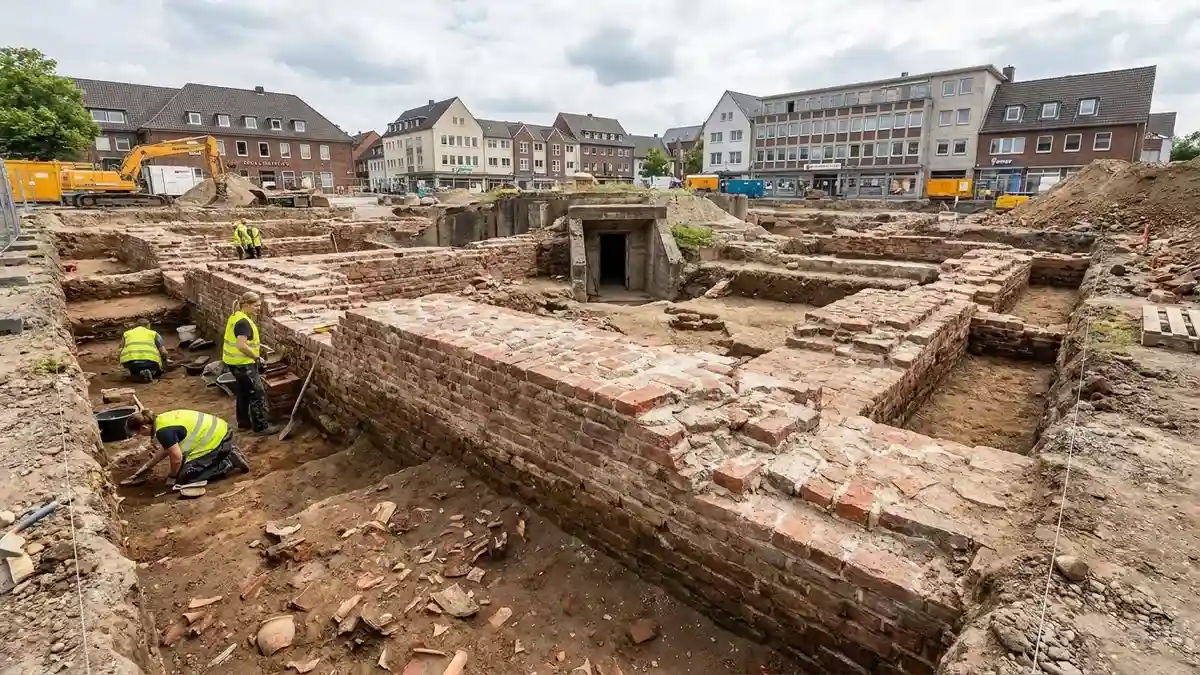
The first hints of the forgotten monastery emerged during initial test trenches and non-invasive geophysical surveys. Located just south of the current operational Caritas buildings, these early exploratory probes struck substantial masonry. As the teams carefully brushed away the earth, they exposed the unmistakable outlines of a 15th-century ecclesiastical building.

+-----------------------------------------------------------------+
|               CHURCH FOUNDATION ARCHITECTURAL PROFILE           |
+-----------------------------------------------------------------+
|  Materiál:            Deep red brick set in robust lime mortar  |
|  Wall Thickness:      Up to 1.25 meters (approx. 4.1 feet)      |
|  Preserved Height:    Roughly 1.60 meters (approx. 5.2 feet)    |
|  Protection Layer:    Dense postwar rubble and compacted soil   |
+-----------------------------------------------------------------+
As the excavation widened, the sheer scale of the medieval construction came into sharp focus. Large sections of the church’s western and southern outer walls were revealed in surprisingly solid condition. The engineering standards of the 15th-century builders are evident in the surviving masonry: one primary outer wall measures an impressive 1.25 meters wide, while the vertical foundation still stands roughly 1.60 meters high. Built using traditional red clay bricks bound with thick lime mortar, the lower courses of the masonry were preserved by heavy layers of overlying rubble, which effectively shielded the brickwork from environmental decay and later agricultural disruption.
Centuries of Continuous Urban Overwriting
The area surrounding the monastery has long been a focal point of regional history. The excavation site sits in close proximity to the historic St. Remigius Church, an institution that traces its roots back to roughly the year 800. During the early Carolingian era, this zone served as a strategic royal missionary outpost and an episcopal estate. Because of this incredibly deep historical footprint, archaeologists anticipated complex, deeply stratified soil deposits beneath the modern pavement, with each layer representing a different generation of inhabitants.
Further trenching carried out in the former garden plots—demarcated for the entrance of a future underground parking garage—laid bare the frantic pace of urban change. The team documented a chaotic subterranean landscape:

Filled Cellars: Subterranean basements from vanished residential homes.
Early Modern Pits: Deep postholes, refuse pits, and an isolated animal carcass disposal site.
Ceramic Stratigraphy: A vast collection of pottery fragments spanning from the late High Middle Ages directly through to the modern era.

These artifacts demonstrate that this specific quarter of Borken was never abandoned; it was continuously occupied, modified, and rebuilt over a dynamic, 600-year sequence.
From Medieval Faith to World War II Concrete
The ground beneath Borken does not just preserve the distant medieval past; it also holds the stark physical scars of the 20th century. Southwest of the medieval church walls, the excavation took a modern turn when workers exposed a massive World War II air raid bunker. Preliminary structural assessments indicate that this reinforced concrete bunker spans across a significant portion of the proposed development zone, serving as a silent witness to the conflicts that reshaped Germany.
War damage fundamentally altered the topography of Borken’s historic center. Intense Allied bombing campaigns and subsequent ground combat destroyed a vast percentage of the city’s core. When the conflict ended, postwar planners did not simply rebuild what was lost; they modernized the layout, completely altering old street lines, consolidating historical property boundaries, and unintentionally sealing the older ruins beneath a thick leveling layer of wartime debris.
A Sacred Site of Shared and Tragic History
The story of the Marienbrink Monastery site is also a narrative of religious transition and ultimate tragedy. Following the widespread secularization of church property across Germany in the early 19th century, the monastery was formally dissolved, and its grand medieval church was systematically demolished.
However, the site remained a place of worship. In 1818, Borken’s growing Jewish community established a new synagogue, an adjoining school, and a mikveh (a traditional Jewish ritual bath) on the exact grounds of the old monastery. The builders of the synagogue actively repurposed and integrated surviving walls and foundations of the older Christian complex into their new structures.
This chapter of the site’s history came to a violent end during the targeted destruction of the November Pogroms of 1938. The synagogue was heavily vandalized and set on fire by Nazi forces, and the scarred remains of the building were completely cleared away the following year. While current excavations have not yet yielded definitive structural walls or plumbing elements that can be clearly tied to the 19th-century synagogue or its ritual bath, the search continues as the fieldwork progresses hand-in-hand with municipal planning.
Frequently Asked Questions
What exactly was discovered in the center of Borken?
Archaeologists uncovered the massive, well-preserved 15th-century foundations of the former Marienbrink Monastery church, alongside a World War II air raid bunker, historical house cellars, and artifacts spanning several centuries.
How large are the surviving medieval monastery walls?
The preservation of the foundation is remarkable. The outer walls of the medieval church measure up to 1.25 meters thick and stand roughly 1.60 meters high, built from red brick and lime mortar.
What happened to the monastery after it was closed?
After the monastery was dissolved in the early 19th century, the church was torn down. In 1818, a Jewish synagogue, school, and ritual bath (mikveh) were built on the property, incorporating parts of the older complex.
Have archaeologists found the remains of the historic synagogue?
Not yet. Although historical records confirm the synagogue stood on this exact property until it was destroyed by the Nazi regime following the November Pogroms of 1938, recent excavations have not yet identified clear architectural remains of the synagogue or the ritual bath.
Why are there so many different historical layers at this single site?
The area has been occupied for over a millennium, starting around the year 800 with a royal missionary post near St. Remigius Church. Continuous rebuilding, medieval expansion, 19th-century re-use, and World War II destruction have piled these historical eras directly on top of one another.