
Table of Contents
- 1. The Accidental Discovery at Piedras de la Barbada
- 2. Why Archaeologists Misidentified the Hoard for Decades
- 2.1. Structural Similarities to Late Roman Gear
- 2.2. An Enigmatic Design Lack of Parallels
- 3. How Radiocarbon Dating Unlocked the Secret of the Fabric
- 4. Armor for the Common Soldier: Insights Into Medieval Infantry
- 5. A Medieval Shipwreck and the Business of War
- 6. Mapping the Mediterranean Arms Trade in a Violent Era
- 7. Conclusion
- 8. Frequently Asked Questions
- 8.1. 1. Why did archaeologists originally think the Spain helmet hoard was Roman?
- 8.2. 2. How did scientists prove the helmets were actually medieval?
- 8.3. 3. Where exactly was the helmet hoard discovered?
- 8.4. 4. What caused the helmets to sink to the bottom of the sea?
- 8.5. 5. Who would have worn these helmets around the year 1400?
43 Medieval Helmets Found in Spain Redefine Maritime History
For over thirty years, a remarkable trove of iron headgear recovered from the shallow waters off Spain’s eastern coast carried a prestigious, ancient label. Discovered by accident, the massive collection of corroded military gear was widely believed to be a rare relic of the Roman Empire’s dominance over the Iberian Peninsula.
However, a groundbreaking study has shattered this long-held archaeological consensus. Using advanced scientific dating techniques, researchers have revealed that Spain’s largest helmet hoard is not Roman at all. Instead, it dates back to the tumultuous transition between the late fourteenth and early fifteenth centuries.
This dramatic age correction shifts our understanding of the artifacts by more than a millennium. The discovery offers an unprecedented look into the medieval arms trade, infantry equipment, and maritime insecurity in the western Mediterranean around the year 1400.

43 Medieval Helmets Found in Spain Redefine Maritime History

The Accidental Discovery at Piedras de la Barbada
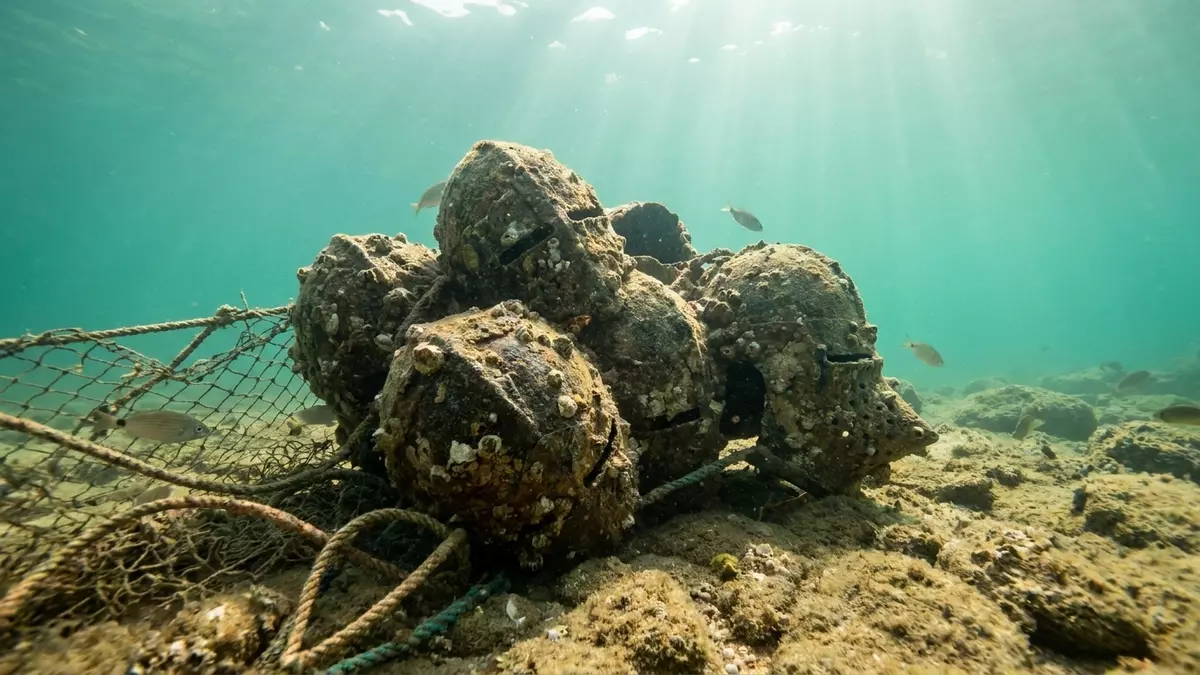
The story of the Benicarló hoard began in 1990 near the underwater site of Piedras de la Barbada, located just off the coast of Benicarló in the Castellón province of Spain. Local fishermen pulling up their nets noticed an unusual, heavy drag. When they hauled the nets to the surface, they discovered two massive, heavily encrusted blocks of corroded metal.
Upon closer inspection by archaeological experts, these marine concretions yielded a stunning surprise: dozens of individual iron helmets fused together by centuries of saltwater exposure and sediment accumulation. In total, researchers documented 43 distinct helmets within the cluster.
This extraordinary quantity immediately set a new benchmark for Mediterranean archaeology. The Benicarló assemblage stands as the largest single collection of medieval helmets ever recovered from the waters of the western Mediterranean. Today, this historic treasure is preserved across two regional institutions, with portions housed at the Museo de Bellas Artes de Castellón and the Museo de la Ciudad de Benicarló.

Why Archaeologists Misidentified the Hoard for Decades
Classifying the Benicarló helmets proved to be an immense challenge for traditional archaeology. For more than three decades, the artifacts fiercely resisted easy categorization, leading to the initial, mistaken Roman attribution.
Structural Similarities to Late Roman Gear
To the naked eye, certain design elements of the iron shells bore a striking resemblance to the utilitarian, mass-produced infantry armor used during the Late Roman Empire. Because few well-preserved examples of everyday soldier gear survive from either the Roman or the medieval eras, researchers had a limited database for comparison.
An Enigmatic Design Lack of Parallels
The primary reason for the confusion lay in the highly unusual, unstandardized shape of the helmets. They represented a transitional, poorly documented phase in European armor production. During the late 1300s, armor styling varied wildly from region to region, before the highly recognizable, standardized factory designs of the mid-to-late 1500s took hold. Without an exact twin in the global archaeological record, the hoard remained shrouded in mystery until modern science intervened.

How Radiocarbon Dating Unlocked the Secret of the Fabric
The breakthrough that finally solved the chronological puzzle did not come from analyzing the iron itself, but from examining what was trapped inside it.
When the cargo sank, several of the helmets still contained their original textile linings. As the iron corroded over the centuries, it formed a thick protective seal of marine sediment and metallic crust. This encapsulation essentially airtight-sealed the delicate organic fabrics, shielding them from the destructive action of oxygen, marine bacteria, and decay.
An international research team extracted tiny samples of these ancient textile linings and sent them to two independent laboratories for high-precision radiocarbon analysis. The results were remarkably consistent:
Chronological Range: The carbon dating placed the production of the textiles—and by extension, the helmets—squarely between the second half of the fourteenth century and the early years of the fifteenth century.
Statistical Validation: Advanced statistical modeling successfully verified four out of the five independent radiocarbon dates.
The Contamination Anomaly: The fifth outlier date was determined to be the result of modern chemical contamination that occurred after the helmets were pulled from the seabed, rather than an indication of a different historical period.
By pairing this absolute scientific dating with classic iconographic and structural analysis, the researchers conclusively proved that the hoard belonged to the Middle Ages, operating as a perfect time capsule from roughly 1400.
Armor for the Common Soldier: Insights Into Medieval Infantry
Beyond correcting the historical timeline, the new study provides a rare, vivid window into the lives of everyday medieval foot soldiers.
Most armor pieces displayed in modern museums or preserved in historical estates belonged to wealthy nobles, elite knights, or high-ranking cavalry officers. These high-end pieces were crafted from superior materials, heavily decorated, and carefully passed down through generations. Conversely, the armor of the common infantryman was treated as a disposable commodity, meaning it rarely survived the ravages of time.
The 43 Benicarló helmets show clear signs of budget-conscious, utilitarian craftsmanship. Their design and simple construction suggest they were manufactured in smaller, regional workshops rather than the elite armor foundries of major European capitals. These were pieces intended for ordinary foot soldiers, local militias, or mercenary companies who fought on the front lines of regional conflicts.
A Medieval Shipwreck and the Business of War
The physical context of the underwater site provides vital clues about how this massive shipment ended up at the bottom of the sea.
Archaeologists recovered the iron masses from remarkably shallow water—only about six meters deep. The site sits adjacent to an area believed to have served as an ancient stone jetty or primitive pier. Because the helmets were found tightly packed together in a single localized cluster, researchers are confident they did not scatter from a dramatic, deep-sea shipwreck.
Instead, all signs point to a localized loading or unloading accident. Sometime around 1400, a trading vessel docked at the Benicarló jetty was either taking on or discharging a substantial cargo of military supplies. A mishap occurred—perhaps a crane failure, a shifting deck, or a sudden coastal squall—causing a major portion of the arms shipment to slip overboard. The heavy iron crates plunged into the shallow coastal mud, where shifting sands quickly buried them, protecting the treasure from scavengers for the next 600 years.
Mapping the Mediterranean Arms Trade in a Violent Era
The sheer volume of the Benicarló find underscores a highly organized, commercial network for weapons distribution across the medieval Mediterranean. This was not a small, localized cache of weapons, but rather a commercial cargo linked to international trade routes.
Historical analysis indicates that the Valencian coast was tightly integrated into commercial networks tied to northern Italy, specifically the powerful maritime republic of Genoa. Italian workshops were global leaders in arms production during this period, exporting thousands of pieces of mass-produced armor to hot zones across Europe.
The timing of the cargo’s loss aligns perfectly with a phase of intense political volatility and maritime danger in the western Mediterranean. Throughout the fourteenth century, piracy spiked dramatically along the Valencian coastline. In response to the constant threat of coastal raids and naval skirmishes, local communities, municipal governments, and regional rulers rapidly upgraded their military readiness.
This climate of fear created an insatiable demand for affordable defensive gear. The ill-fated shipment at Benicarló was a direct response to this market need—a commercial delivery of infantry gear intended to stock a local armory or equip a defensive militia before an unfortunate dockside accident intervened.
Conclusion
The re-examination of the Benicarló helmet hoard represents a triumph of modern, multidisciplinary archaeology. By combining traditional stylistic analysis with rigorous radiocarbon dating of preserved organic matter, scientists have corrected a 30-year-old error and brought a forgotten chapter of medieval history to light.
These 43 iron helmets no longer stand as an anomaly of the Roman frontier. Instead, they serve as a rare, incredibly preserved snapshot of the medieval world in motion—a testament to an era defined by bustling maritime trade, regional craftsmanship, and the constant, pressing realities of war.
Frequently Asked Questions
1. Why did archaeologists originally think the Spain helmet hoard was Roman?
The helmets featured a simple, utilitarian design that shared structural similarities with mass-produced infantry gear from the Late Roman period. Additionally, because the helmets represented a transitional and poorly documented style of medieval armor, there were no exact comparisons available in the archaeological record to point researchers toward the Middle Ages.
2. How did scientists prove the helmets were actually medieval?
Scientists extracted fragments of textile lining that had been preserved inside the iron shells of the helmets. Because marine concretions and sediment sealed these fabrics away from oxygen and bacteria, they did not rot. Researchers used radiocarbon dating on these textile samples across two independent laboratories to lock in a date range between the late fourteenth and early fifteenth centuries.
3. Where exactly was the helmet hoard discovered?
The hoard was discovered in 1990 at an underwater site known as Piedras de la Barbada, located near the coastal town of Benicarló along Spain’s eastern (Valencian) coast. They were found by local fishermen whose nets caught the heavy, corroded masses.
4. What caused the helmets to sink to the bottom of the sea?
Evidence suggests the loss was caused by an accident during loading or unloading operations at a local jetty, rather than a deep-sea shipwreck. The helmets were found in water only six meters deep, tightly packed together, indicating that a portion of a commercial cargo slipped off a vessel or pier and sank directly into the coastal sand.
5. Who would have worn these helmets around the year 1400?
The design and simple construction of the helmets indicate they were made for ordinary infantry soldiers, local coastal militias, or armed mercenary groups rather than wealthy knights or nobility. This makes the find incredibly rare, as affordable, mass-produced foot soldier armor rarely survives in large quantities.