
Table of Contents
Shimmering Artifacts of the North: Massive Iron Age Cemetery and Rare Glass Beads Uncovered in Sweden
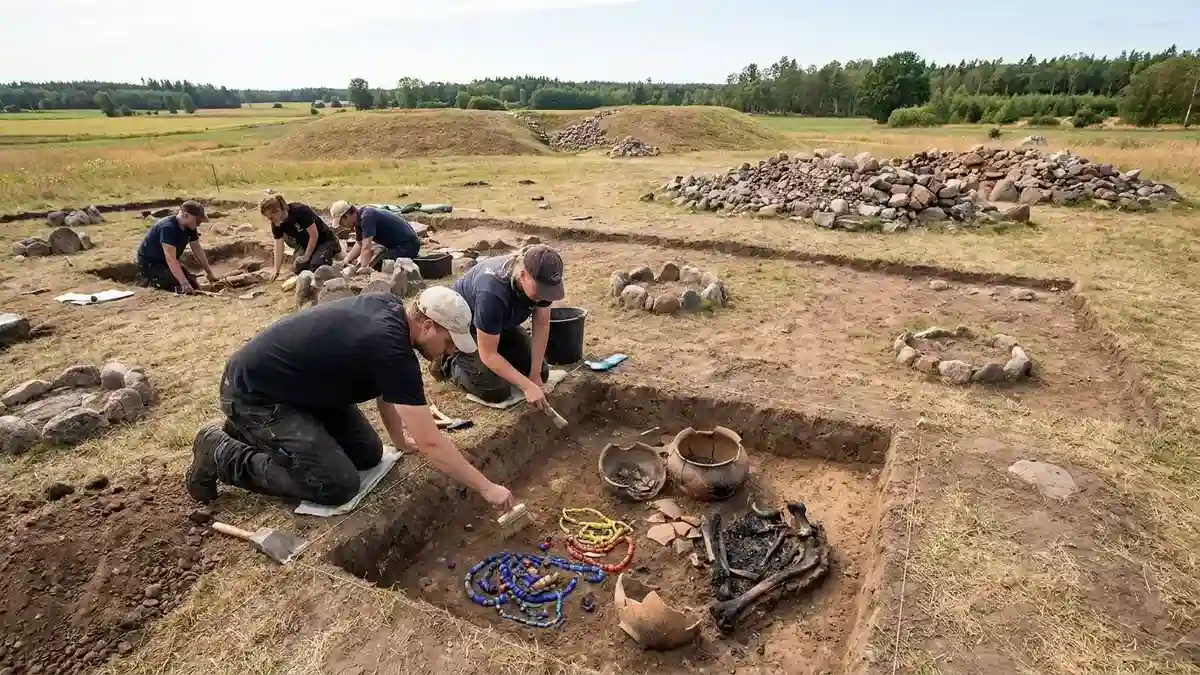
Outside the city of Nyköping, near the quiet village of Rogsta, a massive swath of farmland and woodland has been peeled back to reveal a spectacular archaeological landscape. Spanning roughly 16,000 square meters, this vast excavation is currently one of the largest and most ambitious archaeological investigations underway in the region of Södermanland, Sweden.
A team of approximately 20 dedicated archaeologists has successfully uncovered a sweeping late Iron Age cemetery dating directly to the 600s and 700s CE. Among their most exciting discoveries is a highly unusual, high-status grave containing a treasure trove of nearly 50 vibrant glass beads, alongside beautifully preserved ceramic cremation urns. The site provides a rare, multi-layered look at life, wealth, and spiritual customs in Scandinavia centuries before the dawn of the Viking Age.
Shimmering Artifacts of the North Massive Iron Age Cemetery and Rare Glass Beads Uncovered in Sweden
Unlocking the Stone Circles of Rogsta
To the untrained eye, the site initially appeared to be nothing more than scattered clusters of field stones. To archaeologists, however, these distinct circular arrangements of rocks were the unmistakable surface markers of early Scandinavian burials.
The Anatomy of a Rogsta Burial
├── 1. Surface layer: Circular stone alignments
├── 2. Subsurface level: Dark, charcoal-rich soil patches
└── 3. Burial pit: Fractured ceramic urns containing cremated remains & artifacts
The excavation process is slow and meticulous. Once the heavy surface stones are mapped and carefully removed, researchers look for telltale dark patches of soil. These discolored zones mark the exact locations of the ancient burial pits, where charcoal, ash, and organic matter have stained the earth for nearly 1,500 years.
While the team has completely excavated and documented five graves so far, their work has barely scratched the surface. Approximately 70 burials still lie hidden beneath the soil, waiting to be systematically analyzed over the coming months.
The Fire and Rituals of Scandinavian Cremation
The findings at Rogsta offer an intimate look into the complex mortuary theater of late Iron Age Scandinavia. During the 7th and 8th centuries, cremation was the dominant and most religiously significant burial practice across the region.
When a member of the community passed away, their body was placed atop a large, carefully constructed wooden funeral pyre. This was not a sterile disposal of a corpse, but a profound communal send-off. The deceased was dressed in their finest attire and surrounded by their prized personal belongings.
Furthermore, animal sacrifices played a vital role in ensuring a safe journey to the afterlife. Based on comparisons with similar regional sites, animals such as loyal hunting dogs and high-value horses were frequently placed onto the pyre alongside their owners.
Once the flames subsided, the family meticulously sifted through the cooling ash to gather the remaining white bone fragments and teeth. These sacred remains were then placed inside hand-formed ceramic urns and interred beneath the protective stone circles.
The Grave of 50 Beads: A Symbol of Iron Age Opulence
Among the five completed burials, one specific grave immediately captivated the research team. Nestled alongside the crushed fragments of an ancient ceramic urn and charred bone, archaeologists exposed an extraordinary collection of nearly 50 brightly colored glass beads.
Iron Age Glass Bead Ornaments
├── Material: Imported and locally modified glass
├── Function: Secured to garments or suspended between chest brooches
└── Meaning: Markers of elevated wealth, high social standing, and trade connections
While finding one or two stray beads is relatively common in women’s graves from this era, a single cache of nearly 50 pieces is an exceptionally rare and significant archaeological event. In late Iron Age society, glass beads were luxury items. They were not sewn onto clothing randomly; instead, women traditionally strung them across the front of their garments, suspending them horizontally between two large metal brooches pinned to the chest.
The sheer volume of beads in this single burial points to an individual of highly elevated social standing—potentially a matriarch or a woman of significant political and economic influence within the Rogsta community. These shimmering ornaments served as highly visible markers of tribal identity, family wealth, and access to long-distance trade networks.
A Sacred Landscape Shared Across Millennia
What makes the Rogsta site truly extraordinary is that the Iron Age cemetery represents only the final chapter of the land’s ancient story. As archaeologists dig beneath and around the 1,500-year-old graves, they are running directly into the remains of a sprawling, much older Bronze Age settlement dating from roughly 1700 to 500 BCE.
The team has already mapped out substantial prehistoric earthworks and massive deposits of fire-cracked stones—a classic indicator of Bronze Age cooking, brewing, and industrial activities.
This overlapping of a Bronze Age town and an Iron Age cemetery proves that this specific Swedish hillside held immense structural and cultural value for thousands of years. Generations of completely different communities repeatedly chose this exact landscape to build their homes, farm the land, and ultimately bury their honored dead, creating a continuous historical sequence that few other sites in Scandinavia can match.
Frequently Asked Questions
What is the most significant discovery made at the Rogsta site so far?
The most notable find is an Iron Age grave containing nearly 50 colorful glass beads buried alongside cremated human bones and fragments of a ceramic urn. Discovering a collection of glass beads this large is highly uncommon and indicates that the deceased was a person of immense wealth and high social status.
How did the ancient people of Rogsta bury their dead?
During the late Iron Age (600s and 700s CE), cremation was the standard practice. The deceased was burned on a funeral pyre along with personal items, jewelry, and sacrificed animals (often horses or dogs). The remaining ashes and bone fragments were collected, placed inside ceramic urns, and buried beneath circular stone arrangements.
How did women wear these glass beads during the Iron Age?
In Scandinavian culture during this period, colorful glass beads were prominent fashion accessories and markers of wealth. They were typically strung together and suspended across the chest, anchored on either side by large metal brooches fastened to the woman’s clothing.
How large is the excavation site, and why is it important?
The excavation covers roughly 16,000 square meters, making it one of the largest active archaeological investigations in Södermanland. It is highly important because it features overlapping historical layers—an Iron Age cemetery built directly on top of a much older Bronze Age settlement (1700 to 500 BCE)—revealing thousands of years of continuous human activity in one single location.
What will happen to the site next?
Archaeologists still have around 70 more graves to carefully excavate and analyze within the cemetery field. Once the Iron Age cemetery investigation is fully complete, the team will shift their focus entirely to the deeper Bronze Age layers to learn more about daily life, farming habits, and housing styles from thousands of years ago.