
Table of Contents
Secrets of the Coast: Brain Removal and Long-Distance Dynasties Uncovered in Iron Age Scotland
The Iron Age in Britain (roughly 800 BCE to CE 43) is notoriously difficult for osteoarchaeologists to study. Because of highly acidic soils across the British Isles, ancient skeletons rarely survive the ravages of time. However, the unique environmental conditions of northwestern Scotland have just shattered this barrier.
A high-tech study published in the journal Antiquity has revealed an extraordinary discovery from an Iron Age burial mound at Loch Borralie in Sutherland. By combining skeletal analysis, isotope testing, and ancient DNA (aDNA) mapping, an international research team has uncovered gruesome postmortem body modifications—including evidence of brain removal—alongside proof of massive, seafaring family networks that spanned hundreds of kilometers of treacherous Scottish coastline.
Secrets of the Coast Brain Removal and Long-Distance Dynasties Uncovered in Iron Age Scotland
The Haunting Modifications of Loch Borralie
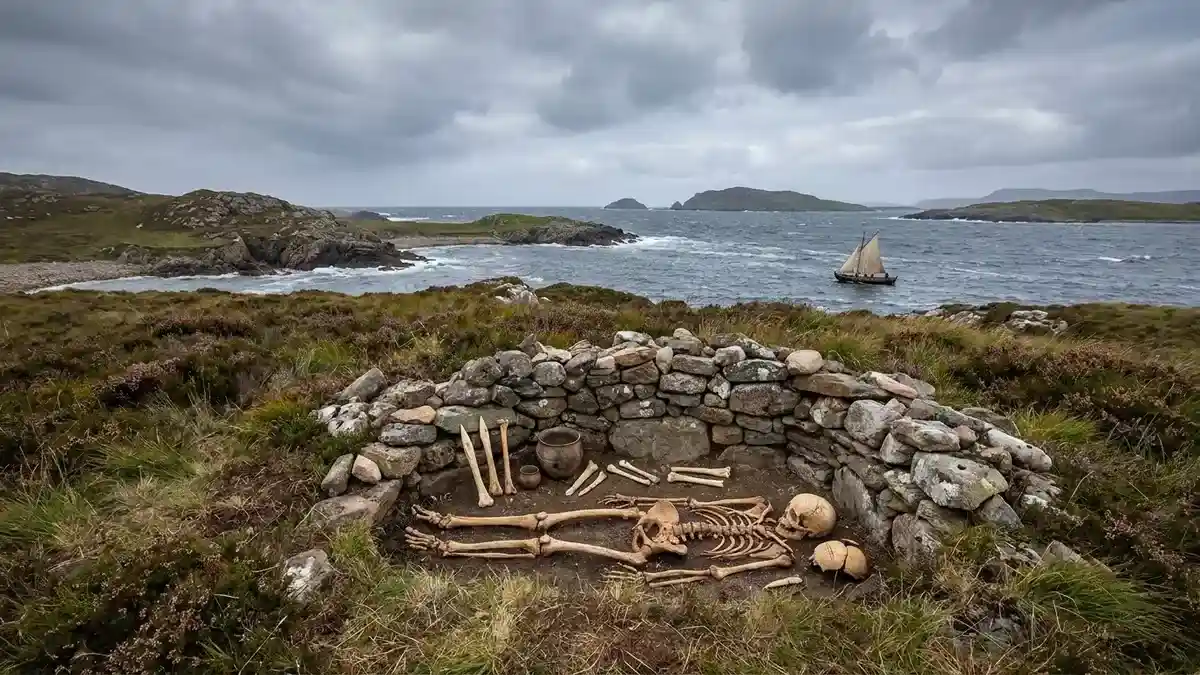
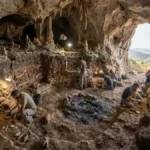
The excavation centered on a low stone cairn containing the co-mingled remains of two individuals: an adult woman and a juvenile boy. When anthropologists from the UK and the US began cleaning and analyzing the woman’s skeletal remains, they uncovered a series of deliberate, perimortem (around the time of death) modifications that point to an incredibly complex, multi-stage funerary ritual.
The most shocking discovery lay hidden on the interior surface of the skull fragments. Fine, precise incised marks scoring the endocranial bone surface strongly suggest that ancient processors carefully extracted her brain shortly after she passed away.
Postmortem Skeletal Modifications Identified on Individual 1
├── Endocranial Incisions: Indicating surgical brain removal
├── Bilateral Scapular Fractures: Symmetrical trauma to the shoulder blades
└── Long Bone Whittling: Arm and leg bones intentionally shaved down into sharp points
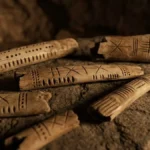
The physical manipulation did not stop with the skull. Several of her long bones—including sections of the arms and legs—showed clear evidence of being carved or scraped, narrowing significantly toward their ends until they formed sharp, deliberate points.
Despite these intense, seemingly violent physical alterations, the woman’s skeleton was not discarded carelessly. Archaeologists noted that her modified bones were meticulously reassembled and laid out with immense care before the stone tomb was sealed. This elaborate, dual-phase treatment suggests she held an exceptionally revered, high-status position within her clan, requiring a specialized transition into the afterlife.
Mapping a Deep-Sea Family Tree
While the young juvenile male buried alongside her did not display the same level of bone carving, molecular science proved that their fates were deeply intertwined. Ancient DNA analysis successfully extracted genetic material from both individuals, revealing a definitive familial bond: they were almost certainly maternal second cousins.
Genetic Connectivity of the Loch Borralie Clan
├── Applecross (Southwest Coast) ── ~225 km ──┐
├── Loch Borralie (Burial Site) ──────────────┼── Shared aDNA & Maternal Lineage
└── Orkney Islands (Northeast Coast) ── ~175 km ┘
By mapping their genetic profiles against a broader database of Iron Age European populations, the researchers hit upon an even larger revelation. The cousins were genetically linked to ancient populations living in completely different regions of northern Scotland.
Their DNA markers directly connected them to ancestral lines in Applecross, roughly 225 kilometers to the southwest, as well as the remote Orkney Islands, sitting 175 kilometers across the rough waters of the Pentland Firth to the northeast.
Reconstructing Ancient Maritime Mobility
How did a family lineage remain completely intact across hundreds of kilometers of rugged, mountain-locked Scottish terrain? The answer lies in the water.
To map out the cousins’ actual movements during their lifetimes, scientists conducted oxygen and strontium isotope analysis on their teeth. Because local water and soil chemistry leave a permanent signature in tooth enamel during childhood, these tests act as a geographic diary of an individual’s early years.
The isotope data proved that neither the woman nor the boy grew up near their final resting place at Loch Borralie. Instead, both spent their childhoods approximately 80 kilometers to the southeast.
This multi-layered data paints a picture of a highly mobile, seafaring society. These coastal Iron Age communities were not isolated or insular. Instead, they used the northern seas and island channels as rapid transit highways, traveling immense distances to forge political alliances, coordinate marriages, and maintain sprawling family dynasties.
A Shared Culture of the Dead
The spectacular finds at Loch Borralie are helping archaeologists redefine the social landscape of Iron Age Britain. While communities in southern Britain practiced completely different, simpler burial customs, the maritime networks of northwestern Scotland and the Northern Isles shared a deeply entrenched, highly distinct “culture of the dead.”
In this rugged coastal world, the deceased were not simply put in the ground and forgotten. Human remains were regularly circulated, curated, modified, and safely deposited among communities over long periods.
Funerary traditions and processing rituals traveled right alongside the people themselves. By physically transforming the bones of their loved ones and carrying them across hundreds of kilometers of ocean, these ancient seafarers successfully maintained an unbroken cultural identity, tightly binding distant living communities to the shared power of their ancestors.
Frequently Asked Questions
What is the most unusual discovery made at the Loch Borralie burial site?
The most unusual discovery is the evidence of extensive postmortem body modification on an adult female skeleton. Archaeologists found fine incisions on the inside of her skull indicating her brain was intentionally removed, alongside arm and leg bones that were whittled down into sharp points before being carefully reassembled for burial.
How did scientists prove the two individuals were related?
Researchers utilized ancient DNA (aDNA) testing to analyze the genetic material of both skeletons. The results proved a definitive, close family connection, establishing that the adult woman and the juvenile male were most likely maternal second cousins.
How far did this family network stretch across Iron Age Scotland?
The genetic mapping revealed that this family network was incredibly vast, stretching across hundreds of kilometers of coastline. The individuals buried at Loch Borralie shared direct genetic ties to ancient populations living in Orkney (175 km to the northeast) and Applecross (225 km to the southwest).
Did the individuals live their entire lives at the burial site?
No. Tooth isotope analysis, which tracks the unique chemical signatures of the water and food consumed during childhood, proved that both individuals grew up in an area roughly 80 kilometers southeast of Loch Borralie, showing they moved significantly during their lifetimes.
What does this study tell us about Iron Age Scottish society?
It demonstrates that Iron Age coastal communities were highly mobile, sophisticated, and deeply interconnected via maritime travel. Rather than living in isolated valleys, they maintained extensive long-distance family alliances and shared unique, complex rituals surrounding the curation and veneration of human remains.