
Industrial Hub and Roman Necropolis Unearthed in Egypt’s Nile Delta
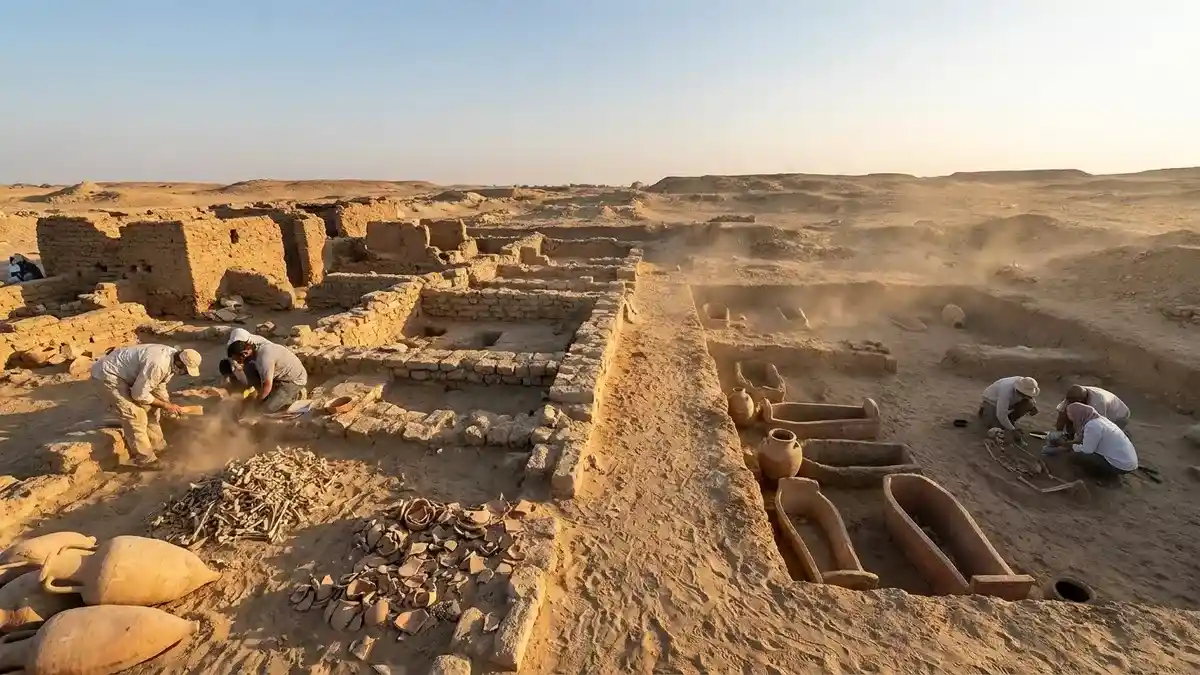
In a significant archaeological breakthrough, a joint Egyptian-Italian mission has uncovered an extensive industrial complex and a Roman-era cemetery in Egypt’s western Nile Delta. Excavations at the sites of Kom el-Ahmar and Kom Wasit, located in the Beheira Governorate, reveal that this region was a thriving economic and cultural center, serving as a critical nexus between the Mediterranean world and the bustling city of Alexandria.
The collaboration, led by the Supreme Council of Antiquities and the University of Padua, provides a rare, multi-layered perspective on how ancient populations lived, worked, and honored their dead across several centuries.
Industrial Hub and Roman Necropolis Unearthed in Egypt’s Nile Delta
A Massive Center for Industrial Production
The heart of the discovery is a large, well-organized industrial building containing at least six distinct rooms. Far from being a one-dimensional production site, the complex reveals a remarkably diverse local economy.
Mass-Produced Salted Fish
Perhaps the most striking find is the evidence of large-scale fish processing. Archaeologists recovered nearly 9,700 fish bones, indicating a robust salted fish industry. In antiquity, salted fish was a high-value commodity, essential for long-distance trade. The volume of remains suggests that this site was not merely serving local needs, but was an active participant in regional export markets.
Crafts and Artisanship
Beyond food production, the complex functioned as a hub for various artisan activities:
Tools: Several rooms were dedicated to the manufacture of metal and stone implements.
Faience Amulets: Artisans produced these iconic blue-glazed amulets, suggesting a steady market for religious and decorative items.
Workshop Diversity: The presence of unfinished limestone figures in various stages of manufacture confirms that this was an active, bustling workshop area where raw materials were transformed into finished goods.
The presence of imported Greek amphorae and pottery fragments confirms that the site was operational as early as the fifth century BCE, illustrating long-standing commercial and cultural ties between Egypt and the wider Greek world.
The Roman Necropolis: Insights into Daily Life
Adjacent to the industrial sector, the archaeological team excavated a Roman-period necropolis. The diversity of burial styles found here—ranging from simple in-ground interments and ceramic coffins to the burial of children inside large amphorae—reflects the complex social structure and evolving cultural traditions of the Delta region under Roman rule.
A Window into Public Health
Bioarchaeological analysis of 23 individuals, including men, women, and children, provides a fascinating look at the quality of life in this ancient community. Initial findings suggest that these individuals enjoyed relatively high living standards, with no evidence of major diseases or violent trauma. Ongoing studies, including dietary and isotopic analyses, will soon provide an even more detailed portrait of the health and demographics of the population.
Remarkable Artifacts and Historical Significance
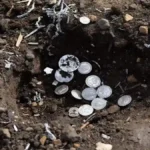
The excavation yielded numerous well-preserved artifacts, including dozens of amphorae and a pair of delicate golden earrings, likely belonging to a young woman. These items have been relocated to the Egyptian Museum in Cairo, where they will undergo further study and eventual exhibition.
For historians, the significance of these finds cannot be overstated. By providing physical evidence of both the “workaday” world of ancient industry and the somber rituals of burial, the sites at Kom el-Ahmar and Kom Wasit prove that the western Nile Delta was a vibrant, interconnected hub. These discoveries serve as a powerful reminder of how trade, production, and cultural interaction shaped the fabric of Egyptian society long before the modern era.
Frequently Asked Questions (FAQ)
1. Where were the industrial complex and necropolis found?
The discoveries were made at the archaeological sites of Kom el-Ahmar and Kom Wasit, located in the Beheira Governorate in the western Nile Delta, Egypt.
2. What was being produced at the industrial complex?
The site was a diverse manufacturing hub. Researchers found evidence of mass-produced salted fish (nearly 9,700 bones), metal and stone tools, and faience amulets. Unfinished stone statues were also found, indicating active artisan workshops.
3. What does the site reveal about trade in the ancient world?
The presence of imported Greek amphorae and pottery, combined with the large-scale production of salted fish (a major trade commodity), suggests that this site was deeply integrated into Mediterranean trade networks as early as the fifth century BCE.
4. What is unique about the Roman burials found there?
The necropolis shows a variety of burial traditions, including ceramic coffins and the use of large amphorae to bury children. This diversity offers clues about the social status and varied cultural influences present in the Delta during the Roman period.
5. What did the study of human remains tell us about these people?
Bioarchaeological analysis of 23 individuals revealed that they lived under relatively good conditions, with no signs of significant disease or violence, suggesting the community was stable and well-nourished.