
Unlocking Ancient Egypt: Decoding Mummy Scents for Science
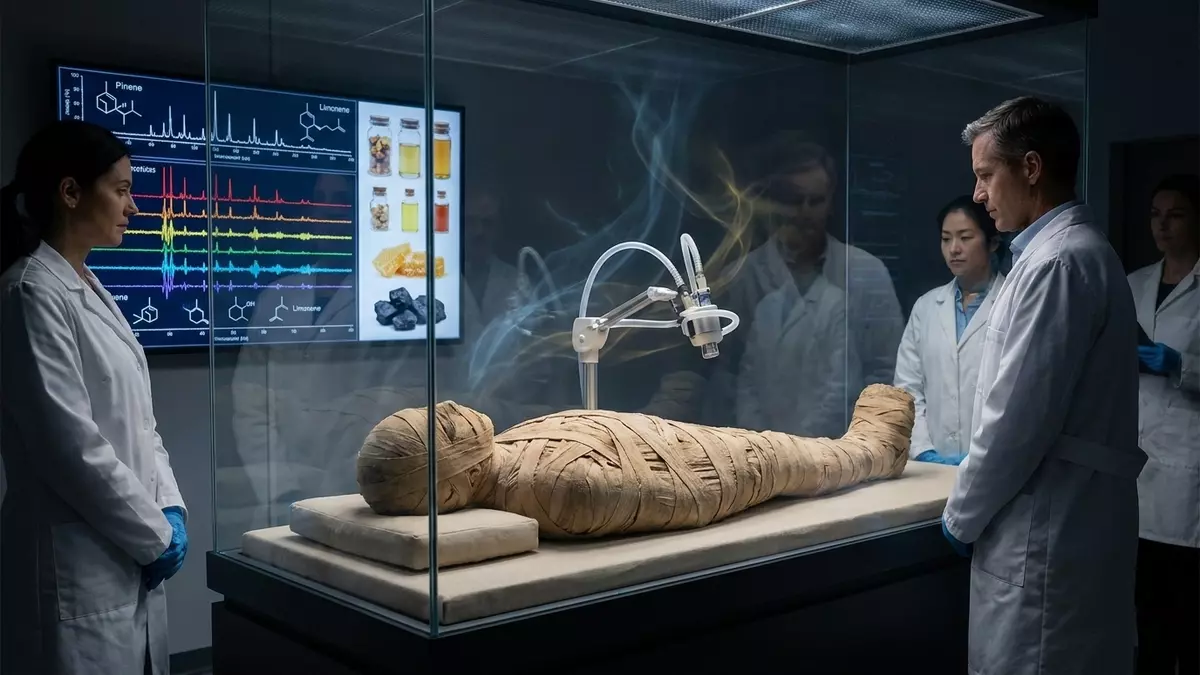
For centuries, the faint, musty odor emanating from ancient Egyptian mummies was dismissed as a simple byproduct of age and inevitable decay. However, a groundbreaking study from the University of Bristol is transforming that assumption. By analyzing the volatile organic compounds (VOCs) trapped in the air surrounding mummified remains, researchers have unlocked a “scent signature” that reveals the intricate, sophisticated recipes used by ancient embalmers to preserve the dead.
Unlocking Ancient Egypt Decoding Mummy Scents for Science
A Non-Destructive Leap in Archaeology
Traditionally, understanding the chemical composition of mummification balms required invasive procedures—cutting into fragile, thousands-year-old bandages or dissolving precious organic material. This often resulted in irreversible damage to historical artifacts.
The new approach, detailed in the Journal of Archaeological Science (2026), utilizes a sophisticated technique known as headspace solid-phase microextraction, paired with gas chromatography and mass spectrometry. By capturing the gases hovering above the mummies and inside their storage containers, researchers can now identify individual molecular components without ever touching the physical body. This non-destructive method provides a powerful new tool for museums and curators to study their collections while maintaining the integrity of the remains.
The Chemistry of Eternal Preservation
The team analyzed 35 samples from 19 mummies, covering over 2,000 years of Egyptian history. Their findings identified 81 distinct volatile organic compounds, categorizing them into four primary groups that correspond to the complex ingredients utilized by ancient embalmers:
Fats and Oils: Responsible for aromatic compounds and short-chain fatty acids.
Beeswax: Contributed mono-carboxylic fatty acids and cinnamic compounds.
Plant Resins: A key source of aromatic compounds and sesquiterpenoids.
Bitumen: Produced distinct naphthenic compounds, detectable even in trace amounts.

This detailed breakdown allows scientists to reconstruct the specific “recipes” that priests and embalmers crafted to ensure the survival of the body.
Tracing Evolution Through Time and Space
One of the most compelling aspects of the study is the chemical variation across historical periods. Earlier mummification efforts displayed relatively simple profiles, relying primarily on fats and oils. As time progressed, the chemical signatures became significantly more complex, incorporating high-value imported resins and bitumen. These changes track the economic shifts, trade expansions, and evolving religious requirements of Egyptian society over two millennia.
Furthermore, the researchers discovered that the “scent profiles” were not uniform across a single body. Analysis revealed distinct differences in compound patterns between the head and the torso. This suggests that Egyptian embalmers were highly skilled, applying specialized, region-specific recipes to different parts of the body to optimize the preservation process.
Implications for Museum Curatorship
This research provides more than just historical insight; it offers a practical, rapid screening tool for curators worldwide. By analyzing the volatile compounds in a display case or storage room, museums can gain a comprehensive understanding of the materials used in a mummy’s preservation without the need for physical intervention.
While traditional, invasive sampling will likely remain necessary for granular, deep-tissue analysis, volatile compound analysis is poised to become the standard first step in archaeological assessment. It allows for the widespread, comparative study of mummies across international collections, bridging the gap between chemical science and Egyptology.
Frequently Asked Questions (FAQ)
1. How were the researchers able to study the mummies without touching them?
The team used a technique called “headspace solid-phase microextraction.” They captured the gases released by the mummified bodies into the air surrounding them, then used gas chromatography and mass spectrometry to identify the chemical molecules present in that air.
2. What do the different “scents” tell us about mummification?
The volatile compounds reveal the ingredients used in the embalming balms. By identifying these chemicals, researchers can determine the exact mix of fats, waxes, resins, and bitumen used, which helps explain the preservation techniques employed during different historical eras.
3. Did the ingredients used in mummification change over time?
Yes. The study found that earlier mummies used simpler recipes dominated by fats and oils. Later mummies featured more complex mixtures, reflecting the inclusion of expensive imported resins and bitumen, likely due to trade advancements and shifts in funerary rituals.
4. Why did the researchers find different chemicals on the head versus the torso?
The presence of different volatile profiles on different parts of the body suggests that Egyptian embalmers used customized recipes for specific body regions. This demonstrates a high level of specialized knowledge and attention to detail in the mummification process.
5. Why is this research considered “non-destructive”?
Traditional analysis required scientists to cut bandages or take tissue samples, which damaged the physical remains. This new method captures gases that are already being released into the air, meaning the mummy itself remains entirely undisturbed during the data collection process.