
3,400-Year-Old Bronze Sword Reveals Prehistoric Engineering Mastery
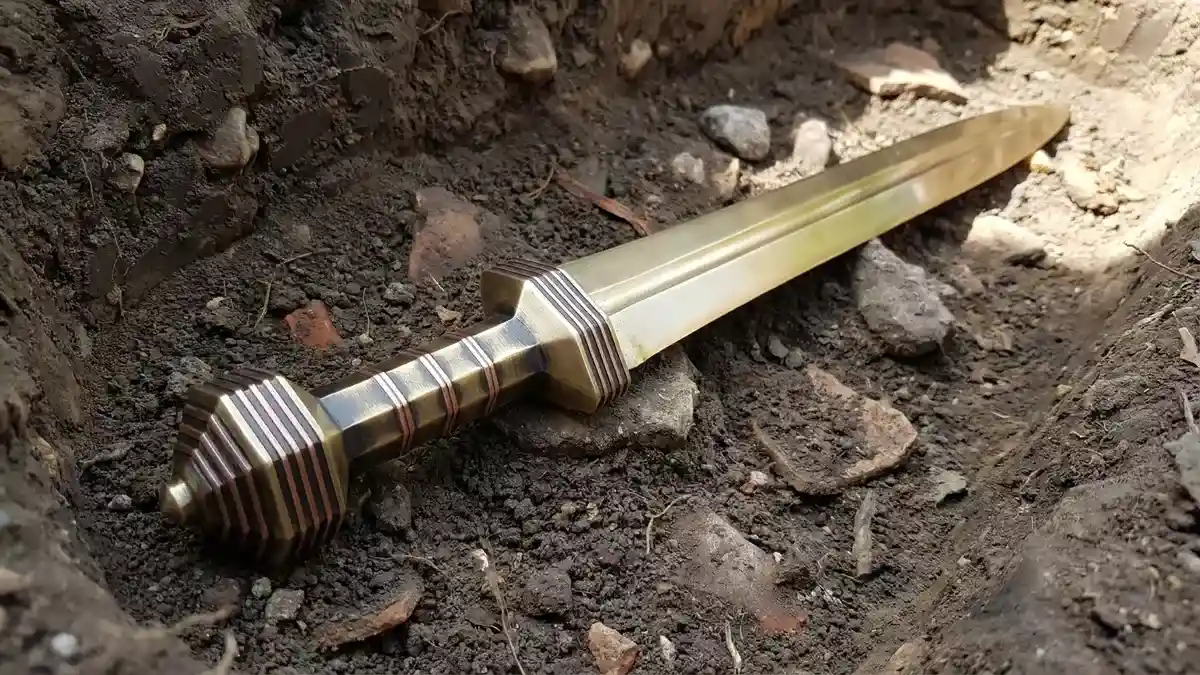
In 2023, the discovery of an octagonal bronze sword in Nördlingen, Swabia, captivated the archaeological world. Dating back over 3,400 years to the Middle Bronze Age, this pristine weapon was more than just a burial offering—it was a masterpiece of prehistoric engineering. Recent high-tech analysis, conducted by a multi-disciplinary team using synchrotron radiation and computed tomography, has now pulled back the curtain on how this elite weapon was crafted, revealing manufacturing techniques that push the boundaries of what we thought possible for the era.
3,400-Year-Old Bronze Sword Reveals Prehistoric Engineering Mastery
A High-Tech Examination of Ancient Steel
Because of the sword’s exceptional preservation—it still retains a metallic sheen and an edge that remains dangerously sharp—researchers were determined to analyze it without causing damage. The study utilized non-destructive, cutting-edge diagnostic tools:
High-Resolution CT Scanning: This provided a 3D internal map of the sword, allowing researchers to see how the tang of the blade was clamped and riveted into the hilt.
X-Ray Diffraction & Fluorescence: By using the BESSY II synchrotron, the team subjected the sword to intense radiation to identify the exact elemental composition of the metal and its decorations at the atomic level.
Stress Mapping: Scientists measured the residual stress within the crystalline structure of the bronze, effectively “reading” the metal’s history to reconstruct the forging, casting, and quenching stages used by the ancient smith.

The Mystery of the Copper Inlays
One of the most striking features of the Nördlingen sword is the set of deep, geometric grooves decorating its pommel. Initial theories suggested these might be inlaid with tin to provide a bright, contrasting color against the golden-hued bronze.

However, the synchrotron radiation revealed a more complex reality. The inlays are not tin, but intricately crafted copper wires. Working with pure copper in the Bronze Age was a demanding, high-precision task. To ensure the reddish copper popped visually against the golden bronze base, the ancient smith likely employed a sophisticated patination process—a chemical darkening of the surrounding bronze—to create a sharp, intentional visual contrast. This reveals a level of aesthetic planning and chemical knowledge that is rarely captured in the archaeological record.
Engineering a Masterpiece
The CT scans provided a rare “x-ray” view of the sword’s assembly. The blade continues into the hilt as a tang, which was carefully clamped and secured with rivets. The resolution was so precise that researchers could identify individual tool marks, showing exactly how the smith shaped and finished the metal thousands of years ago.
The data mapping of the crystalline structure suggests the sword underwent rigorous cycles of forging and quenching. This was not a weapon made for mass production; it was the product of a highly specialized workshop, likely located in southern Germany, which acted as a major hub for the production of these rare octagonal swords.
 Popcorn’s discovery 7,000 years ago: archaeologist explores its ancient appeal in the Americas
Why This Sword Matters
This research does more than explain how one sword was built; it provides a technical blueprint for Bronze Age metallurgy. It highlights that the smiths of the second millennium BCE were not just workers of metal—they were material scientists. They understood the properties of alloys, the effects of heat and pressure on crystalline structures, and the potential for chemical treatments to alter the appearance of their work.
Through this scientific lens, the Nördlingen sword is transformed from a static museum piece into a dynamic testament to human ingenuity. It demonstrates that the Middle Bronze Age was a period of high technological complexity, where precision, chemistry, and artistry converged to create objects of enduring power. As the full evaluation of the data continues, researchers hope to narrow the weapon’s origin down to a specific workshop, potentially identifying the hands of a master smith who worked over three millennia ago.
Frequently Asked Questions
What makes the Nördlingen sword so rare?
It belongs to a very exclusive group of “octagonal” swords found in southern Germany. These are distinguished by their complex hilt design, which required exceptional skill to cast and decorate.
How did the smiths create the contrast on the hilt?
They inlaid pure copper wires into the bronze base and then likely used a chemical patination process to darken the surrounding bronze, making the copper stand out brilliantly.
Does the sharp blade mean it was a weapon or a ritual item?
Its balance and sharp edge suggest it was fully functional. While such high-status weapons were often used as status symbols in burials, this sword was clearly engineered for performance as well as prestige.
What is the “tang” and why is it important?
The tang is the extension of the blade that fits into the hilt. By scanning the hilt, researchers were able to see exactly how the smith clamped the blade into the handle and used rivets to lock it in place, showing the precise mechanical design of the sword.
Can we identify the specific workshop?
Not yet, but we are close. The elemental “fingerprint” of the copper and the specific forging patterns identified by the synchrotron allow researchers to compare this sword against others from the region. The goal is to eventually trace this sword to a specific historical workshop in southern Germany.