
The Dawn of Geometry: 60,000-Year-Old Engravings Unveiled
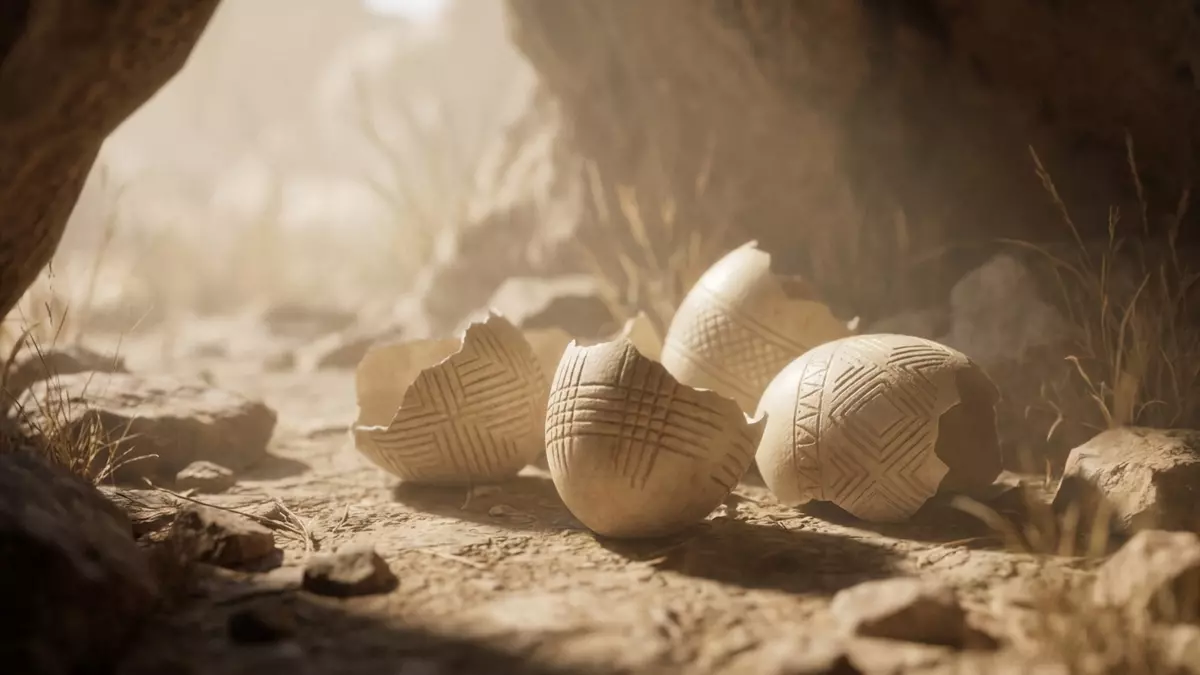
For decades, the story of human cognitive evolution has been centered on the “big bang” of symbolic thought, often associated with much later European cave art. However, a groundbreaking study published in PLOS ONE is shifting the timeline of human intellect significantly further back. Researchers have discovered that as early as 60,000 years ago, Homo sapiens in southern Africa were utilizing a sophisticated “geometric grammar” to decorate ostrich eggshells with complex, intentional patterns.
The Dawn of Geometry 60,000-Year-Old Engravings Unveiled
Beyond Random Scratches: A Geometric Language
The Howiesons Poort period of the Middle Stone Age—centered in sites like Diepkloof and Klipdrift in South Africa and Apollo 11 in Namibia—has long been known for yielding fragments of ostrich eggshells. While it was clear these shells likely functioned as portable water containers, the nature of the lines carved into their surfaces had been a subject of debate: were they accidental, decorative, or something more profound?
A research team from the University of Bologna applied rigorous geometric and spatial analysis to 112 of these fragments to settle the question. By measuring angles, line spacing, and curvature with high precision, they identified a level of regularity that cannot be attributed to chance.
The data revealed that over 80 percent of the engravings followed a consistent spatial order. The patterns were not haphazard; they were deliberate, rule-based compositions. The engravers consistently used:
Parallelism: Lines were maintained at stable distances from one another.
Angular Consistency: Angles frequently clustered near 90 degrees, indicating an intentional mastery of right-angle crossings.
Complex Motifs: The artisans created grids, diamond shapes, and hatched bands using intersecting diagonals.

The Cognitive “Geometric Grammar”
The most significant finding of the study is the presence of what researchers call a “geometric grammar.” This term describes a stable set of procedures used to organize visual space. The artisans did not simply cut lines at random; they performed a series of controlled, repetitive operations.
The study identified a clear hierarchy in the engraving process. The makers often started by laying out a basic framework or skeleton for the design and then meticulously inserted smaller elements within those boundaries. This “nesting” of forms and the translation of motifs across the curved surface of the eggshell require a high level of abstract planning and spatial memory. The engravers had to hold the overall design in their minds while simultaneously managing the physical challenges of a small, curved surface.
Why This Matters for Human Evolution
This discovery provides some of the earliest physical evidence of organized graphic representation in human history. To create these patterns, the artisans had to master several key cognitive abilities that are foundational to modern human thought:
Spatial Control: The ability to map a design onto a three-dimensional, curved object.
Iterative Planning: The capacity to repeat specific actions (like cutting a line) while ensuring they fit into a larger, coherent structure.
Abstract Logic: The use of geometry suggests that these early humans were not just copying nature, but were creating a symbolic language that was likely shared across their community.
Redefining the Middle Stone Age
The findings challenge the long-held assumption that structured graphic systems are a relatively modern development. Long before the rise of agriculture, organized religion, or written language, the inhabitants of southern Africa were already engaged in the “math of art.”
These engraved eggshells serve as a bridge between our ancestral past and the complex cognitive abilities we possess today. They reveal that the human drive to impose order, logic, and aesthetic beauty onto the world is not a recent innovation, but a fundamental trait that has defined Homo sapiens for at least 60,000 years.
Frequently Asked Questions
Why were ostrich eggshells used as canvases?
Ostrich eggshells were incredibly durable and lightweight, making them ideal portable water containers for nomadic groups in southern Africa. Engraving them allowed these communities to personalize their property and potentially signal group identity or symbolic meaning.
What do we mean by “geometric grammar”?
“Geometric grammar” refers to a systematic set of rules for creating patterns. Just as language uses grammar to organize words, the artists of the Howiesons Poort phase used a consistent set of geometric rules (parallelism, right-angle intersections, nesting) to organize their visual art.
Could these designs be unintentional?
No. The statistical analysis of the fragments—showing consistent spacing, repeated angles, and the nesting of shapes—proves that these were planned, intentional designs. They are far too regular to be the result of a slipping tool or random scratching.
Does this mean these people had a written language?
Not necessarily. While this is a form of symbolic communication and organized graphic representation, it does not function as a writing system. However, it does represent the cognitive foundation—planning, symbol usage, and spatial reasoning—that would eventually make writing possible.
How does this change our view of the Stone Age?
It shifts our view of Middle Stone Age humans from “primitive” to “symbolically sophisticated.” It proves that the drive for abstraction and structured design was firmly established in Africa tens of thousands of years before it appeared elsewhere in the world.