
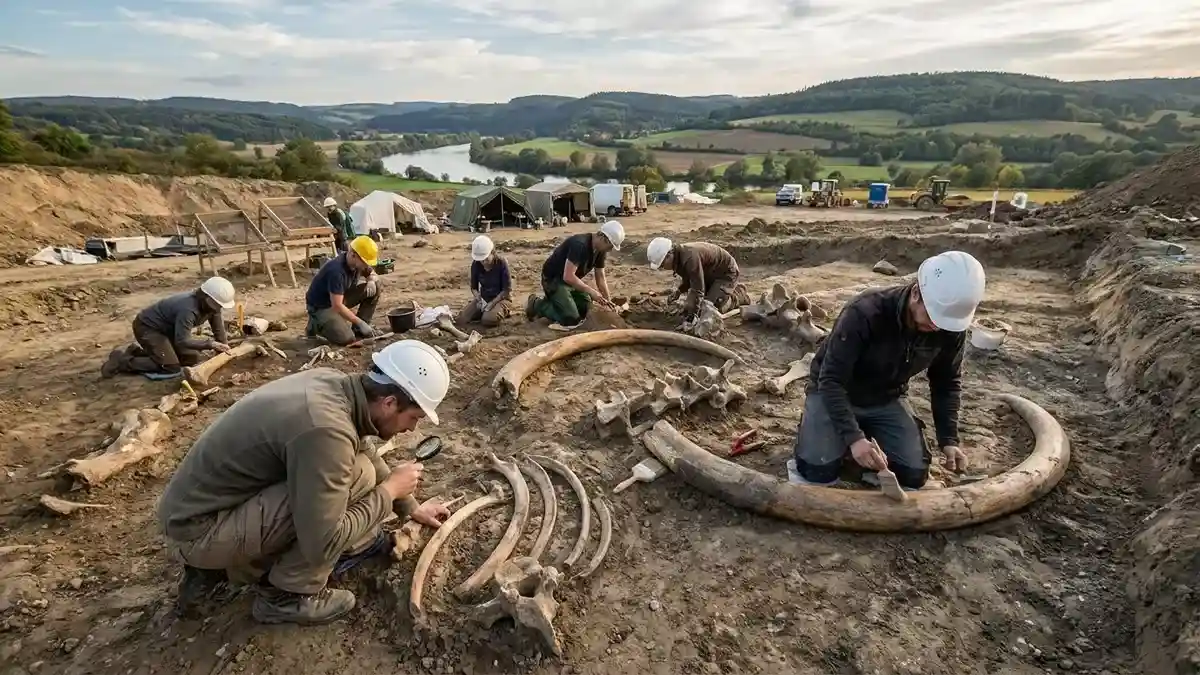
27,000-Year-Old Mammoth Discovery Rewrites Bavarian History
In a remarkable archaeological breakthrough, researchers in southeastern Germany have unearthed evidence of human interaction with a woolly mammoth dating back roughly 27,000 to 25,000 years. Found near Taimering, this discovery provides a rare, vital connection to a period when human presence in Central Europe was rapidly dwindling due to the onset of harsh climatic shifts.
27,000-Year-Old Mammoth Discovery Rewrites Bavarian History
A Chance Discovery in the Danube Valley
The remains were first encountered in March 2020, not by archaeologists searching for prehistoric treasure, but by construction workers. While the initial goal was to investigate medieval deposits, the discovery of ancient river sediments revealed something far more significant: 72 skeletal elements and a pristine tusk belonging to a single, adolescent woolly mammoth.
Radiocarbon dating placed the specimen squarely in the late Gravettian period. This era is of critical interest to scientists because it marks the threshold of the Last Glacial Maximum, a time when advancing glaciers and plummeting temperatures forced human populations across northern and central Europe to retreat or vanish.

Butchery Marks: The Smoking Gun of Human Activity
Initially, the bones were classified as a paleontological specimen. Because no stone tools, hearths, or habitation structures were found in the immediate vicinity, experts assumed the mammoth had died of natural causes.
However, a closer laboratory inspection revealed a hidden story. Specialists identified distinct, sharp-tool incisions on the mammoth’s ribs. These marks, found exclusively on flat surfaces, are consistent with deliberate butchery. One specific rib even appears to have functioned as a workbench, serving as a cutting surface for the processing of meat.
While the researchers cannot definitively state whether these early humans were hunting the mammoth or merely scavenging from a carcass they found, the find serves as undeniable proof that humans were present and active in the Bavarian landscape during a period previously thought to be almost entirely abandoned.

Adapting to a Shrinking World
The significance of the Taimering mammoth lies in its context. Data indicates that during the late Gravettian, the habitable range for hunter-gatherers in Europe contracted by half, dropping from approximately 240,000 square kilometers to 120,000 square kilometers. The total human population in these regions likely plummeted from roughly 2,800 individuals to a mere 1,000.
Bavaria, in particular, suffered from this environmental squeeze. As climatic conditions worsened, the region’s traditional cultural links to the more densely populated areas of Austria, Moravia, and southern Poland began to fray. The Taimering discovery suggests that, despite this isolation, small, resilient groups of hunter-gatherers maintained a presence in the Danube Valley.
The processing methods used on the mammoth carcass—which emphasize the animal as a major economic resource—strongly suggest these individuals belonged to “eastern” Gravettian groups. In Eastern Europe, mammoth exploitation was a well-documented survival strategy, and this find confirms that those cultural traditions persisted in Bavaria longer than previously documented.

Why the Absence of Tools Matters
The mystery of the Taimering site is deepened by what was not found. Despite rigorous follow-up excavations in 2021—including the meticulous wet-sieving of over 400 liters of sediment—no stone tools or flint flakes were recovered.
This absence highlights the challenge of identifying human activity in the Paleolithic record. It suggests that these ancient groups were highly mobile, potentially visiting the site for a very brief, targeted purpose—such as harvesting meat from a carcass—before moving on. Without these “archaeological signatures” like hearths or stone tools, many such encounters remain invisible to history.
The Taimering mammoth stands as the most recent known evidence of human occupation in Bavaria before a significant “settlement hiatus” occurred across the region. It offers a fleeting, precious glimpse into the lives of the last survivors who clung to this landscape before the full force of the Ice Age took hold.
Frequently Asked Questions
How do we know humans processed this mammoth?
Detailed microscopic analysis of the rib bones revealed precise, rhythmic cut marks that only occur when a sharp stone blade is used to slice through muscle and tissue. One bone even showed wear patterns indicating it was used as a chopping block.
Was the mammoth hunted or scavenged?
Archaeologists currently cannot confirm if the humans killed the mammoth or encountered the carcass after it died. However, the systematic nature of the butchery marks indicates that the carcass was a valuable resource to the people who found it.
Why is this discovery considered “rare”?
Finding evidence of human activity from 27,000 years ago is difficult because populations were so sparse and migratory. Finding such evidence in Bavaria, a region known for a major population decline during that era, makes this an exceptionally rare “snapshot” of human survival.
What is the “Gravettian culture”?
The Gravettian was a widespread Upper Paleolithic culture known for its complex tool-making, cave art, and specialized hunting strategies. It is one of the most studied cultures of the Ice Age due to their impressive adaptability in a changing climate.
Why were there no stone tools found at the site?
It is likely that the human activity at the site was very brief. Small, mobile bands of hunters often left little behind, especially if they only stayed for a few hours to butcher a carcass and then carried their tools away to their next camp.