
**Coral Dating Unlocks Colonial Secrets in Pacific Islands**
Archaeologists have discovered a powerful new tool for uncovering the hidden timelines of colonial-era sites in the Pacific: dating the coral blocks used in historic buildings. This innovative approach is transforming how researchers understand construction and cultural changes in remote islands like French Polynesia, where traditional records are often scarce or incomplete.
A recent study tested uranium-thorium (U-Th) dating on coral from 19th-century structures in the Mangareva Islands. The results provide more reliable construction dates than many conventional methods, offering fresh insights into how French Catholic missionaries and local Polynesian communities reshaped architecture and daily life after the 1830s.
Coral Dating Unlocks Colonial Secrets in Pacific Islands
### The Challenges of Dating Colonial Sites in Remote Pacific Regions
Historians and archaeologists typically rely on written documents, coins, ceramics, or glass artifacts to date colonial buildings. In isolated island settings, however, these sources can be unreliable. Ships delivered goods irregularly, and many structures contain few datable objects. Radiocarbon dating loses precision for the last few centuries, and tropical climates rarely preserve wood for tree-ring analysis.
Coral, a material widely used across Polynesia for construction, now fills this gap. U-Th dating measures the radioactive decay of uranium into thorium within the coral skeleton. Because coral dies once harvested from reefs, the technique pinpoints when the organism stopped growing—giving scientists a minimum possible age for when the building was constructed.
 Radiocarbon dating confirms Teutonic Knights built Feldioara Fortress in 13th-century Transylvania
This method proves especially valuable in French Polynesia, where missionary activities dramatically altered settlement patterns and building styles during the 19th century. The research, conducted by archaeologist James Flexner and colleagues, focused on missionary-linked structures in Mangareva, providing a clearer picture of this transformative period.
### Inside the Study: Coral Samples from Mangareva Buildings
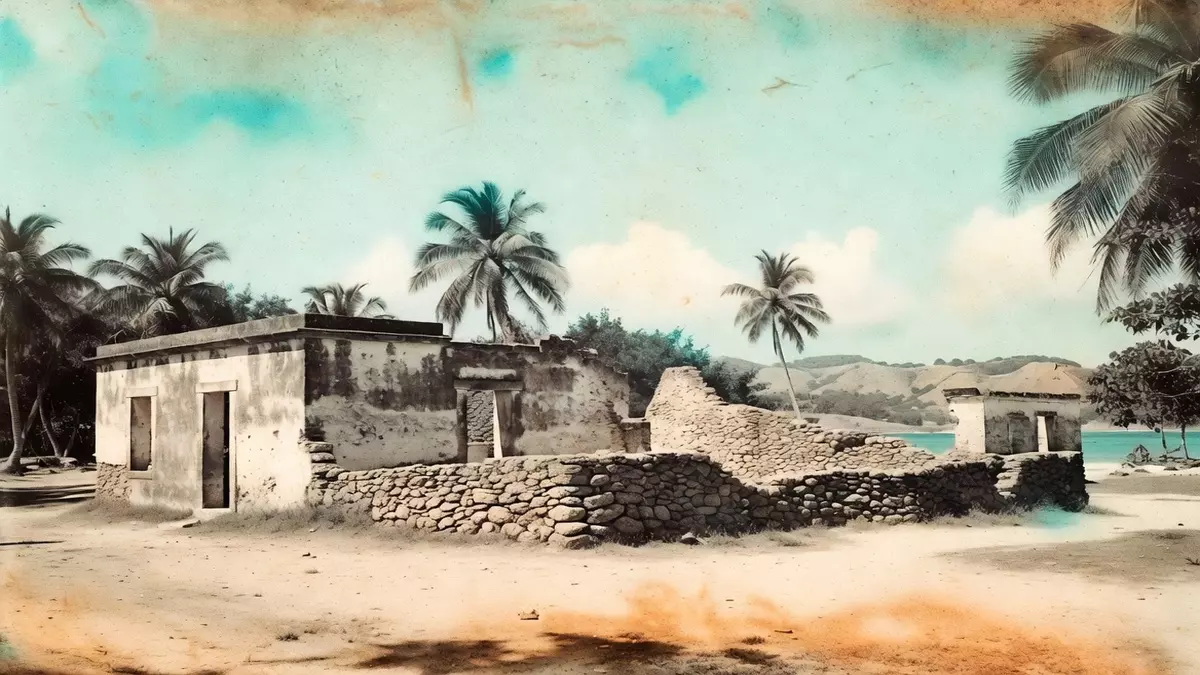
The team sampled minimally weathered branch corals from nine ruined buildings. These included seven traditional-style stone cottages known locally as *are po’atu*, a coral watchtower, and a school with known historical construction dates used as a control group.
Laboratory analysis yielded dates that aligned closely with the era of intense missionary activity. Many samples pointed to the 1830s and 1840s, shortly after French Catholic missionaries arrived in Mangareva in 1834. During this time, missionaries introduced European-style masonry techniques and trained local converts, leading to a boom in durable stone and coral construction that replaced earlier architectural traditions.
The *are po’atu* cottages became emblematic of these changes. These modest stone dwellings reflected both outside religious influence and the growing strength of Polynesian Catholic communities adapting new materials and methods to their needs.
One particularly compelling case involved matching coral dates from a house with artifacts from a nearby pit feature. Both dated to the mid-1840s, suggesting the building and associated deposits—containing food remains, metal items, glass fragments, and other daily objects—belonged to the same brief period. Researchers propose this could relate to a communal feast or gathering held around the time of construction.
**H3: Understanding Inbuilt Age and Its Limitations**
Not all results were straightforward. Some coral blocks returned dates significantly older than the buildings, sometimes predating sustained European contact. This phenomenon, known as inbuilt age, occurs when builders used coral that had already died years or decades earlier on the reef. In other instances, materials were likely recycled from older structures, including traditional Polynesian ceremonial platforms called *marae*.
Despite this, the method still delivers valuable chronological anchors. The dates represent the earliest possible construction window, helping archaeologists build more accurate timelines even when exact years remain elusive.
### How Coral Construction Changed Polynesian Societies
The arrival of missionaries in the Mangareva Islands marked a pivotal shift. Beyond spreading Christianity, they introduced new building technologies that influenced housing, community organization, and economic life. Coral and stone structures offered greater durability against tropical weather compared to traditional wooden or thatched buildings. Local laborers, trained in these techniques, created lasting monuments that blended European and Polynesian elements.
These changes didn’t occur in isolation. They reflected broader patterns of religious conversion, colonial expansion, and cultural adaptation across the Pacific. In Mangareva, the new architecture supported growing Catholic communities while altering how people lived, gathered, and expressed their evolving identities.
The study highlights how Indigenous agency played a key role. Polynesian converts actively participated in construction projects, making the resulting buildings products of cultural exchange rather than simple imposition.
**H3: Scientific Innovation Meets Pacific Archaeology**
U-Th dating on coral builds on established techniques used for reef and climate studies but applies them innovatively to historical archaeology. The method requires only small samples, minimizing damage to fragile heritage sites. In tropical environments where other scientific dating tools struggle, coral offers a robust alternative.
The research team’s careful sampling—from surface blocks with minimal weathering—helped ensure reliable results. Future refinements could account more precisely for inbuilt age by analyzing multiple samples per building or combining U-Th with other methods.
### Broader Implications for Pacific and Colonial Archaeology
This coral-dating approach has exciting potential beyond Mangareva. Similar coral-block architecture appears throughout French Polynesia and other tropical regions with colonial histories. Expanding the technique could help resolve dating uncertainties at many sites, revealing patterns of missionary expansion, local responses, and settlement development.
It also addresses gaps in documentary records. Many colonial-era structures in the Pacific were built by or for Indigenous communities, leaving fewer traces in official European archives. Material-based dating gives voice to these underrepresented histories.
The findings contribute to a more nuanced understanding of colonialism in the Pacific. Rather than viewing missionary buildings solely as symbols of foreign dominance, the research shows them as sites of interaction, adaptation, and community formation.
**H3: Connecting Past and Present in French Polynesia**
Today, the ruined *are po’atu* and other coral structures stand as tangible reminders of 19th-century transformations. They tell stories of faith, resilience, and cultural blending that continue to shape Polynesian identities. For descendants and visitors alike, these buildings bridge generations and offer opportunities for heritage preservation and education.
Climate change and rising sea levels pose growing threats to coastal archaeological sites in the Pacific. Techniques like U-Th dating on coral help document and prioritize these vulnerable resources before they are lost.
### Why This Matters for Understanding Global Colonial History
Colonial-era sites worldwide often suffer from incomplete records, especially in remote or marginalized areas. The success of coral dating in Mangareva demonstrates how creative scientific applications can overcome these challenges. It encourages archaeologists to look more closely at building materials themselves as chronological tools.
In the United States, where interest in Pacific history, Indigenous perspectives, and colonial legacies remains strong, this research resonates. It parallels efforts to re-examine American colonial sites using advanced methods, emphasizing material culture and local experiences over official narratives alone.
The study also underscores the value of interdisciplinary collaboration. Archaeologists, geochemists, and historians working together can extract maximum information from limited evidence, enriching our collective knowledge of the past.
As more coral-dated sites emerge across the Pacific, researchers will gain finer resolution on the pace and nature of cultural changes during the 19th century. This could illuminate migration patterns, economic shifts, and social dynamics that written sources only hint at.
### The Future of Coral-Based Dating in Archaeology
The initial study, though based on a modest sample, proves the concept works. Larger-scale applications could test how widespread inbuilt age effects are and develop statistical models to refine date ranges. Combining U-Th results with artifact analysis, oral histories, and archival fragments will create even richer interpretations.
This method opens doors for studying other coral-dependent cultures and periods. From ancient Polynesian *marae* to later colonial fortifications, coral holds untapped potential as both a construction material and a dating archive.
The research ultimately humanizes history. Behind each dated coral block lies a story of people cutting and shaping reef materials, learning new skills, and building structures that reflected their changing world. These acts of construction were deeply tied to survival, community, and belief.
## FAQ: Coral Dating Colonial Sites in French Polynesia
**Q: How does uranium-thorium dating work on coral?**
A: It measures the decay of uranium to thorium in the coral skeleton after the organism dies, providing a precise estimate of when the coral was harvested for building.
**Q: What are *are po’atu* buildings?**
A: Small stone cottages built with coral blocks during the missionary period, reflecting blended Polynesian and European architectural influences in 19th-century Mangareva.
**Q: Why is coral dating useful in the Pacific?**
A: Traditional methods struggle with recent centuries and sparse records. Coral provides direct minimum ages for structures in tropical environments where wood and other materials decay quickly.
**Q: What is “inbuilt age” in coral dating?**
A: It refers to coral that died years or decades before use in construction, or reused materials, making dates a minimum rather than exact construction year.
**Q: When did French missionaries arrive in Mangareva?**
A: In 1834, sparking a period of religious conversion and architectural innovation that the coral dates help document.
**Q: Can this method be used elsewhere?**
A: Yes. Coral buildings are common across French Polynesia and other tropical regions, suggesting broad applications for colonial and prehistoric archaeology.
**Q: What are the limitations of the technique?**
A: Inbuilt age can make dates older than actual construction. Multiple samples and integration with other evidence help improve accuracy.
This innovative use of coral dating is revolutionizing Pacific archaeology. By turning building materials into time capsules, researchers are uncovering detailed stories of cultural encounter and adaptation that might otherwise remain hidden. As the method expands, it promises to deepen our appreciation for the complex histories of colonial-era Pacific communities and the enduring legacy of their built environments.