
Table of Contents
- 1. The Ongoing Excavations at Ancient Tripolis
- 2. The Massive Scale of the Elite Roman Estate
- 3. Botanical Frescoes and Artistic Traditions
- 4. The Inland Fish Pond: A Rare Status Symbol
- 4.1. Fresh Seafood as a High-Society Flex
- 5. A Growing Treasury of Anatolian History
- 6. Frequently Asked Questions
- 6.1. Where was this luxury Roman villa discovered?
- 6.2. How old is the villa, and who lived there?
- 6.3. What makes the wall paintings in the villa special?
- 6.4. Why is the private marble fish pond such a significant find?
- 6.5. What other major discoveries have been made at Tripolis?
Luxury Roman Villa Unearths Ancient Elite Secrets for Archaeologists
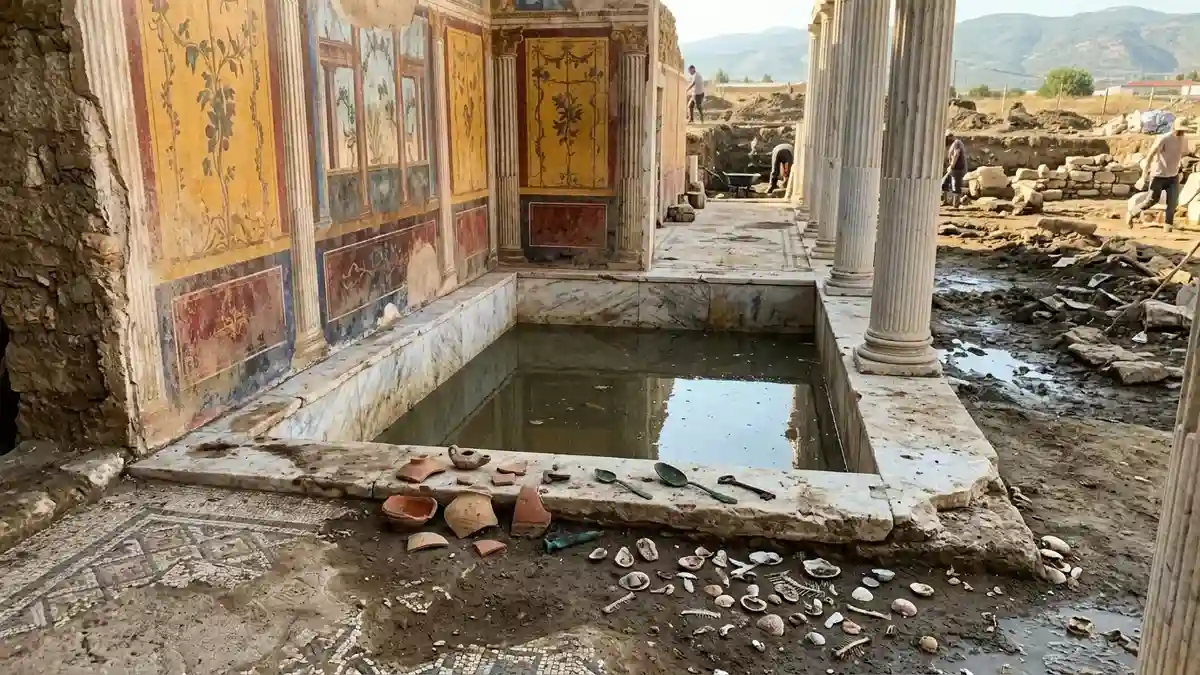
A spectacular archaeological excavation in western Turkey has pulled back the curtain on the extreme opulence enjoyed by the Mediterranean elite during the twilight of the Roman Empire. While investigating the ancient, sun-drenched ruins of Tripolis, researchers uncovered a massive, beautifully preserved residential villa. Dating back approximately 1,600 years, the sprawling estate comes complete with vivid, multi-colored wall paintings and a highly unusual, private marble fish pond.
This dramatic discovery provides an unprecedented look at how wealthy provincial families lived, socialized, and displayed their massive fortunes. The presence of such premium luxury installations in an inland city challenges long-held historical assumptions about the distribution of wealth, trade logistics, and architectural sophistication in late Roman Anatolia.
Luxury Roman Villa Unearths Ancient Elite Secrets for Archaeologists
The Ongoing Excavations at Ancient Tripolis
The uncovering of this ancient estate is the crown jewel of an intensive, 13-year field project at the Tripolis archaeological site, located near the modern town of Denizli. The long-term scientific investigation is spearheaded by Professor Bahadır Duman from Pamukkale University’s Archaeology Department. The dig operates under the ambitious “Heritage for the Future” initiative, a national conservation and research framework funded and managed by Turkey’s Ministry of Culture and Tourism.

[ Geographic & Tactical Setting of Ancient Tripolis ]

              +-------------------------------------+
              |       Büyük Menderes River          |
              |   (Primary Trade & Water Route)     |
              +------------------+------------------+
                                 |
                                 v
              +------------------+------------------+
              |     Inland Trading Hub: Tripolis    |
              |   (High Agricultural & Silk Wealth) |
              +------------------+------------------+
                                 |
                                 v
              +------------------+------------------+
              |   Elite Sector: 1,500 sq m Villa    |
              |  (Frescoes, Fountains, Fish Pond)   |
              +-------------------------------------+
Geographically positioned along the fertile banks of the Büyük Menderes River, Tripolis was a thriving commercial and agricultural hub during the classical period. Thanks to its favorable climate, proximity to water, and position along critical trade routes, it grew into an exceptionally wealthy urban center.
Today, it is widely recognized by historians as one of the best-preserved ancient cities in western Anatolia. Decades of careful mud and debris removal have left its street grids, public arenas, and residential sectors remarkably intact, providing a pristine laboratory for studying classical history.
The Massive Scale of the Elite Roman Estate
The newly exposed residential complex is staggering in its proportions, far exceeding the size, layout, and material quality of a standard Roman home from the 4th or 5th century CE. Sprawling across roughly 1,500 square meters (approximately 16,145 square feet), the villa’s floor plan was explicitly engineered for high-society entertaining, political networking, and domestic comfort.

                 [ Conceptual Layout of the 1,500 sq m Villa ]

       +-----------------------------------------------------------+
       |   Room 1   |   Room 2   |       Large Reception Hall 1     |
       +------------+------------+---------------------------------+
       |                         |                                 |
       |  20-Meter Colonnaded    |     40 sq m Marble Fish Pond    |
       |        Gallery          |     (Feasting & Status Symbol)   |
       |                         |                                 |
       +------------+------------+---------------------------------+
       |   Room 3   |   Room 4   |       Large Reception Hall 2     |
       +-----------------------------------------------------------+
       |   Water Systems: 2 Fountains  |  Subterranean Water Cistern|
       +-----------------------------------------------------------+
An architectural audit of the estate revealed a complex network of domestic and public zones:
Living Quarters: Four dedicated residential rooms alongside two massive, high-ceilinged reception halls used for formal banquets and judicial gatherings.
The Grand Promenade: A spectacular, 20-meter-long (65-foot) colonnaded gallery that offered a shaded outdoor walkway where the owner could stroll with guests.
Hydraulic Infrastructure: A sophisticated private water system fed by a large subterranean storage cistern, which pumped pressurized water directly into two highly decorative courtyard fountains.

Botanical Frescoes and Artistic Traditions
Every single vertical surface inside the villa’s reception halls and private rooms was treated as a canvas. The walls are entirely covered in vibrant, multi-layered frescoes that have retained their rich pigment for sixteen centuries.
The ancient painters utilized a sophisticated palette dominated by deep ochre yellows, vivid blues, rich iron reds, and earthy browns. Rather than depicting mythological battles or imperial portraits, the artwork across this villa focuses heavily on botanical and intricate architectural themes.
Rows of stylized vines, repeating floral patterns, and painted faux-marble pillars line the walls, creating an illusion of open-air gardens and grand structural depth. These paintings provide modern art historians with invaluable data regarding the evolutionary trajectory of late Roman provincial art, showcasing how regional workshops adapted classical Roman design traditions into their own distinct aesthetics.
The Inland Fish Pond: A Rare Status Symbol
While the villa’s immense size and beautiful frescoes confirm the owner’s elite status, it is the 40-square-meter (430-square-foot) marble-lined fish pond that has truly captivated the global archaeological community.
               [ The Social Role of the Elite Piscina ]

    +---------------------------------+  +---------------------------------+
    |        Logistical Wealth        |  |        Political Power          |
    | Fresh seafood transported from  |  | Serving live-harvested seafood  |
    | coastal networks to an inland   |  | at inland banquets stunned and  |
    | estate via specialized transit. |  | impressed local rivals.         |
    +---------------------------------+  +---------------------------------+
In the ancient Roman world, private fish ponds—known as piscinae—were the ultimate luxury flex. While coastal aristocrats regularly built these installations along the Mediterranean shore to farm seafood, finding an operational, marble-lined fish pond this far inland in Anatolia is extraordinarily rare.
Fresh Seafood as a High-Society Flex
Archaeologists discovered large deposits of marine shells scattered around the immediate vicinity of the pond structure, validating the theory that this was a functional aquaculture pool. The wealthy homeowner did not simply use the pond for visual relaxation; it was a living larder.
Live fish and marine delicacies were transported from coastal networks via specialized, water-filled transit systems and kept alive in this marble pool. During lavish dinner parties, guests could watch their dinner being pulled fresh from the water—an unimaginable display of wealth in a city located miles away from the open sea. Utilizing a pool for live food storage required tremendous financial capital to construct and maintain, making it a loud statement of political influence, sophistication, and logistical power.
A Growing Treasury of Anatolian History
This lavish residential estate is just the latest in a long series of monumental discoveries made by Professor Duman’s team at Tripolis. Over more than a decade of careful digging, the “Heritage for the Future” project has systematically exposed an entire urban ecosystem that highlights the city’s continuous prosperity across the centuries.
Previous excavation seasons have successfully brought to light a beautifully preserved, 1,500-year-old early Christian church, an older 2,000-year-old villa floors covered in intricate geometric mosaics, massive Roman imperial grain depots, industrial manufacturing workshops, and extensive public bathhouses. This newly discovered villa fits perfectly into this rich historical puzzle, providing critical domestic context to the grand civic structures that defined life in ancient western Turkey.
Frequently Asked Questions
Where was this luxury Roman villa discovered?
The villa was discovered during ongoing excavations in the ancient city of Tripolis, located near the modern town of Denizli in western Turkey. The ruins are situated near the fertile Büyük Menderes River.
How old is the villa, and who lived there?
The estate is approximately 1,600 years old, dating back to the late Roman period. Because of its massive size, expensive decorations, and rare architectural features, archaeologists are certain it belonged to an ultra-wealthy elite family or a powerful political figure.
What makes the wall paintings in the villa special?
The villa’s walls are completely covered in well-preserved frescoes featuring vibrant yellows, blues, reds, and browns. The artwork utilizes detailed botanical and architectural themes, offering deep insights into late Roman artistic styles.
Why is the private marble fish pond such a significant find?
Private fish ponds (piscinae) were highly expensive status symbols. Finding a large, 40-square-meter marble fish pond this far inland is incredibly rare. It shows that the owner had the wealth and trade connections to transport and keep marine fish alive far from the coast to impress guests at banquets.
What other major discoveries have been made at Tripolis?
Over 13 years of digging, archaeologists have uncovered an ancient 1,500-year-old church, an older mosaic-covered villa, massive Roman grain storage facilities, industrial craft workshops, and large public buildings.