
Table of Contents
- 1. The “Archaeological Unconscious” and Erasing Later History
- 2. Life Among the Ashes: How Survivors Transformed the Ruins
- 2.1. Architectural MacGyvering in a Disaster Zone
- 3. The Two Distinct Timelines of Pompeii’s Resurrection
- 3.1. The Early Roman Return (Late 1st to Early 3rd Century CE)
- 3.2. The Late Antique and Christian Wave (4th to Mid-5th Century CE)
- 4. The Final Blow: The Eruption of 472 CE
- 5. Conclusion
- 6. Frequently Asked Questions
- 6.1. 1. Did anyone survive the famous 79 CE eruption of Mount Vesuvius?
- 6.2. 2. Why did people choose to move back to a disaster zone like Pompeii?
- 6.3. 3. How did post-eruption residents change the buildings of Pompeii?
- 6.4. 4. What is the historical significance of the Chi-Rho oil lamps found at the site?
- 6.5. 5. When was Pompeii permanently and completely abandoned?
Archaeologists Confirm Pompeii Survived For Centuries After Eruption
For generations, the tragic story of Pompeii has been taught as a definitive, instantaneous end. The popular narrative suggests that when Mount Vesuvius violently erupted in 79 CE, burying the Roman resort city under a thick blanket of volcanic ash and pumice, time completely stopped. Pompeii became a legendary time capsule—a city frozen in its tracks, completely abandoned by humanity until modern excavators uncovered its pristine ruins.
However, groundbreaking new evidence is fundamentally turning this one-dimensional historical narrative on its head. Recent stratigraphic excavations have confirmed that Pompeii did not vanish from the human story after the volcanic cataclysm. Instead, the ruined city became a site of gritty resilience, adaptation, and survival, playing host to multiple waves of reoccupation that lasted for centuries after the disaster. While the settlement never fully regained its former imperial splendor, its story is far more complex than a simple tale of sudden destruction.
Archaeologists Confirm Pompeii Survived For Centuries After Eruption
The “Archaeological Unconscious” and Erasing Later History
The reason this post-eruption chapter of Pompeii went unnoticed for so long stems from the history of archaeology itself. When early excavators began clearing the site centuries ago, they were driven by a singular, hyper-focused obsession: to expose the dramatic, tragic reality of the 79 CE disaster.
In their rush to reveal the famous frescos, grand villas, and haunting plaster casts of victims at the exact moment of their deaths, early teams routinely stripped away upper layers of soil and debris. Gabriel Zuchtriegel, the current director of the Pompeii Archaeological Park, refers to this systemic oversight as an “archaeological unconscious.” By prioritizing a single, momentous historical event, generations of researchers inadvertently made post-eruption Pompeii invisible, discarding invaluable evidence of later human habitation.
A modern shift toward meticulous, layer-by-layer stratigraphic excavation has finally allowed these forgotten centuries to emerge. The latest discoveries come directly from the Insula Meridionalis, a prominent southern quarter of the city that stretches from the Villa Imperiale to the Quadriportico dei Teatri. While parts of this sector were stabilized during the “Great Pompeii Project” between 2012 and 2023, ongoing conservation and safety works have opened up pristine subterranean layers, revealing that life stubbornly found a way back into the shadow of Vesuvius.
Life Among the Ashes: How Survivors Transformed the Ruins
Prior to the disaster, Pompeii was a wealthy, bustling municipality home to roughly 20,000 residents. Experts estimate that between 15% and 20% of the population perished during the eruption, largely due to thermal shock from rapid pyroclastic surges. The thousands of citizens who managed to escape fled into a chaotic, altered landscape.
For many displaced survivors, starting over in a foreign Roman territory proved impossible. Drawn back by family roots, a lack of options, or the sheer economic opportunity hidden beneath the debris, these individuals returned to the ruined landscape. They were quickly joined by newcomers—primarily lower-class citizens, freedmen, and opportunistic scavengers—who realized that a half-buried city was prime real estate for those bold enough to claim it.
Architectural MacGyvering in a Disaster Zone
The newly uncovered structural remains show how creatively these later inhabitants modified the ruined architecture to fit a gritty, subsistence economy:
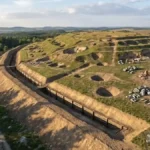
Upper-Floor Living: Because the lower floors of homes were completely choked with hardened ash and pumice, returning residents moved directly into the upper stories of structures that still jutted out above the volcanic layer.
Repurposed Basements: What were once ground-floor rooms and entryways were cleared out just enough to be repurposed as subterranean cellars and cold storage units.
Subdivided Warehouses: The massive, vaulted spaces of the city’s earlier horrea (commercial warehouses) were divided by crude interior walls into small, multi-family apartments.
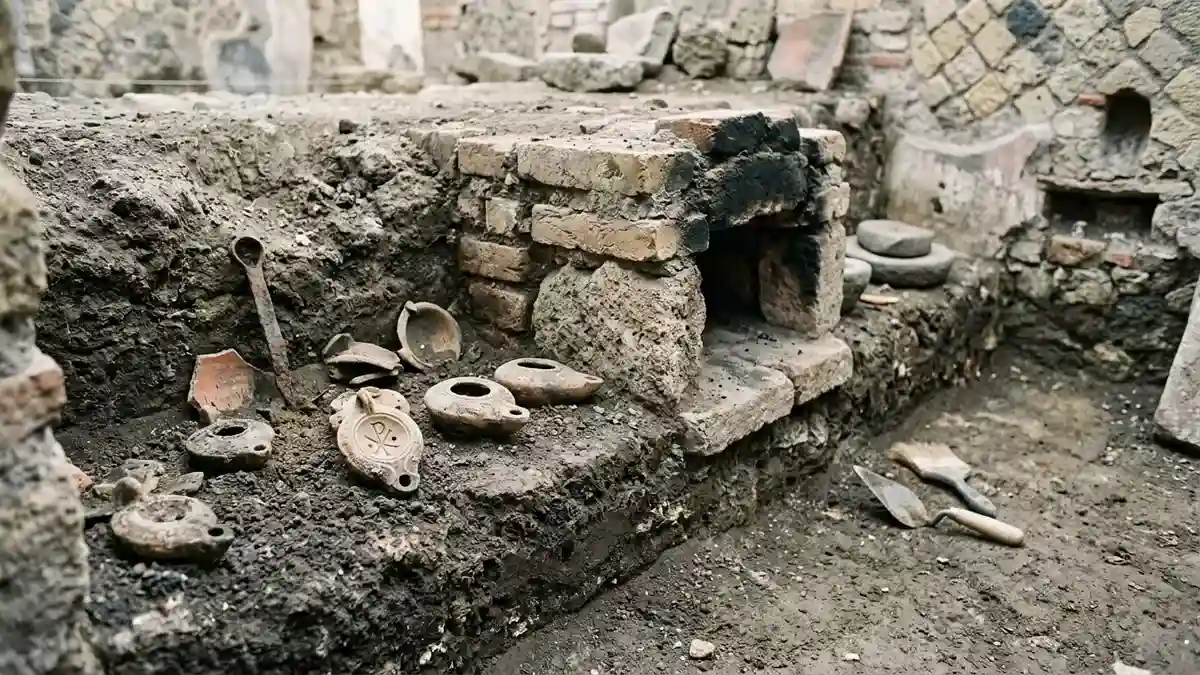
Cistern Forges and Bakeries: In a striking display of adaptive reuse, later residents built functional bread-baking ovens and set up millstones inside old, drained water cisterns, such as those found inside the ruined House of the Geometric Mosaics.
The Two Distinct Timelines of Pompeii’s Resurrection
The artifacts recovered from the Insula Meridionalis prove that this resettlement wasn’t a brief, disorganized camping trip. Analysis of pottery styles, recovered tools, and currency point to two major, organized phases of post-eruption reoccupation.
The Early Roman Return (Late 1st to Early 3rd Century CE)
The initial wave of reoccupation began remarkably soon after the volcanic ash cooled. Historical records from ancient authors, including Suetonius and Cassius Dio, confirm that the Roman government attempted to provide organized disaster relief. Emperor Titus personally commissioned two former consuls to oversee safety efforts and jumpstart reconstruction initiatives in the region. These early operations were financed using imperial funds pulled from the estates of local victims who died without leaving legal heirs.
Despite this top-down imperial backing, Pompeii never managed to rebuild its grand public infrastructure, sprawling bathhouses, or monumental temples. Instead, it functioned as a rough-and-tumble industrial outpost. People scavenged the buried villas for valuable marble, lead piping, and bronze statues to resell, while setting up localized agricultural operations in the newly fertilized volcanic soil. A poignant reminder of daily family life during this era was uncovered by modern teams: the formal burial of a newborn baby, dated securely between 100 and 200 CE, proving that families were actively nesting and mourning within the ruins.
The Late Antique and Christian Wave (4th to Mid-5th Century CE)
After a lull in activity, a distinct second wave of settlers established roots in Pompeii during the late imperial period. The most striking evidence of this late antique occupation is the discovery of fifth-century ceramic oil lamps stamped clearly with the Chi-Rho monogram—a prominent early Christian symbol combining the first two Greek letters of Christ’s name.
[79 CE Eruption] ➔ [1st-3rd C. Industrial Scavenging] ➔ [4th-5th C. Christian Community] ➔ [472 CE Final Flight]
The presence of these lamps demonstrates that by the fifth century, the residents living in the modified ruins of Pompeii were no longer practicing traditional Roman paganism; they were part of the rapidly growing Christian world. This community continued to farm, trade, and survive among the historic ruins for several generations, entirely altering the cultural fabric of the old pagan resort city.
The Final Blow: The Eruption of 472 CE
This long, unwritten chapter of human resilience finally reached its definitive conclusion in the latter half of the fifth century. Around 472 CE—ironically, just a few years before the formal collapse of the Western Roman Empire—Mount Vesuvius suffered another major, violent eruption.
While not as globally famous as the 79 CE disaster, this late-fifth-century event showered the remaining settlements with a fresh layer of volcanic debris, rendering the hard-fought agricultural plots and modified villas completely unusable. Exhausted by the recurring volcanic threat and facing a collapsing imperial economy, the final residents permanently walked away from the site, allowing the wilderness to reclaim the ruins.
Conclusion
Today, approximately one-third of Pompeii’s 22-hectare urban footprint remains completely undisturbed and buried underground, protected as a UNESCO World Heritage site for future generations of archaeologists. The latest discoveries from the Insula Meridionalis have added a vital, missing chapter to global history books. Pompeii is no longer just a grim monument to sudden death; it is a profound testament to human resilience, showing that even after a catastrophic disaster, the human spirit has an enduring drive to rebuild, adapt, and survive amid the ruins.
Frequently Asked Questions
1. Did anyone survive the famous 79 CE eruption of Mount Vesuvius?
Yes, a significant majority of Pompeii’s population survived. Out of an estimated 20,000 residents, archaeologists calculate that roughly 15% to 20% perished, primarily from the intense thermal shock of pyroclastic surges. The thousands who escaped fled southward toward neighboring coastal towns or eventually returned to the site.
2. Why did people choose to move back to a disaster zone like Pompeii?
Many survivors were low-income citizens, freed laborers, or local business owners who had lost everything and lacked the resources to build a new life in other expensive Roman cities. Additionally, the half-buried ruins offered a wealth of free building materials, abandoned property to claim, and incredibly fertile volcanic soil perfect for agricultural production.
3. How did post-eruption residents change the buildings of Pompeii?
Because the lower levels of most villas were completely packed with hardened ash, residents adapted by building staircases to access upper-story windows and turning the exposed top floors into living quarters. They also divided large public warehouses into smaller apartments and built industrial baking ovens directly inside old water cisterns.
4. What is the historical significance of the Chi-Rho oil lamps found at the site?
The Chi-Rho monogram is a prominent early Christian symbol. Finding fifth-century oil lamps bearing this mark proves that Pompeii was inhabited well into the Late Antique period, demonstrating that the community living within the ruins had transitioned from traditional Roman pagan worship to early Christianity.
5. When was Pompeii permanently and completely abandoned?
Pompeii was finally abandoned following another significant eruption of Mount Vesuvius in 472 CE. This secondary natural disaster, combined with the widespread economic and political chaos surrounding the imminent fall of the Western Roman Empire, forced the last remaining farmers and scavengers to leave the site forever.