
Table of Contents
- 1. Unearthing a Imperial-Era Warrior Burial
- 2. The Ceramic Cache: Uncovering 11th-Century Wealth
- 3. The July Breakthrough: The Gothic Gold Torc
- 3.1. A Heavyweight Masterpiece of Ancient Gold
- 3.2. A First-of-Its-Kind Discovery for Poland
- 4. Preserving Poland’s Hidden Heritage
- 5. Frequently Asked Questions
- 5.1. 1. What are the most important items found in the Grodziec Forest?
- 5.2. 2. Who were the Goths and what was their connection to Poland?
- 5.3. 3. What is a gold torc and how was it used?
- 5.4. 4. Why was the gold necklace folded up inside a ceramic pot?
- 5.5. 5. Where can the public see these newly discovered treasures?
Rare Gothic Gold Necklace and Hidden Coin Hoards Discovered in Poland
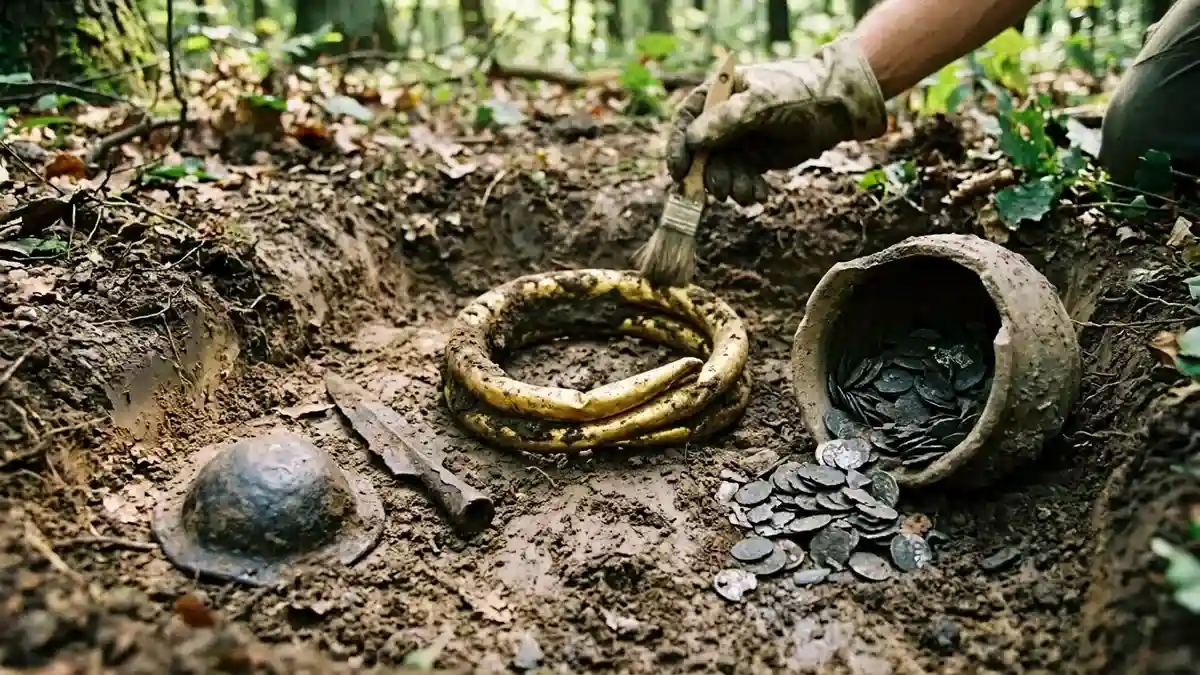
Deep beneath the quiet, leaf-covered floor of the Grodziec Forest District near Kalisz, Poland, a series of remarkable historical secrets have finally come to light. Over a historic five-week span this summer, a team of amateur metal detectorists struck literal and metaphorical gold. Working in close coordination with regional environmental protection officials, the independent researchers brought to the surface an array of stunning artifacts that span centuries of human conflict, trade, and migration.
From the resting place of an ancient imperial-era combatant to massive buried jars packed with medieval silver currency, the summer excavations yielded a treasure trove of historical data. The crown jewel of the entire season emerged in mid-July: a heavy, intact, fifth-century Gothic gold neck-ring. This spectacular artifact not only represents a premier archaeological find for Central Europe but also rewrites our understanding of ancient migration patterns across modern-day Poland.
Rare Gothic Gold Necklace and Hidden Coin Hoards Discovered in Poland
Unearthing a Imperial-Era Warrior Burial
The highly successful exploration campaign kicked off in early June when members of the Denar Kalisz Association chanced upon a ancient cemetery dating back to the height of the Roman period. The burial site has been officially linked to the Przeworsk culture—an ancient society that thrived in what is now central and southern Poland from the third century BCE down to the fifth century CE.
[Przeworsk Culture Warrior Grave]
   ├── Central Component: Skeletal remains of a male combatant
   ├── Offensive Weaponry: Intact iron spearhead
   └── Defensive Equipment: Heavy metal shield boss (umbro)
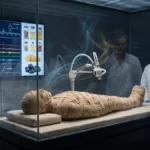
Inside one of the primary graves, researchers uncovered the skeletal remains of a prominent warrior. He had been laid to rest alongside his essential battlefield gear, including a preserved iron spearhead and a heavy circular shield boss—the central metal dome of a wooden shield designed to deflect incoming blows. The presence of these specific items highlights the deeply ingrained martial traditions and warrior ethos that governed provincial societies operating along the outer frontiers of the Roman Empire.
The Ceramic Cache: Uncovering 11th-Century Wealth
Just days after mapping out the imperial-era burial site, the search group’s metal detectors signaled another major find nearby. It began with the discovery of a loose, stray eleventh-century silver coin lying near the surface soil. Recognizing that individual coins often act as markers for larger intentional deposits, the team focused their efforts on the immediate area.
Their instincts paid off when they uncovered a small, striated ceramic vessel buried deep in the forest clay. The sealed container was carefully extracted and transported to the laboratory facilities at the University of Science in Kalisz for professional examination.
Upon opening the ancient jar, university experts uncovered a massive hoard of 631 individual silver coins and fragmented pieces of currency. The sheer volume of the cache suggests it was a hidden family fortune or a merchant’s emergency savings, intentionally buried during a period of intense civil unrest or military invasion.
The momentum continued through the end of June when the group hit another major jackpot: a second ceramic pot, similarly crammed to the brim with ancient coins. These back-to-back currency discoveries provide invaluable economic data for historians, offering a clear window into the trade volume, monetary circulation, and localized wealth accumulation that characterized medieval Poland.
The July Breakthrough: The Gothic Gold Torc
While the silver coin hoards were enough to secure a historic season, the biggest story of the summer broke on July 12. While scanning a new sector of the Grodziec Forest, explorer Mateusz Lachowicz uncovered a heavy, metallic object caked in dirt. Initially, the item appeared to be nothing more than a fragment of an old brass or copper bracelet.

However, once the object was cleaned and subjected to professional non-destructive X-ray fluorescence analysis, the true nature of the artifact left the entire regional archaeological community stunned.
A Heavyweight Masterpiece of Ancient Gold
The item was identified as a complete, massive gold torc—a rigid, semi-flexible neck-ring—dating precisely to the fifth century CE. To make the valuable piece of jewelry fit inside the ceramic pot where it was deposited, its ancient owner had carefully bent and folded the metal loops.
| Attribute | Measurement / Detail |
| Material Composition | High-purity, near-solid gold |
| Total Physical Weight | 222 grams (nearly 8 ounces) |
| Fastening Mechanism | Primitive hook-and-loop closure |
| Inscriptions / Markings | Completely plain; no apparent runic writing |
This remarkable piece of jewelry is directly tied to the Gothic culture, a prominent confederation of Germanic tribes who played a monumental role in Western history. During the Migration Period—a turbulent era of widespread human movement that reshaped Europe as the Western Roman Empire collapsed—various Gothic sub-groups established deep roots across modern-day Poland. While the Goths had previously settled heavily in the Lower Vistula region, including the Tuchola Forest and the Krajna territory, this new find confirms their elite members were moving through and interacting with early Slavic cultures further south.
A First-of-Its-Kind Discovery for Poland
While similar gold torcs have occasionally been unearthed across Scandinavia—frequently featuring elaborate runic inscriptions carved into the metal terminals—this is the first intact Gothic gold neck-ring of this specific style ever pulled from the ground in Poland. The lack of text or decorative markings indicates it may have been produced in a specialized regional workshop, serving as a raw store of immense wealth or an badge of elite social status worn by a high-ranking chieftain.
Preserving Poland’s Hidden Heritage
The successful recovery of these artifacts highlights the immense value of structured cooperation between passionate amateur historical groups and state regulatory agencies. Rather than keeping their discoveries private, the Denar Kalisz Association worked hand-in-hand with the Voivodeship Office of Environmental Protection to ensure every item was precisely mapped, carefully excavated, and properly documented using modern scientific standards.
Following extensive conservation work and study by academic specialists, the fifth-century gold necklace and the massive coin hoards will be officially transferred to the Kalisz Regional Museum. There, they will be placed on permanent public display, allowing visitors to connect directly with the complex, multi-layered history that quietly waits beneath the European forest floor.
Frequently Asked Questions
1. What are the most important items found in the Grodziec Forest?
The summer excavations yielded three major discoveries: a Roman-era warrior grave belonging to the Przeworsk culture containing a spearhead and shield boss; two separate medieval ceramic vessels containing over 631 silver coins and fragments from the eleventh century; and an incredibly rare, 222-gram Gothic gold neck-ring (torc) dating to the fifth century CE.
2. Who were the Goths and what was their connection to Poland?
The Goths were an ancient Germanic people who migrated from Scandinavia down into parts of modern-day Poland, particularly along the Vistula River, during the early centuries CE. During the Migration Period, they interacted extensively with local Slavic populations and Roman frontier outposts as they moved across Central Europe, eventually splitting into the Visigoths and Ostrogoths.
3. What is a gold torc and how was it used?
A torc (or torque) is a large, rigid neck-ring made from twisted or solid metal, typically crafted from bronze, silver, or gold. In ancient European cultures, including the Celts and Germanic Goths, these neck-rings were far more than simple jewelry; they served as prominent symbols of elite military rank, immense personal wealth, and high social status.
4. Why was the gold necklace folded up inside a ceramic pot?
Archaeologists discovered that the gold torc had been intentionally bent and folded over on itself. This was a common practice in antiquity when hiding valuables. The owner likely folded the rigid necklace to make it compact enough to fit inside a standard ceramic storage jar before burying it underground to protect it from thieves or invading forces.
5. Where can the public see these newly discovered treasures?
Once the ongoing preservation, cleaning, and scientific documentation processes are completed by university historians and conservation experts, the Gothic gold necklace, the warrior weapons, and the medieval silver coins will be moved to the Kalisz Regional Museum for permanent public exhibition.