
Table of Contents
- 1. From Student Rumors to Historical Discovery
- 2. Unearthing a Luxurious Imperial Domus
- 2.1. A Prime Real Estate District of Ancient Rome
- 2.2. Connecting the Dots to the Umbrius Family
- 3. Breathtaking Artistry Preserved for Two Millennia
- 3.1. Masterful Frescoes and Stucco Work
- 3.2. Opulent Mosaic Flooring
- 4. A Layered History: Century-Old Student Graffiti
- 5. The Future of the Liceo Cavour Excavation
- 5.1. Expanding the Archaeological Scope
- 5.2. Conservation and Digital Transformation
- 6. Integrating Antiquity into Modern Education
- 7. Frequently Asked Questions
- 7.1. How old is the Roman villa found under the high school?
- 7.2. Who owned this ancient Roman residence?
- 7.3. What kind of artifacts and art were discovered inside the villa?
- 7.4. Can tourists visit the underground Roman villa right now?
- 7.5. What role did the high school students play in this discovery?
Roman Villa Found Under High School Gym Stuns Archaeologists
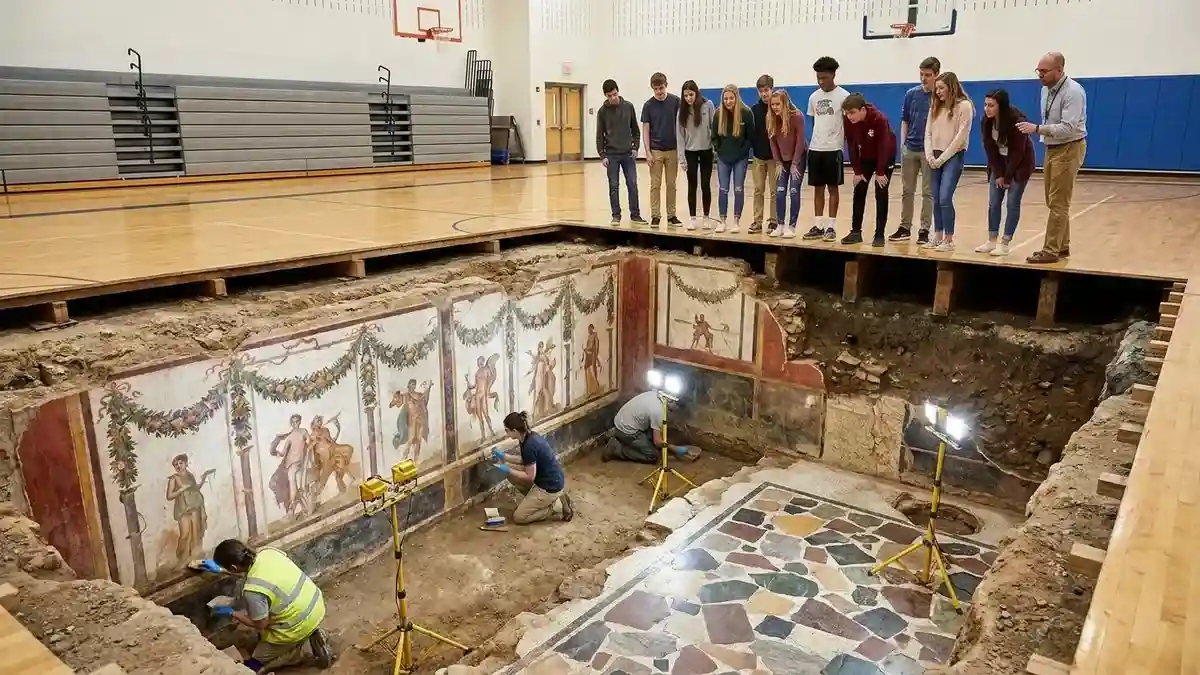
For decades, students at a high school near Rome’s famous Colosseum shared rumors about secret underground chambers hidden beneath their gymnasium. What many dismissed as campus folklore has now been confirmed as an extraordinary archaeological reality. Recent excavations have unveiled a remarkably well-preserved Roman villa dating back to the mid-second century CE, buried directly under the school’s floorboards.
This incredible discovery bridges antiquity and modern education, offering a rare glimpse into the luxurious lifestyle of Rome’s imperial elite. Here is the full story behind the historic excavation beneath the Liceo Scientifico Cavour and what it means for our understanding of the ancient city.
Roman Villa Found Under High School Gym Stuns Archaeologists
From Student Rumors to Historical Discovery
The breakthrough occurred at the Liceo Scientifico Cavour, a high school housed in a historic building that formerly served as a Catholic missionary center. Driven by curiosity, several students managed to access sealed underground passages beneath their campus. Inside, they navigated a labyrinth of ancient chambers and corridors.

Recognizing the potential significance of their find, the students informed Claudia Marino, their history and Latin teacher. Marino immediately contacted Rome’s archaeological authorities to report the underground structures. Official excavations commenced in January 2026, culminating in a public presentation of the stunning results in May of the same year.
Unearthing a Luxurious Imperial Domus
Archaeologists quickly determined that the subterranean structures were not mere storage cellars but part of a massive domus—a grand, luxurious private residence belonging to wealthy Roman citizens during the imperial era.
A Prime Real Estate District of Ancient Rome
The villa sits in a highly prestigious location between the Carinae and the Esquiline Hill. During the Roman Republic and early Empire, this neighborhood was the Beverly Hills of its day. Historic figures who shaped Western civilization lived in this immediate area, including:
Cicero: The legendary orator and statesman.
Pompey the Great: The renowned general and political rival of Julius Caesar.
Octavian (Emperor Augustus): The first official Emperor of the Roman Empire.
Despite its immense historical importance, modern construction has heavily altered and built over the ancient landscape. Consequently, archaeologists have historically known very little about the specific layout of this district, making the Liceo Cavour discovery a monumental win for Roman topography studies.
Connecting the Dots to the Umbrius Family
This was not the very first time the site had teased researchers. Parts of the grand residence originally came to light in 1895 during civic engineering works connected to the opening of the Via degli Annibaldi. During those late 19th-century excavations, workers uncovered fragments of the building alongside a lead water pipe.
Crucially, that ancient pipe bore an inscription featuring the name of a member of the Umbrius family. Based on this historical marker, contemporary researchers believe the newly excavated villa belonged to this aristocratic lineage. While surviving historical texts offer scarce details about the Umbrii, scholars suggest the family originally hailed from Samnium, a rugged mountainous region in south-central Italy.
Breathtaking Artistry Preserved for Two Millennia
Because the newly excavated rooms remained completely buried for nearly their full height, they were shielded from the destructive elements of time, weather, and human interference. This natural sealing helped preserve their interior decorations in an astonishingly pristine state.
Masterful Frescoes and Stucco Work
As archaeologists cleared away centuries of earth, they exposed vibrant painted walls featuring intricate figurative scenes, delicate floral frescoes, and highly elaborate stucco reliefs. These artistic details extend all the way up to the vaulted ceilings of the chambers, showcasing the immense wealth and refined taste of the property owners.
Opulent Mosaic Flooring
In addition to the wall art, one of the primary rooms features a spectacular mosaic floor constructed from large, irregular pieces of colored stone. This specific architectural style was a hallmark of elite Roman households during the second century CE, serving as a status symbol to impress visiting guests.
A Layered History: Century-Old Student Graffiti
Interestingly, ancient Romans were not the only ones to leave their mark on the site. The villa also preserves a fascinating record of more recent human exploration.
Scattered across some of the ancient surfaces is graffiti left behind by students, adventurous tourists, and urban explorers who snuck into the caverns during the twentieth century. Rather than viewing this as vandalism, historians see it as a valuable chronological layer that chronicles the building’s modern folklore alongside its ancient origins.
The Future of the Liceo Cavour Excavation
The discovery made in early 2026 is only the beginning. To date, only a fraction of the sprawling residential complex has been thoroughly examined.
Expanding the Archaeological Scope
Project researchers strongly believe that the villa extends far beyond the gymnasium, stretching beneath additional wings of the active high school campus. Because the decorative elements are in such an exceptional state of preservation, continuing the excavation has become a top priority for Italian cultural heritage authorities. Future phases of the project will focus on carefully removing the remaining soil and fill from adjacent rooms to reveal the complete, uninterrupted decorative program.
Conservation and Digital Transformation
A comprehensive conservation effort is currently underway to protect this newly exposed treasure. The multidisciplinary project includes:
Structural Stabilization: Ensuring the safety of both the ancient ruins and the modern school building above.
Surface Restoration: Cleaning and preserving the fragile painted frescoes and stuccoes.
Diagnostic Studies: Analyzing the materials to understand ancient construction techniques.
Comprehensive Documentation: Mapping the entire site using advanced 3D scanning technology.
Integrating Antiquity into Modern Education
Looking ahead, school officials and archaeological authorities are working hand-in-hand to ensure the site is safely modified for public access. The ultimate goal is to open the underground villa to tourists and history enthusiasts through a blend of physical walkways and cutting-edge digital interpretation tools, such as augmented reality.
In a beautiful closing of the circle, students at Liceo Scientifico Cavour are expected to play an active, hands-on role in presenting the history of the villa to visitors. This initiative will directly connect modern Italian teenagers with the living history beneath their feet, keeping the stories of a 1,900-year-old imperial neighborhood alive for generations to come.
Frequently Asked Questions
How old is the Roman villa found under the high school?
The villa dates back to the mid-second century CE, making the structure nearly 1,900 years old. It was built during the height of the Roman Imperial period.
Who owned this ancient Roman residence?
Based on a lead water pipe inscription discovered nearby in 1895, archaeologists believe the home belonged to the wealthy Umbrius family, who are thought to have originated from the Samnium region of Italy.
What kind of artifacts and art were discovered inside the villa?
The excavation revealed exceptionally well-preserved vaulted chambers featuring colorful floral frescoes, figurative painted scenes, intricate stucco work, and a classic second-century mosaic floor made of large, irregular stone pieces.
Can tourists visit the underground Roman villa right now?
Currently, the site is undergoing active excavation, structural stabilization, and conservation, so it is closed to the general public. However, future plans include opening the site to visitors using both physical paths and digital tools.
What role did the high school students play in this discovery?
Students at Liceo Scientifico Cavour investigated long-standing school rumors about hidden underground passages. After exploring the chambers, they reported their findings to their history and Latin teacher, which officially prompted the professional archaeological excavation.