
4,000-Year-Old Farmstead Found in England’s Cheviot Hills
Archaeologists have unearthed a remarkably well-preserved Bronze Age hilltop settlement at Harden Quarry in the Cheviot Hills of Northumberland, England. Located within the scenic bounds of Northumberland National Park, this discovery provides a rare, comprehensive look at early agricultural life in the British uplands. The findings, which date back to approximately 2400 BCE, are challenging long-held assumptions about when and how prehistoric communities occupied and farmed these challenging, high-altitude landscapes.
4,000-Year-Old Farmstead Found in England’s Cheviot Hills
A Rare Glimpse into Bronze Age Daily Life
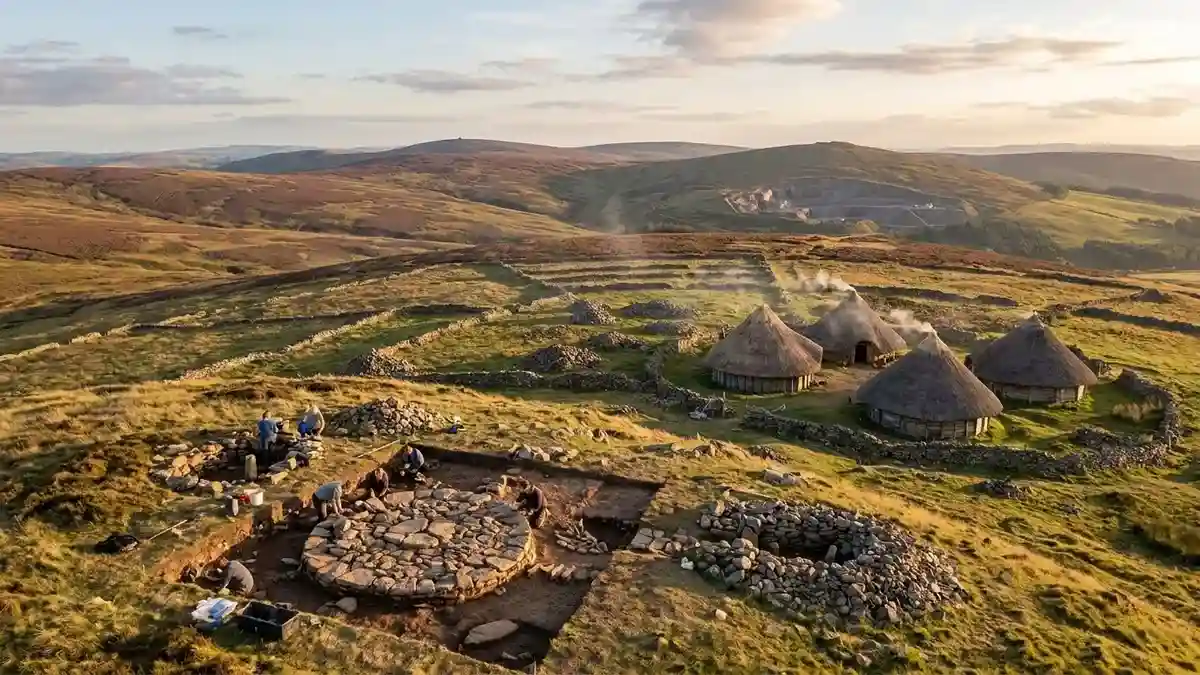
The excavation, conducted by Archaeological Research Services Ltd ahead of a planned quarry extension, revealed a landscape that once hummed with human activity. Field teams identified a series of circular platforms—the tell-tale remnants of timber roundhouses that served as the domestic heart of the settlement.
Beyond the living quarters, the site provided clear evidence of intensive land management. Archaeologists documented sophisticated early field systems and numerous “clearance cairns”—piles of stone removed by farmers to cultivate the soil. These features are significant because they indicate that the inhabitants were not merely seasonal visitors or nomadic grazers, but a settled community that invested significant labor into permanent agricultural infrastructure.

Pushing Back the Timeline of Upland Farming
One of the most exciting aspects of the Harden Quarry discovery is the chronological data. Radiocarbon dating has placed the peak of the site’s activity around 2400 BCE, near the very beginning of the British Bronze Age.
Previously, many archaeological models suggested that intensive agriculture in such high, exposed terrain was a feature of much later periods. By proving that sustained, organized farming was taking place in the Cheviot Hills as early as 2400 BCE, this site effectively rewrites the history of upland colonization in northern England, showing that Bronze Age farmers were far more capable and established in these environments than previously believed.
Rituals and Burials: The Sanctity of the Hilltop
The settlement was not just a place of labor; it was also a place of ancestral reverence. The team uncovered three distinct burial cairns on the hilltop, revealing a complex sequence of funerary practices:

Stone-Lined Graves: The excavation revealed early monuments containing cists—stone-lined graves used for formal burials.
Cremation Deposits: A later phase of the site included the interment of cremated human remains, some of which were placed in ceramic urns, while others were deposited in small pits nearby.
Beaker Culture Connections: The discovery of fragments from a “Beaker” style pot provides a crucial cultural link. Beaker pottery is famously associated with the arrival of new social customs, metalworking, and agricultural techniques that spread across Britain during the early Bronze Age, further confirming the site’s importance during this transformative era.

Why Harden Quarry Is an Archaeological Milestone
The level of preservation at Harden Quarry is described by experts as exceptional for an upland site. Usually, environmental factors and centuries of erosion leave only fragmented evidence. At this location, researchers found a complete “package” of human existence: the homes where they lived, the fields they tilled, the stones they cleared, and the monuments where they honored their dead.
Clive Waddington of Archaeological Research Services Ltd noted that the site offers a near-complete picture of a Bronze Age community. Having all these elements in a single, undisturbed landscape allows specialists to study the relationship between daily subsistence and ritual behavior, rather than looking at these aspects of ancient life in isolation.
Looking Forward
The excavation at Harden Quarry—a site famous for its unique red felsite stone used in modern construction—has proven that the area’s cultural heritage is just as significant as its natural beauty. While the fieldwork is finished, the project is far from over. Specialists are now conducting detailed laboratory analyses on soil, charcoal, and pottery fragments. These studies will help refine the timeline of the settlement, identify the specific crops being grown, and provide a clearer picture of the environmental conditions that these early farmers faced four millennia ago.
As this data is published, it will serve as a foundational dataset for future research into Britain’s Bronze Age, highlighting the resilience and ingenuity of the early communities that dared to settle the rugged beauty of the Cheviot Hills.
Frequently Asked Questions (FAQ)
1. Where was this Bronze Age site discovered?
The site was discovered at Harden Quarry in the Cheviot Hills, which is located within Northumberland National Park in northern England.
2. How old is the settlement?
Radiocarbon dating places the settlement’s primary activity around 2400 BCE, marking the very beginning of the British Bronze Age.
3. Why is this discovery considered “rare”?
It is rare because of the level of preservation. In upland settings, it is uncommon to find a site where the homes (roundhouse platforms), agricultural systems (field boundaries and clearance cairns), and ritual sites (burial cairns) have all survived together in one landscape.
4. What did archaeologists find in the burial cairns?
The excavations found stone-lined graves (cists) and cremated human remains. Some of these remains were found inside pottery vessels, including one complete food vessel, and others were found in small pits.
5. What does the “Beaker” pottery tell us?
The discovery of Beaker-style pottery links the inhabitants of Harden Quarry to the wider social changes occurring across Britain at the time. This culture is historically associated with the introduction of new metalworking technologies, farming methods, and funerary customs.