
The Dawn of Information: 40,000-Year-Old Signs Reveal Ancient Logic
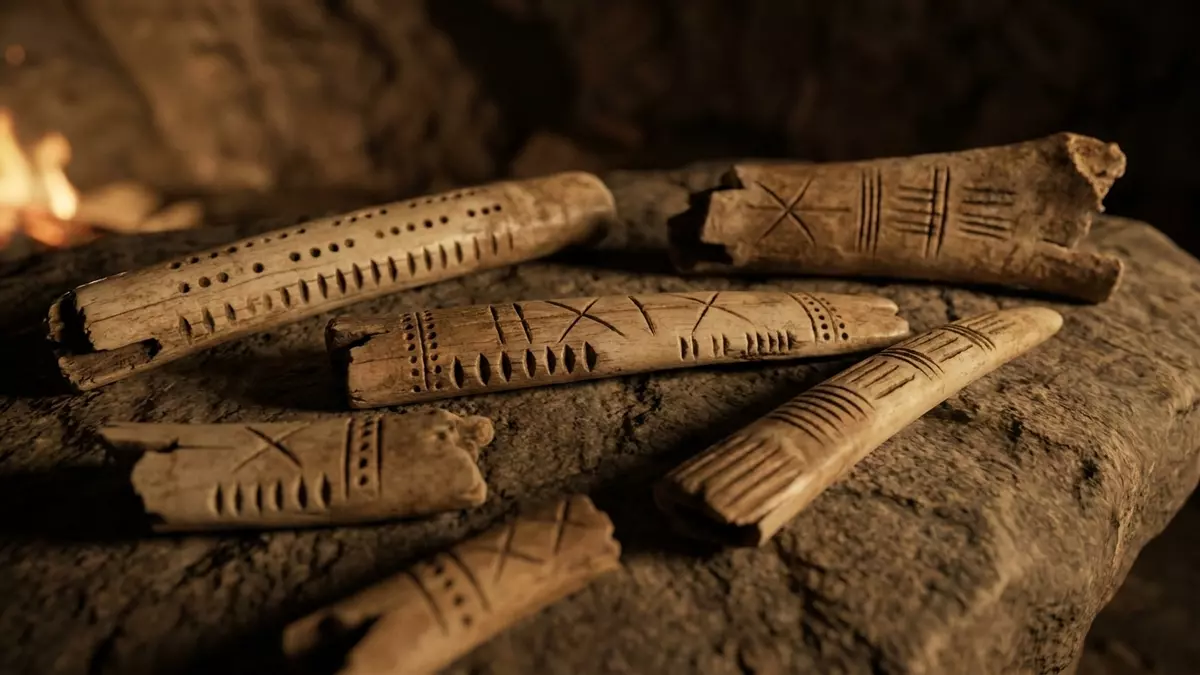
For over a century, archaeologists have puzzled over the thousands of dots, notches, crosses, and lines etched into ivory and bone by the earliest Homo sapiens to arrive in Europe. Were they mere artistic flourishes, random doodles, or something more purposeful? A groundbreaking study published in the Proceedings of the National Academy of Sciences (PNAS) provides a definitive answer: these were not random decorations, but a highly structured, conventional system for encoding information.
The Dawn of Information 40,000-Year-Old Signs Reveal Ancient Logic
Testing the “Random Decoration” Theory
Led by linguist Christian Bentz of Saarland University and archaeologist Ewa Dutkiewicz of Berlin’s Museum für Vor- und Frühgeschichte, the research team analyzed over 3,000 individual engravings on 260 artifacts dating between 34,000 and 45,000 years ago. These artifacts, largely hailing from the caves of the Swabian Jura in southwestern Germany, include iconic pieces like the “Lion Man” of Hohlenstein-Stadel and the delicate, ivory “Adorant” figurine from Geißenklösterle.
To determine if these marks were systematic, the team employed modern statistical modeling and machine learning. They analyzed the “entropy” of the sequences—a measure of how predictable and ordered a set of symbols is. If the marks were purely random, they would show high entropy (unpredictability). If they were a structured code, they would show a measurable, consistent pattern of repetition.

The Results: A “Pre-Writing” Language?
The findings were startling. The statistical structure of these Paleolithic sequences—characterized by repetitive, predictable patterns—closely mirrors the structure of the earliest proto-cuneiform tablets from Mesopotamia, created nearly 40,000 years later.
While the study is careful to note that these signs do not constitute a “spoken language” (they lack the complexity and density of true phonetic writing), they do represent a conventionalized information system.
Low Entropy, High Order: Like early bookkeeping tablets, these engravings rely on the repetition of simple symbols.
A “Geometric Grammar”: The engravers used a consistent set of rules to arrange signs. Whether it was a row of dots or a series of crosses, the sequences were organized, directional, and repeated with purposeful precision.
Technological Stability: For tens of thousands of years, humans used this repetitive style of encoding to organize their world. It was only about 5,000 years ago, with the rise of cities and statehood, that humanity shifted to writing systems that phonetically represented spoken language.

Cognitive Continuity in the Paleolithic
This discovery challenges the notion that sophisticated information management was a byproduct of the agricultural revolution. Instead, it places the origins of “data storage” firmly in the hands of the first modern humans in Europe.

These artifacts were small and portable, designed to be held, carried, and used in everyday life. By recording information through standardized marks, early Homo sapiens were able to coordinate their groups, manage memories, and perhaps even conduct early forms of accounting or ritual tracking that extended far beyond the reach of human speech.
The researchers have purposefully avoided assigning a singular “meaning” to these signs—whether they were hunting tallies, ritual notations, or ownership marks remains a subject of further study. However, the study successfully proves that these marks are the product of a clear, planned, and socially shared logic.
The Deep History of Human Cognition
Writing did not appear as a sudden invention in the Fertile Crescent. Instead, it sits at the end of a long, deep history of human information processing. The inhabitants of the Swabian Jura were cognitively identical to us, possessing the same drive to organize, categorize, and store information outside of their own biological memory.
This study reveals that long before the creation of clay tablets or the establishment of complex bureaucracies, our ancestors were already using simple symbols to build a bridge across time—a way to ensure that what was known in one moment could be understood in the next.
Frequently Asked Questions
Why do researchers think these signs are “structured”?
The study found that the sequences of dots, lines, and crosses were not random. They showed high levels of repetition and predictability (low entropy), which indicates that the makers were following a consistent set of “rules” or a “grammar” when creating them.
Is this the same thing as writing?
No. Writing systems typically represent the sounds of spoken language and have a very high information density. These Paleolithic signs are more like early notation or bookkeeping, where symbols represent concepts rather than speech.
How does this compare to ancient Mesopotamian writing?
Surprisingly, the statistical patterns are very similar. Both the 40,000-year-old signs and the 5,000-year-old proto-cuneiform tablets from Mesopotamia rely on repeating signs in predictable patterns, suggesting a shared approach to encoding information.
What were these objects used for?
We do not know for certain. They could have been hunting tallies, calendars, ritual symbols, or even markers of individual ownership. The study’s main accomplishment was proving that they were intended to be information, rather than just decoration.
Does this discovery change how we view early humans?
Yes. It reinforces the idea that Homo sapiens arrived in Europe with the full suite of modern cognitive abilities. They were already master planners who possessed the technological and mental tools to create shared, conventional systems for managing their world.