
Table of Contents
- 1. Discovering the Industrial Footprint at Søften
- 1.1. The Pit House Phenomena
- 2. From Flax Fields to the Looms: Standardized Assembly Lines
- 2.1. The Processing Steps of Linen Production
- 2.2. The Manager’s Estate
- 3. Feeding the Global Markets of Aros
- 4. Mapping the Greater Aarhus Manufacturing Network
- 5. Conclusion
- 6. Frequently Asked Questions
- 6.1. 1. What exactly was discovered near Aarhus, Denmark?
- 6.2. 2. What is a Viking pit house and why were they used for textiles?
- 6.3. 3. How did the Vikings turn flax plants into linen cloth?
- 6.4. 4. Who managed the large production site at Søften?
- 6.5. 5. Where did all the finished cloth go?
Mass Textile Industrial Zone Discovered Near Viking Trade Hub
The popular image of the Viking Age is often one of small, isolated family farms that produced just enough food and clothing to survive the harsh Scandinavian winters. When mass production is discussed, it is usually associated with weapons or ships. However, a massive archaeological excavation in Denmark is turning these traditional views on their head.
Teams have uncovered the remains of a sprawling, 1,000-year-old industrial manufacturing center dedicated almost entirely to mass textile production. Operating on a scale that went far beyond local needs, this highly structured settlement functioned as a dedicated supplier of linen, cloth, and other commercial goods for one of Northern Europe’s primary Viking trade hubs.
Mass Textile Industrial Zone Discovered Near Viking Trade Hub
Discovering the Industrial Footprint at Søften
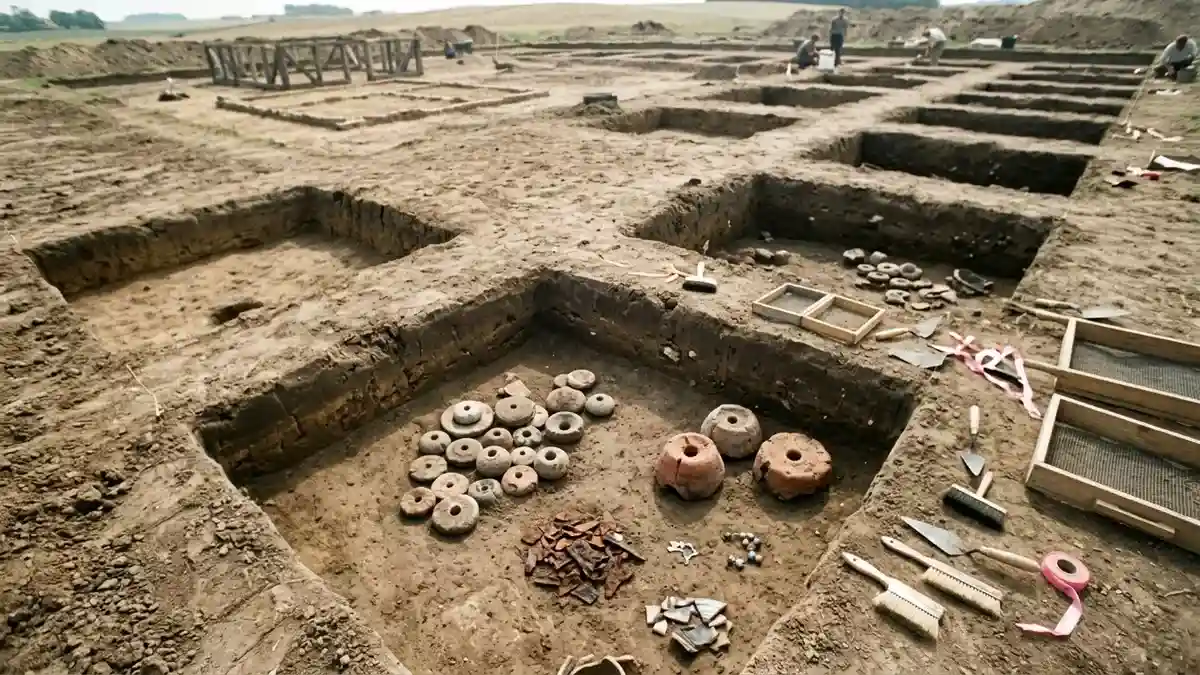
The site of this major discovery is located near the town of Søften in eastern Jutland, sitting roughly 10 kilometers (about 6 miles) north of modern Aarhus. The extensive excavation, spearheaded by the Moesgaard Museum, covers a current investigation zone of over 60,000 square meters, with the entire historical footprint estimated to spread across at least 100,000 square meters.
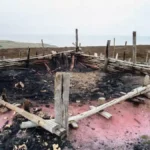
As teams cleared the soil layers, they quickly realized they were not looking at a standard, self-sustaining agricultural village. Instead, the architecture, layout, and dense concentrations of specialized tools pointed to a single reality: a planned, highly organized industrial manufacturing zone.
The Pit House Phenomena
The primary evidence for this large-scale production lies in the discovery of 82 pit houses. In the Viking world, pit houses (grubehuse) were small, semi-subterranean structures built with floors dug directly into the earth. These sunken designs provided excellent insulation, maintaining stable humidity and temperature levels throughout the year.
[Sunken Earth Design] ➔ [Stable Humidity & Temperature] ➔ [Ideal Environment for Spinning & Weaving]
This climate control was not for human comfort—it was an absolute technical requirement for processing plant fibers. If wool or flax fibers become too dry, they grow brittle, snap easily, and become impossible to spin tightly. The stable, damp air inside a pit house kept the raw materials flexible and strong, turning these small structures into the perfect specialized workshops for high-volume spinning and weaving.

From Flax Fields to the Looms: Standardized Assembly Lines
The internal layout of the Søften settlement proves that the site operated under a well-planned division of labor, with different zones dedicated to specific steps of the manufacturing process.
The Processing Steps of Linen Production
Rather than having individual families manage every step of their own clothes-making, the Søften complex was structured like an early assembly line designed to turn flax plants into premium linen cloth:
Flax Preparation Areas: Workers gathered harvested flax plants and soaked them in water (a process called retting) to rot away the woody outer stalks. The remaining fibers were then dried, beaten, and scraped to isolate the soft, spin-ready flax strands.
The Spinning Sector: Inside the specialized pit houses, workers utilized hand-held spindles anchored by heavy spindle whorls—circular weights made of stone, baked clay, or lead—to twist the raw flax fibers into uniform, strong thread.
The Weaving Workshops: The thread moved to upright, warp-weighted looms. Heavy ceramic or stone loom weights were tied to the bottom of the vertical threads to keep them perfectly taut while weavers systematically interlaced the horizontal threads to create tight, durable bolts of linen cloth.
The Manager’s Estate
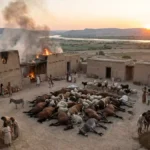
In a traditional Viking village, longhouses were clustered together with no clear administrative hierarchy. At Søften, however, a single, large residential house stood physically apart from the rows of uniform workshops.
Archaeologists hypothesize that this distinct structure served as the residence and headquarters of a site manager or overseer. This individual was responsible for coordinating the incoming flow of raw materials, supervising the workforce, protecting the valuable tool inventories, and managing the outgoing shipments of finished textiles.
Feeding the Global Markets of Aros
The sheer volume of textiles produced at Søften went far beyond what a local population could ever wear. Historians note that this industrial center was built specifically to feed the global commercial appetites of Aros—the prominent Viking trading town that eventually evolved into modern Aarhus.
During the Viking Age, Aros grew into one of Denmark’s primary commercial gateways. It served as a international marketplace where local merchants connected directly with long-distance trade routes spanning across the Baltic Sea, the British Isles, Western Europe, and into Islamic territories.
[Søften Industrial Zone] ➔ [Mass Textile Shipments] ➔ [Aros Trade Hub] ➔ [Northern European Markets]
The recovery of silver coins, cut pieces of hack-silver used as weight-based currency, luxury glass beads, and high-grade imported pottery across the Søften site proves that the textile workers were heavily compensated through this international trade system. The linen and wool cloth manufactured in these Jutland pit houses functioned as a high-value currency of its own, exported across Northern Europe to sail Viking ships, line winter cloaks, and serve as trade capital.
Mapping the Greater Aarhus Manufacturing Network
The discovery of the Søften industrial zone provides a vital missing piece to a larger regional puzzle. It matches a series of recent archaeological discoveries that show how tightly organized the landscape surrounding Aros actually was:
The Lisbjerg Elite Estate: Located just four kilometers away, this wealthy noble estate maintained close administrative and political links to the rulers of Aros, likely serving as a regional center of political control.
The Elsted Silver Hoard: A significant cache of Viking silver unearthed in 2024 nearby, demonstrating the massive influx of international wealth pouring into the immediate rural suburbs.
Søften Outposts: Earlier excavations conducted south of the current site in 2008 and 2013 revealed additional ancient workshops, proving that this industrial manufacturing zone stretched across a massive regional landscape.
To refine the timeline of this industrial network, researchers are currently utilizing advanced radiocarbon dating alongside pollen analysis. By studying fossilized plant pollen trapped in the ancient soil layers, scientists can identify the exact fields where the flax was cultivated, reconstructing the complete lifecycle of Viking textile production from seed to sail.
Conclusion
The excavations at Søften have provided the historical community with a profound shift in perspective. The Viking Age was not just an era of spontaneous seafaring adventures and localized farming; it was a time of sophisticated economic planning, high-volume industrial production, and complex trade logistics. By proving that a dedicated, managed manufacturing center could mass-produce textiles for an international trade hub 1,000 years ago, this discovery shows that the roots of modern industrial networks run much deeper into the European past than we ever imagined.
Frequently Asked Questions
1. What exactly was discovered near Aarhus, Denmark?
Archaeologists from the Moesgaard Museum uncovered a massive, 1,000-year-old Viking Age industrial production site near the town of Søften. Spanning at least 100,000 square meters, the planned settlement featured 82 specialized pit houses used for the large-scale manufacturing of textiles, particularly linen.
2. What is a Viking pit house and why were they used for textiles?
A pit house (grubehuse) is a small building constructed over a shallow pit dug directly into the earth. The surrounding soil provided natural insulation that kept the interior air consistently humid and cool. This specific climate stopped organic fibers like flax and wool from drying out and breaking, making them ideal for spinning and weaving.
3. How did the Vikings turn flax plants into linen cloth?
The process involved harvesting the flax, soaking it in water to rot away the tough outer stalk (retting), and beating the stems to isolate the soft inner fibers. These fibers were then spun into thread using hand spindles weighted by spindle whorls, and finally woven into cloth on large, vertical, warp-weighted looms.
4. Who managed the large production site at Søften?
The site layout features a single, prominent residential house that stands completely separate from the rows of uniform workshop pit houses. Archaeologists believe this building belonged to a high-ranking manager or overseer who controlled the raw materials, supervised the craftspeople, and organized the trade logistics.
5. Where did all the finished cloth go?
The vast majority of the finished textiles were transported ten kilometers south to Aros (modern Aarhus). During the Viking Age, Aros was a powerful, fortified international trading port that exported these mass-produced cloths to lucrative markets scattered all across Northern and Western Europe.