
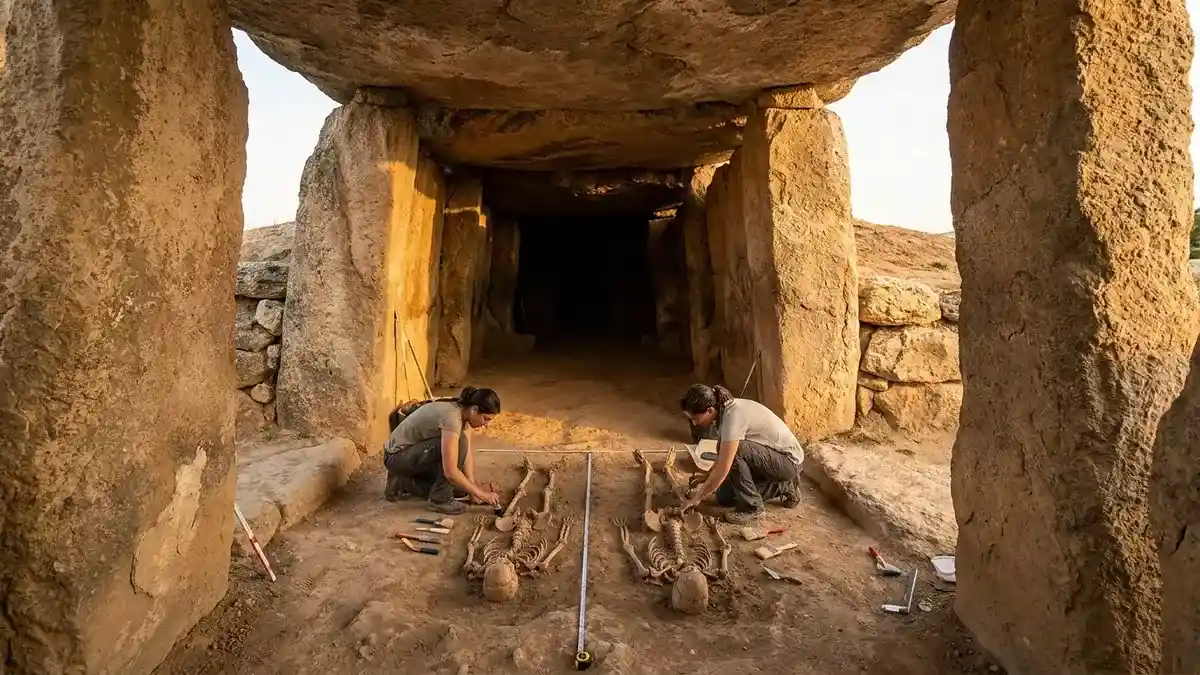
Ancient Stones, New Lives: Medieval Burials at the Menga Dolmen
The Menga dolmen in Antequera, Spain, has long been celebrated as a masterpiece of Neolithic engineering—a colossal tomb built nearly 6,000 years ago. However, a groundbreaking study published in the Journal of Archaeological Science: Reports (2026) reveals that this UNESCO World Heritage site was far more than a prehistoric relic. By combining ancient DNA (aDNA) analysis with archaeological data, researchers have confirmed that Menga remained a sacred focal point of human activity well into the medieval period.
Ancient Stones, New Lives Medieval Burials at the Menga Dolmen
A Sanctuary Across Millennia
Built around the fourth millennium BCE, the Menga dolmen was originally designed as a communal burial site. While it was long suspected that later societies repurposed the structure, the discovery and analysis of two medieval burials in the dolmen’s atrium provide the most definitive evidence to date of this long-term cultural significance.
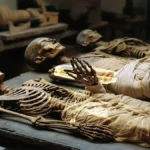
Archaeologists uncovered two adult individuals dating to between the 8th and 11th centuries CE—a time when the Iberian Peninsula was under Islamic rule as Al-Andalus. The burial style is striking: while the bodies were placed face-down in a manner broadly consistent with Islamic funerary customs, they were deliberately oriented toward the dolmen’s central axis. This precise alignment suggests that the monument itself—not just the surrounding land—retained profound spiritual or symbolic importance to these medieval inhabitants.
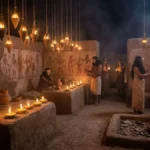
Genomic Secrets of the “Menga1” Individual
Recovering DNA from the warm, Mediterranean climate of southern Spain is famously difficult, yet the researchers successfully extracted genetic data from one of the two skeletons, an adult male labeled “Menga1.”
The genetic profile of Menga1 tells a story of a cosmopolitan, interconnected Mediterranean world:
Diverse Ancestry: His DNA reveals a complex mixture of Western European, North African, and Eastern Mediterranean lineages.
Cultural Mobility: While his paternal line was typical of Europe, his maternal ancestry shared deep links with North African populations.
Historical Context: This genetic profile mirrors the broader migration, trade, and mobility patterns common in the Iberian Peninsula following the Islamic expansion in the 8th century.
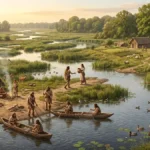
Researchers are careful to note that genetic markers do not necessarily dictate a person’s religious or cultural identity. Instead, Menga1’s genome acts as a biological signature of a period characterized by intense cross-continental exchange.
The Biography of a Sacred Landscape
Perhaps the most significant revelation of this study is the “long biography” of the Menga dolmen. Medieval communities did not view the dolmen as a mere ruin or an abandoned pile of stones. Instead, they treated it as a place of power, perhaps linking it to ancestral memory or seeing it as a bridge to the past.
The study joins a growing body of evidence across Iberia showing that megalithic structures were frequently revisited and reused during the medieval period. This persistence suggests that sacred landscapes have an extraordinary capacity to transcend religious and cultural shifts. Even as beliefs changed—from the Neolithic spiritualities that raised the stones to the Islamic traditions practiced by the individuals buried there—the monument itself remained a fixed point of spiritual gravity.
By layering ancient genetics over archaeological context, this research offers a profound look at how humans anchor their lives and deaths to the physical world. The Menga dolmen stands today not just as a testament to Neolithic builders, but as an enduring monument that served as a silent witness to four millennia of human history, change, and devotion.
Frequently Asked Questions (FAQ)
1. What is the Menga dolmen?
The Menga dolmen is a massive Neolithic megalithic tomb located in Antequera, Spain. Built around 4,000 BCE, it is one of Europe’s largest and most famous prehistoric monuments and is a UNESCO World Heritage Site.
2. What did the study discover about the medieval burials?
Researchers found two burials from the 8th to 11th centuries CE inside the dolmen’s atrium. The individuals were buried face-down and aligned with the monument’s central axis, suggesting that medieval people still considered the dolmen a sacred or powerful place.
3. What did the DNA of the “Menga1” individual reveal?
The DNA revealed that the individual had a diverse mixture of Western European, North African, and Eastern Mediterranean ancestries. This reflects the high levels of mobility and trade that characterized the Iberian Peninsula during the early medieval period of Al-Andalus.
4. Does the burial indicate the individuals were Muslim?
The researchers note that the burial orientation is broadly consistent with Islamic funerary practices of the time. However, they emphasize that genetics cannot definitively confirm a person’s religious identity; rather, the find shows how diverse people interacted with ancient sacred spaces.
5. Why is this finding important?
It changes our view of prehistoric monuments from “abandoned ruins” to “living landmarks.” It demonstrates that megalithic sites remained culturally and symbolically relevant for thousands of years, transcending the different religions and cultures that passed through the region.