
60,000-Year-Old Arrows Reveal Earliest Use of Poison
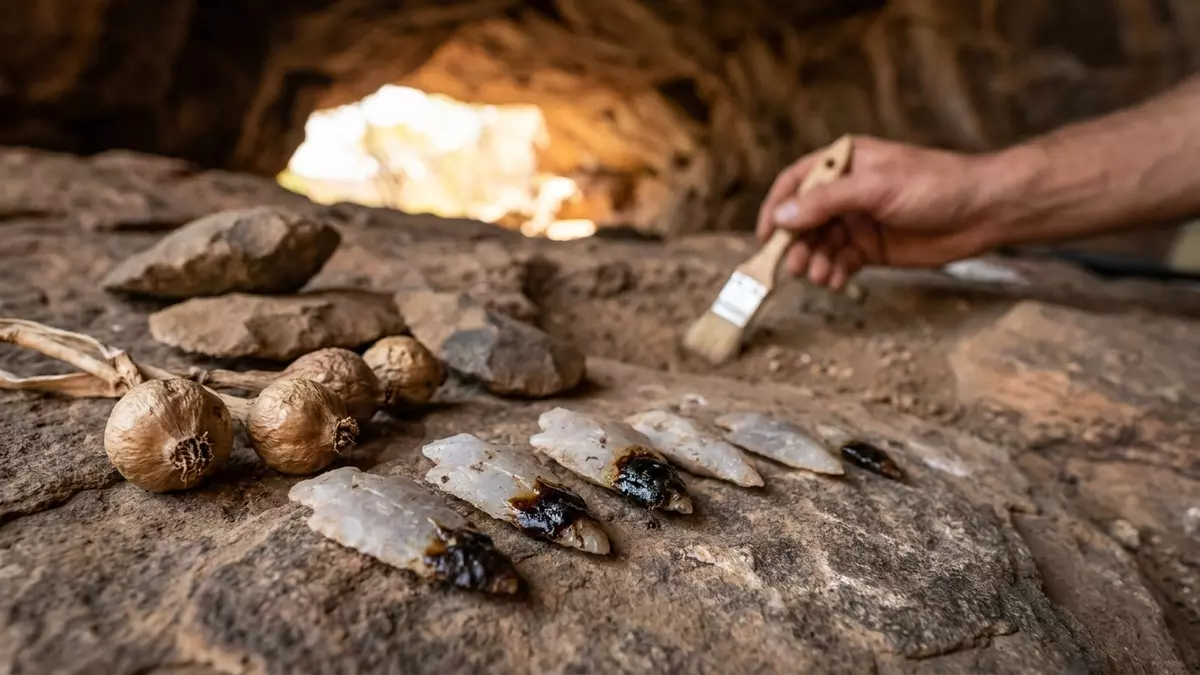
A groundbreaking study has pushed the timeline of sophisticated human weaponry back by over 50,000 years. Archaeologists analyzing quartz arrowheads from the Umhlatuzana Rock Shelter in KwaZulu-Natal, South Africa, have identified the oldest direct evidence of poisoned hunting weapons. Dating back 60,000 years, this discovery provides a rare, tangible link to the complex cognitive abilities and ecological knowledge of Middle Stone Age Homo sapiens.
60,000-Year-Old Arrows Reveal Earliest Use of Poison
Chemical Traces from the Middle Stone Age
The study, published in Science Advances (2026), focused on stone arrow tips associated with the “Howiesons Poort” cultural tradition—a period characterized by rapid technological advancement. Rather than relying on indirect evidence, researchers employed advanced microchemical and biomolecular analysis to investigate residues trapped on the quartz surfaces.
The results were definitive. In five out of ten analyzed arrowheads, the team discovered the presence of specific alkaloids: buphandrine and epibuphanisine. These toxic compounds are derived from the Amaryllidaceae family of plants. Remarkably, these same toxins are still harvested today from the poisonous bulb of Boophone disticha by indigenous groups in southern Africa for use as arrow poison.

The Strategy Behind the Poison
The use of poison represents a sophisticated understanding of delayed cause-and-effect. Because these toxins are slow-acting, they would not have killed prey instantly. Instead, they would have progressively weakened the animal, making “persistence hunting” far more efficient and safer for the hunter. By reducing the physical stamina required to track prey over long distances, this technology drastically increased the success rate of hunters, allowing them to secure food with less risk of injury.
The discovery suggests that these early humans were not merely reacting to their environment; they were actively managing it. The manufacturing of a poisoned weapon required:
Botanical Expertise: Knowledge of which plants were toxic and how to extract their properties.
Process Engineering: The ability to refine and apply these toxins to a weapon without poisoning the hunter.
Strategic Planning: An understanding of how the poison would affect the prey’s behavior over time.

An Astonishing Continuity of Knowledge
To confirm their findings, the researchers compared the ancient residues against poison samples from 18th-century hunting implements and fresh extracts from modern Boophone disticha bulbs. The matches were precise, revealing an astonishing 60,000-year continuity of ecological knowledge. This suggests that the practical skills required to survive in the southern African landscape were passed down through countless generations, forming a robust, long-term tradition of hunting excellence.

This evidence fundamentally shifts the academic narrative surrounding the late Pleistocene. It proves that the “complex subsistence strategies” long attributed to more modern human societies were already deeply embedded in the lives of our ancestors 60 millennia ago.
A New Window into Ancient Residues
Beyond the hunting implications, this study proves that fragile organic residues can survive for vast stretches of time under the right environmental conditions. By successfully isolating these molecular “fingerprints,” researchers have opened a new door for identifying other ancient practices, including the use of prehistoric medicines and other organic technologies that were previously thought to be lost to decay.
This discovery is a testament to the ingenuity of early Homo sapiens. It reminds us that 60,000 years ago, our ancestors were already master chemists, strategists, and engineers, navigating their world with a level of complexity that continues to reshape our understanding of the human story.
Frequently Asked Questions (FAQ)
1. How old are the poisoned arrowheads?
The arrowheads date back 60,000 years, making them the oldest direct evidence of poisoned hunting weapons ever discovered. Previous confirmed examples were only a few thousand years old.
2. How did researchers confirm the presence of poison?
The team used advanced microchemical and biomolecular analysis to identify specific toxic alkaloids (buphandrine and epibuphanisine) on the quartz arrowheads. These chemicals matched the toxins found in the Boophone disticha plant.
3. Why would ancient hunters use slow-acting poison?
Slow-acting poison weakens prey over time rather than killing it instantly. This made hunting safer and more efficient, as it reduced the need for long, exhausting pursuits and increased the likelihood of a successful kill.
4. What does this discovery tell us about early human intelligence?
It proves that 60,000 years ago, humans already possessed complex cognitive skills, including the ability to understand plant properties, plan for delayed cause-and-effect, and develop sophisticated, multi-step technological solutions for survival.
5. Why is this finding significant for future archaeology?
It demonstrates that delicate organic residues can survive for tens of thousands of years. This methodology could allow scientists to identify other ancient technologies, such as prehistoric medicines or dyes, that were previously believed to be lost forever.