
A Soldier’s Resilience: The Lost Memoir of Shadrach Byfield
History is often written by the victors, but the true human cost of conflict is best preserved in the voices of those who bore its physical and economic burdens. The rediscovery of the personal memoirs of Shadrach Byfield—a British soldier who fought in the War of 1812—offers a startling, visceral look at the life of an ordinary enlisted man navigating disability, poverty, and the complex bureaucracy of nineteenth-century Britain.
A Soldier’s Resilience The Lost Memoir of Shadrach Byfield
From the Frontlines to the Weaver’s Loom
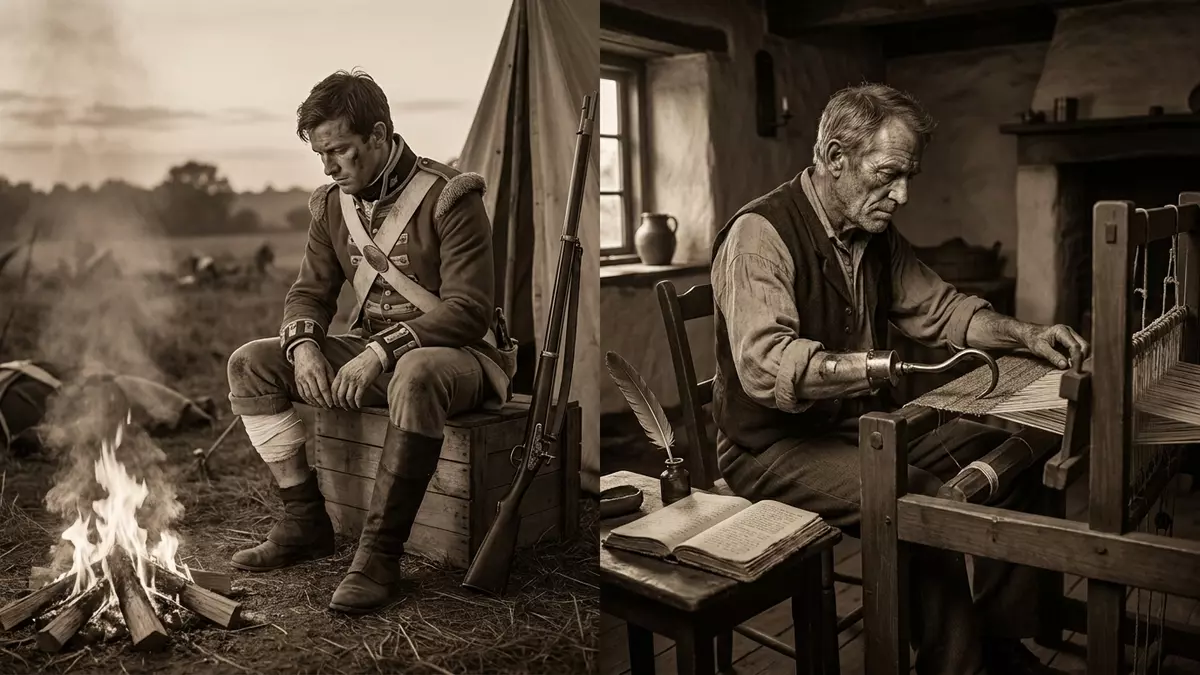
Born in 1789 near Bradford-on-Avon, Byfield’s trajectory from militia volunteer to a veteran of the 41st Regiment of Foot was marked by relentless hardship. After sailing to Canada in 1809, he found himself in the heat of battle when the War of 1812 erupted. Byfield survived numerous close calls, but his life was irrevocably altered in 1814 when a musket ball shattered his left forearm.
In a scene that highlights the brutal reality of battlefield medicine, Byfield underwent an amputation without the benefit of anesthetic. Defying the trauma of the procedure, he famously retrieved his own severed limb to bury it himself. Following his return to civilian life, he did not surrender to his disability. With the help of a local blacksmith, he had a prosthetic arm constructed—a mechanical aid that allowed him to return to his trade as a weaver, highlighting the era’s fierce expectation that even the severely disabled would continue to provide for their families.

The Dual Memoirs: Duty vs. Reality
Byfield’s legacy is preserved in two distinct memoirs, each serving a different purpose. His 1840 Narrative was a public-facing document, crafted to emphasize his duty, loyalty, and his role as a capable provider. It was designed to secure respect and potentially bolster his claims for state support.
In contrast, his 1851 History and Conversion of a British Soldier revealed a much grittier, more vulnerable truth. It recounted his struggles with chronic pain, mounting debt, and social conflicts in civilian life. Perhaps most strikingly, he wrote of a physical confrontation at a Baptist chapel in Gloucestershire, where he admitted to using the hook of his prosthetic arm during a dispute. Legal records and contemporary newspapers corroborate the incident, painting a portrait of a man who was neither the idealized soldier nor the passive victim, but a complex individual navigating a difficult world.
The Politics of the Pensioner
For a common soldier in the 1800s, survival after the war was a strategic negotiation. Byfield’s standard pension was a meager nine pence a day—hardly enough to sustain a family, especially while battling the long-term effects of his injuries and severe rheumatism.

His survival relied on a three-pronged approach:
State Assistance: Petitioning the Royal Hospital Chelsea for increased payments.
Patronage: Leveraging relationships with influential figures like Sir William Napier to gain support above the standard pension.
Manual Labor: Working as a farmhand, a gardener, and a “chairman,” transporting patients in wheelchairs—a poignant irony for a man navigating his own mobility challenges.

Byfield’s ability to move between these worlds demonstrates the agency that ordinary veterans often exerted. He did not simply wait for the state to care for him; he campaigned for it, cultivated supporters, and maintained a fierce sense of military identity until his death in 1874.
A Legacy of Recognition
Byfield’s memoirs were not merely personal reflections; they were tools of advocacy. In an era when officers were provided with sophisticated prosthetics and retained their status, Byfield’s writing asserted that the sacrifice of an enlisted man was equally significant. His work helped shape the public perception of the “common soldier,” framing his service as both dutiful and fraught with systemic struggle.
When he died, his daughter listed his occupation on his death certificate not as a weaver or a gardener, but as “Private, late of the 41st Regiment of Foot.” This final declaration speaks volumes about the man. Shadrach Byfield refused to be erased by his injury or the economic hardships that followed. Through his writing, he ensured that his struggle—and the struggles of thousands of forgotten veterans of the Napoleonic era—would remain a part of the historical record.
Frequently Asked Questions (FAQ)
1. Who was Shadrach Byfield?
Shadrach Byfield was a British soldier who served in the 41st Regiment of Foot during the War of 1812. He is best known for his memoirs, which detail his military service, his battlefield amputation, and his later life as a disabled veteran.
2. How did Byfield lose his arm?
His left forearm was shattered by a musket ball during combat in 1814. The arm was subsequently amputated in a field surgery without anesthetic.
3. What kind of prosthetic did he use?
After the war, a local blacksmith constructed a prosthetic arm with a hook, which allowed Byfield to return to his work as a weaver.
4. Why did Byfield write two different memoirs?
His 1840 Narrative was likely written to demonstrate his reliability and duty to secure public and state support. His 1851 History and Conversion provided a more personal, unfiltered account of his struggles, conflicts, and daily realities.
5. What does Byfield’s story tell us about 19th-century military life?
His life reveals the stark divide between officers and common soldiers regarding post-war support. It also highlights how disabled veterans had to navigate a complex mix of state pensions, private patronage, and manual labor to survive in a society that expected them to remain productive despite their injuries.