
Ancient Golden Tomb Unearthed: Elite Burial Found in Panama
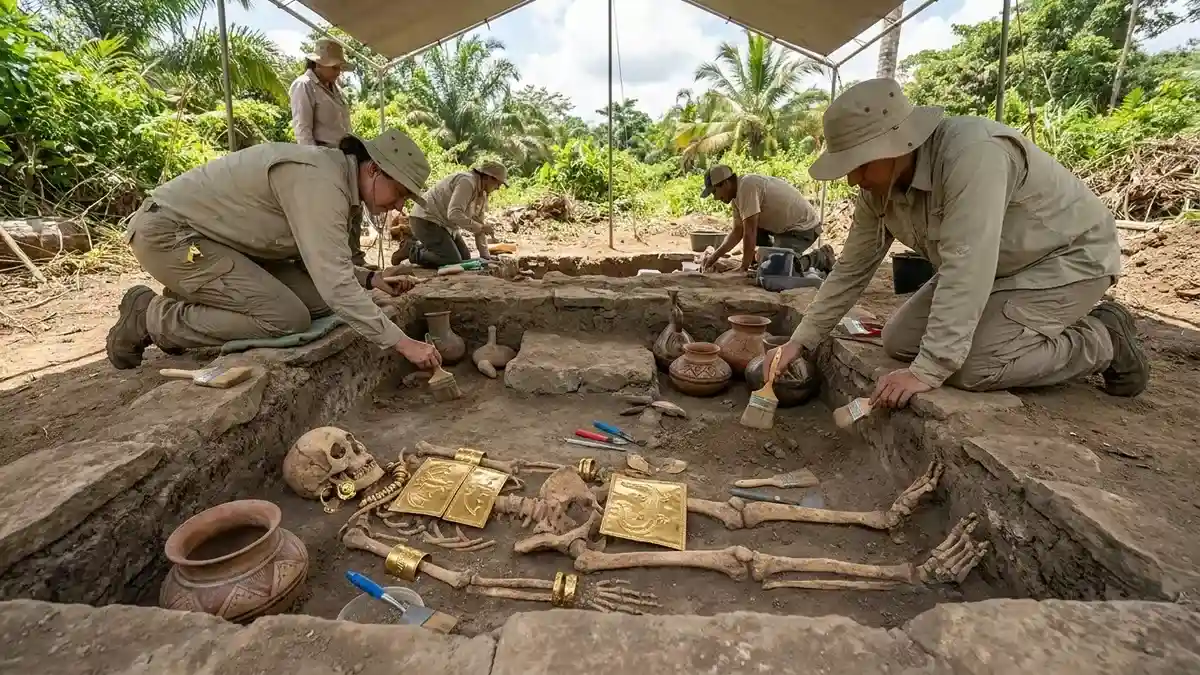
A remarkable archaeological discovery has emerged from the depths of the El Caño Archaeological Park in Panama. Excavations at the site, located in the Natá district approximately 124 miles southwest of Panama City, have revealed a lavish, 1,000-year-old tomb belonging to an elite individual. This find provides a glittering glimpse into the sophisticated social hierarchy and artistic mastery of the pre-Columbian societies that flourished in Central America between CE 800 and 1000.
Researchers uncovered the skeletal remains of a high-ranking figure positioned at the center of the grave, accompanied by an extraordinary collection of funerary goods. The burial was adorned with intricate gold ornaments and finely crafted ceramic vessels, artifacts that serve as vital links to the cultural identity of the region’s ancient inhabitants.
Ancient Golden Tomb Unearthed Elite Burial Found in Panama
Unveiling Elite Status and Artistic Sophistication
The tomb’s contents speak volumes about the status of the deceased. The burial was accompanied by two gold bracelets, a pair of ornate earrings, and several pectoral plates. These golden treasures are particularly notable for their artistic detail; they feature vivid depictions of bats and crocodiles, creatures that held significant symbolic weight within the visual language and cosmology of ancient central Panamanian societies.
The craftsmanship displayed in these gold pieces reflects a high level of technical expertise. The ability to manipulate precious metals with such precision confirms that metallurgy was a well-developed skill in the region long before the arrival of Europeans. Alongside the gold, archaeologists found various ceramic vessels decorated with traditional motifs characteristic of communities active in the area during this specific century-long window.
Social Hierarchy and Funerary Rites
Archaeologists suggest that the careful placement of these gold ornaments indicates more than mere wealth; it is a clear indicator of a rigid social hierarchy. By interring the individual with such specific symbols of rank, the community emphasized that the status held during life extended well into the afterlife. This practice highlights a society that placed immense importance on lineage, identity, and the spiritual continuation of authority.
A Legacy of Leadership at El Caño
The discovery at El Caño is not an isolated event but rather part of a larger, ongoing narrative. Excavations at this park have been conducted for nearly two decades, and this tomb is the tenth of its kind to be uncovered. The presence of multiple similar graves suggests that the site functioned as an exclusive necropolis for the region’s elite leaders for approximately two centuries.
The fact that generations returned to this same location to inter their most influential members underscores the site’s importance as a focal point of ancestral memory and social cohesion. By burying their leaders in a dedicated space, these communities reinforced their internal power structures and maintained a continuity of tradition that lasted across several generations.
Regional Connectivity and Influence
Scholars view El Caño as a vital piece of the puzzle in understanding how ancient societies interacted across the Central American isthmus. As a land bridge connecting North and South America, the region was a nexus for cultural and technological exchange. The sophisticated metalworking skills observed at this site suggest that these ancient Panamanian groups were part of a broader, interconnected network of specialized craft and trade that spanned the isthmus.
The Significance for Prehispanic History
Panama’s Ministry of Culture has characterized this find as a monumental contribution to the nation’s archaeological heritage. Every new tomb uncovered at El Caño provides researchers with fresh data, helping to reconstruct the complex prehispanic history of Central America. These findings offer more than just aesthetic beauty; they provide concrete material evidence of:
Complex Social Structures: The stratification between elite burials and common sites reveals the organizational sophistication of these early societies.
Belief Systems: Funerary offerings provide deep insights into how these people perceived death, the afterlife, and the role of their leaders within the spiritual realm.
Artistic Traditions: The evolution of ceramic designs and metalwork reveals a rich history of indigenous craftsmanship that evolved over centuries.
As research continues, the site at El Caño remains a primary focus for historians looking to understand the foundations of Panamanian civilization. By meticulously documenting these graves, archaeologists are ensuring that the stories of these ancient elites are preserved for future generations, allowing us to better understand the deep, complex history of the land bridge that shaped the Americas.
Frequently Asked Questions (FAQ)
1. Where exactly was this 1,000-year-old tomb found?
The tomb was unearthed at the El Caño Archaeological Park, situated in the Natá district, about 124 miles southwest of Panama City, Panama.
2. How old are the items found in the grave?
The burial dates back to the period between CE 800 and 1000, roughly 1,000 years ago, during the final centuries of the region’s pre-Columbian era.
3. What kind of objects were buried with the individual?
The elite individual was buried with significant gold jewelry—including bracelets, earrings, and pectoral plates—alongside traditional ceramic vessels. The ornaments often depicted bats and crocodiles.
4. Why is this discovery important for archaeology?
This discovery provides rare insight into the social hierarchy, belief systems, and advanced metallurgical skills of ancient Panamanian societies. It also helps historians understand how leadership and power were manifested in death within these cultures.
5. Is this the first tomb discovered at El Caño?
No, this is the tenth tomb of its type discovered at the site. Excavations have been ongoing at El Caño for nearly 20 years, revealing a long-standing tradition of burying elite members in this specific cemetery.