
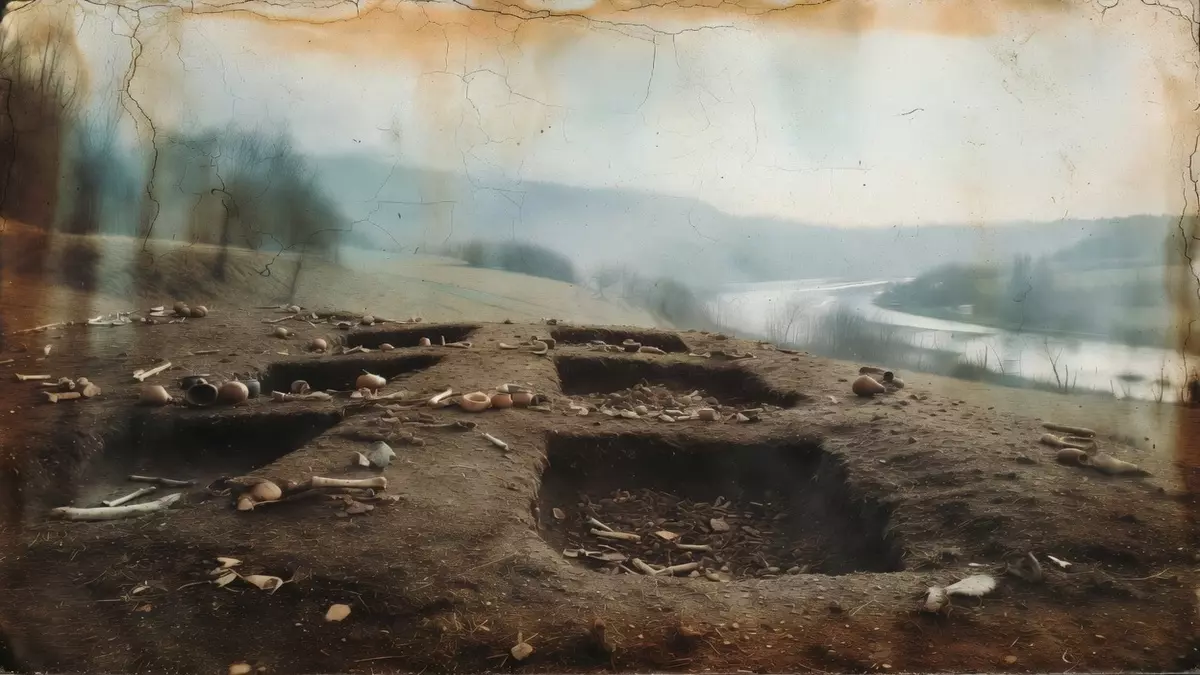
**Ancient DNA Rewrites Fall of Rome with Small Migrations**
A major ancient DNA study is transforming our understanding of the fall of the Roman Empire in Central Europe. Instead of massive invasions by Germanic tribes, researchers found evidence of smaller, gradual movements by families and local groups that slowly reshaped the population over centuries. This new genetic evidence from southern Germany paints a more nuanced picture of how Roman rule ended and early medieval societies emerged.
The research, led by experts at Johannes Gutenberg University Mainz and published in the journal *Nature*, analyzed 258 ancient genomes from burials dating between 400 and 700 CE. By comparing these with over 2,800 other ancient and modern DNA samples from across Germany, the team uncovered surprising patterns of migration, integration, and daily life during this pivotal era.
Ancient DNA Rewrites Fall of Rome with Small Migrations
 The Archaeology of Portugal Fellowship
### Challenging Long-Held Views on the End of Roman Rule
For decades, historians linked the collapse of the Western Roman Empire in the fifth century to large-scale migrations of Germanic peoples into Roman territories. Popular narratives often described waves of invaders overwhelming the empire’s borders. However, this comprehensive genetic study reveals a different story: change came through smaller movements and gradual mixing rather than sudden conquests.
The focus was on row grave cemeteries, a distinctive burial style that spread across parts of Europe starting in the mid-fifth century. These sites contained individuals from two main genetic backgrounds. One group showed strong ancestry tied to northern Europe, while the other reflected the diverse, mixed population of the late Roman provinces—shaped by centuries of connections spanning Europe and parts of Asia.
 Harriet and Leon Pomerance Fellowship
Importantly, people with northern ancestry had already begun settling in the Roman frontier zones before central authority fully broke down. They often maintained separate communities, marrying within their groups, possibly due to Roman policies that granted land under specific conditions. This separation started to fade in the late fifth century as Roman urban centers and military structures weakened.
**H3: A Gradual Shift Toward Rural Life and Integration**
As people moved away from declining towns toward rural areas, interactions between the northern and provincial groups increased. Shared burial grounds appeared, and genetic data shows rising rates of intermarriage. By the early seventh century, the two populations had largely merged, creating a genetic profile remarkably similar to that of modern Central Europeans.
This finding aligns with a broader shift in historical scholarship away from dramatic “invasion” models toward more complex stories of transformation. Cultural elements from the Roman world persisted, blending with incoming traditions to form the foundations of medieval society.
### Insights from Ancient Genomes: Family Life and Demographics
One of the study’s strengths is its detailed look at family relationships reconstructed from DNA. Households typically centered on nuclear families rather than large extended clans. Marriages were generally monogamous, with no evidence of unions between close relatives. Kinship ties were traced through both maternal and paternal lines, matching descriptions in late antique written sources.
Demographic data adds human depth to the numbers. The average generation length was about 28 years. Women had a life expectancy around 40 years, slightly lower than men. Infant and child mortality remained high, as was typical for the period. Roughly one in four children lost at least one parent before age ten, yet many grew up with grandparents still present in the household—highlighting the resilience of family bonds amid challenging conditions.
These patterns suggest stability in social structures even during political upheaval. The genetic evidence indicates that everyday life continued with familiar rhythms, while larger societal changes unfolded gradually.
### The Science Behind the Discoveries
Paleogenomics—the extraction and analysis of ancient DNA—has revolutionized archaeology in recent years. From tiny bone fragments, such as those from a woman’s skull found in Ergoldsbach, scientists reconstructed complete genomes. Anthropological examination of skeletons from sites like Altheim complemented the genetic work, providing a fuller picture of health, diet, and physical activity.
The study’s scale stands out. With 258 new genomes from carefully dated cemeteries, researchers could track changes over 300 years with unprecedented precision. Comparisons to modern populations confirm that the genetic makeup established by the seventh century in southern Germany contributed significantly to today’s Central European ancestry.
This region, rich in fertile lands and strategic river valleys, served as a crossroads during the Migration Period. The data shows how local dynamics, rather than distant mass movements, drove demographic shifts.
### Implications for Understanding Migration and Identity
The results challenge simplistic narratives about the fall of Rome. Instead of replacement through large invasions, the evidence points to integration. Northern groups brought new practices, but Roman provincial populations contributed substantially to the emerging society. This mixed heritage formed the basis for later medieval kingdoms and, ultimately, aspects of modern European identities.
Experts note that similar small-scale processes likely played out across other parts of the former empire. The study encourages historians to re-examine written sources alongside genetic data, revealing how archaeology and genomics together create richer historical accounts.
**H3: Broader Context of the Migration Period**
The period from 400 to 700 CE witnessed the fragmentation of Roman authority, the rise of new kingdoms, and cultural transformations across Europe. In southern Germany, row grave cemeteries became common markers of these changes. The genetic separation followed by blending mirrors linguistic and archaeological evidence of evolving identities.
This research also addresses contemporary debates about migration. It shows that population movements have always been part of human history—but their scale, pace, and impacts vary widely. In this case, incremental family relocations and social mixing proved more influential than any single “wave.”
### Why This Study Matters Today
For American readers fascinated by history, ancient DNA offers a direct link to the past. These 1,400-year-old individuals—farmers, families, and community members—experienced a world in transition much like our own era of change. Their stories humanize abstract historical events, showing continuity amid disruption.
The persistence of Roman cultural influences alongside new arrivals underscores themes of resilience and adaptation. As modern societies grapple with migration and cultural blending, lessons from the early medieval period feel relevant: integration often happens gradually through daily interactions, marriages, and shared spaces.
Ongoing technological advances promise even more discoveries. Future studies could incorporate more samples from across Europe, explore disease patterns, or examine how environmental factors influenced these population shifts.
### Connecting the Past to Modern Central Europe
By the seventh century, the genetic structure in southern Germany had stabilized into something recognizable today. Both northern European and Roman provincial ancestries left lasting marks. This blending laid groundwork for the diverse populations that followed, influencing everything from language and customs to genetic traits still present in the region.
The study reinforces that history is rarely black-and-white. The “fall” of Rome was less a catastrophic end and more a transformation, with ordinary people—moving in small groups, raising families, and adapting—shaping the outcome.
Archaeologists, geneticists, and historians working together continue to refine this picture. Each new genome adds detail to our understanding of how Europe transitioned from antiquity to the Middle Ages.
This research from Johannes Gutenberg University Mainz exemplifies the power of interdisciplinary science. It moves beyond old debates to reveal the human realities behind one of history’s most famous turning points.
## FAQ: Ancient DNA and the Fall of Rome
**Q: What did the DNA study reveal about migrations after Rome?**
A: Rather than large invading armies, it showed smaller movements by families and groups, followed by intermarriage and integration over generations.
**Q: How many ancient genomes were analyzed?**
A: Researchers studied 258 genomes from southern German burials between 400 and 700 CE, compared against thousands of other samples.
**Q: What were row grave cemeteries?**
A: Distinctive burial sites used from the mid-fifth century that contained people from both northern and Roman provincial genetic backgrounds.
**Q: What was family life like according to the genetics?**
A: Nuclear families were common, marriages were monogamous, and there was no close-kin pairing. Life expectancy hovered around 40 years with high child mortality.
**Q: How does this change views of the Migration Period?**
A: It supports a model of gradual transformation and cultural continuity rather than sudden replacement by mass migrations.
**Q: Where were the key sites located?**
A: Focus areas included Altheim and Ergoldsbach in southern Germany, near Landshut, revealing local patterns in the former Roman frontier.
**Q: What does this mean for modern populations?**
A: The merged genetic profile by the seventh century closely resembles modern Central Europeans, showing deep roots for today’s ancestry.
The ancient DNA from these early medieval burials brings fresh clarity to a transformative chapter in European history. By highlighting small-scale movements and human connections, the study reminds us that societal change often stems from the quiet decisions of families and communities. As science uncovers more secrets from the past, our understanding of the fall of Rome—and its lasting legacy—continues to evolve.