
3,000-Year-Old Battlefield Discovery in Lithuanian Bog
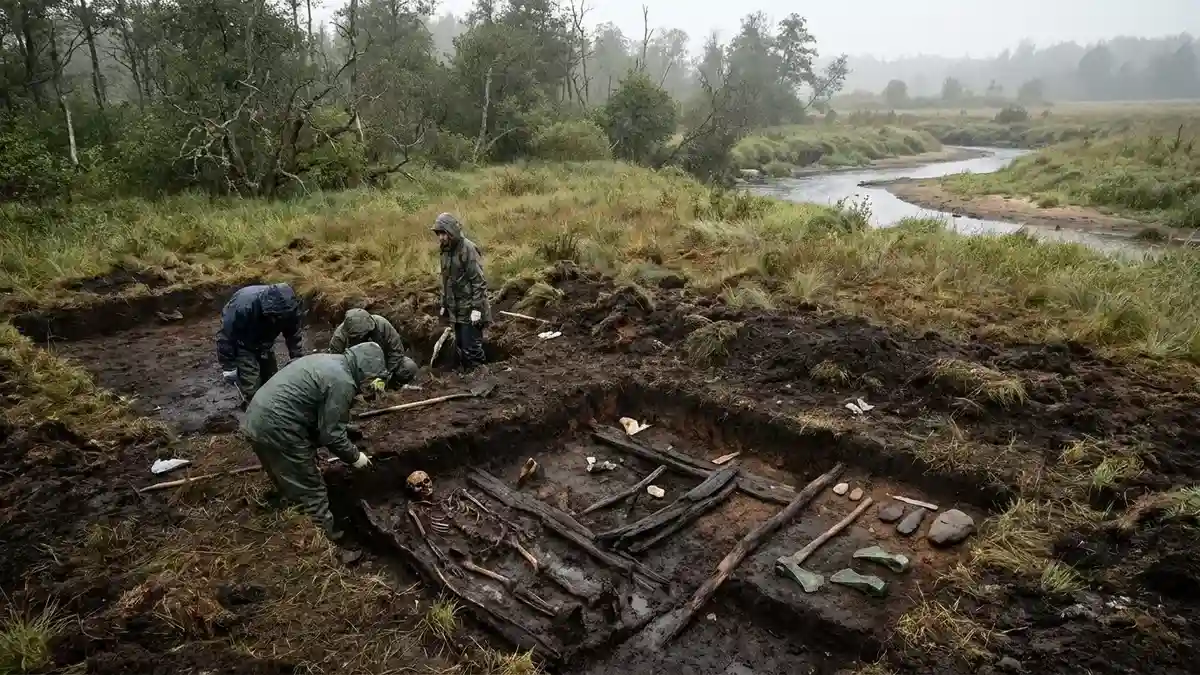
A chilling discovery in the Turlojiškė peat bog of southern Lithuania has provided compelling evidence of a violent, large-scale conflict dating back to the Late Bronze Age. Approximately 3,000 years ago, a group of young men met their end in what was then a shallow lake, their remains eventually becoming encased in the protective layers of the encroaching marsh.
The site, located in the Kalvarija eldership, has been yielding clues for nearly a century, but only recent interdisciplinary research has revealed the true nature of this grim historical mystery.
3,000-Year-Old Battlefield Discovery in Lithuanian Bog
A Century of Uncovering the Past
Interest in the site dates back to 1930, when workers straightening the Kirsna River discovered a human skull accompanied by primitive bone, antler, and flint tools. Throughout the late twentieth century, sporadic finds were made, leading to systematic excavations between 1996 and 2003 by archaeologist Algimantas Merkevičius. These early efforts identified a settlement near the ancient lake, but it was not until 2025 that a new team, led by archaeologist Mantas Daubaras, launched a comprehensive investigation to piece together the events of this ancient tragedy.
By integrating archival records, modern AMS radiocarbon dating, and forensic analysis of remains stored at Vilnius University, the team confirmed that at least 11 individuals—all young men—died in a single, synchronized event during the Late Bronze Age.
Decoding the Battlefield
The evidence for a combat-related deposition is overwhelming:
Signs of Trauma: Forensic analysis of the skeletal remains revealed clear perimortem injuries, including sharp-force trauma consistent with weapon strikes.
Weaponry: Excavators found flint arrowheads and various bronze and stone axes lying in the same sediment layers as the human remains.
Demographics: The fact that the remains belong exclusively to young men strongly suggests a military engagement rather than a communal cemetery or a natural disaster.

Geological mapping, involving over 640 boreholes, allowed the team to create detailed 3D models of the basin as it existed 3,000 years ago. These models show that the men died in a shallow, marshy lake, which eventually transitioned into the peat bog that preserved their remains for millennia.
A Wider Context of Bronze Age Conflict
The Turlojiškė site is of immense importance to European archaeology. It mirrors other famous Bronze Age conflict sites, such as the Tollense Valley in Germany and Alken Enge in Denmark, where mass depositions have provided evidence of large-scale, organized warfare. This discovery in Lithuania acts as a vital eastern Baltic counterpart, suggesting that endemic, violent conflict was a widespread feature of Bronze Age society across the continent.
Biological data from sediment samples, analyzed by zoologists from the Tadas Ivanauskas Zoological Museum, has even allowed researchers to reconstruct the ecosystem of the lake at the time of the event, offering a clearer picture of the environment in which these men fought and died.
Future Research and Legacy
The investigation is far from over. With a follow-up field season planned for 2026, the research team is currently preparing a series of scientific papers that will offer in-depth analyses of the skeletal injuries, the associated artifacts, and the environmental data collected from the bog.
This discovery not only restores the history of these forgotten warriors but also highlights the changing nature of Bronze Age research. By combining ancient history with cutting-edge geological and forensic science, researchers are bringing to light a forgotten chapter of European violence—proving that the peat bogs of the Baltic hold secrets that are finally ready to be told.
Frequently Asked Questions (FAQ)
1. Where was the Bronze Age battlefield found?
The site was discovered at the Turlojiškė peat bog in southern Lithuania, in the Kalvarija eldership.
2. How old are the remains found in the bog?
Radiocarbon dating indicates that the event took place during the Late Bronze Age, approximately 3,000 years ago.
3. How do we know this was a battlefield and not a burial site?
The evidence includes perimortem sharp-force trauma on the bones, the presence of weapons like arrowheads and axes in the same sediment layers, and the fact that all 11 identified individuals were young men, which points to a combat-related mass deposition rather than a traditional cemetery.
4. How did the peat bog preserve these remains for 3,000 years?
The site was originally a shallow lake. Over time, sediments and vegetation turned it into a marshy peat bog. The oxygen-poor, acidic conditions in the bog slowed the decay process, allowing bones and some wooden artifacts to survive in remarkable condition.
5. Why is this discovery important for European history?
It aligns the Baltic region with other major European Bronze Age conflict sites like those in Germany and Denmark. It provides concrete evidence that organized, large-scale violence was a recurring phenomenon across Europe during this era.