
Elite Anglo-Saxon Cemetery Discovered Near Sizewell
Archaeologists working near the Sizewell C nuclear power project in Suffolk, England, have unearthed a rare and highly significant early medieval burial ground. Dating back to the sixth and seventh centuries, the cemetery offers a hauntingly clear window into the lives, rituals, and social hierarchies of the Anglo-Saxon elite during a period of fierce competition between emerging English kingdoms.
The site, discovered during pre-construction surveys for the power station’s access road, provides a rare look at a planned mortuary landscape, featuring at least 11 burial mounds organized across a raised area of land.
Elite Anglo-Saxon Cemetery Discovered Near Sizewell
The “Ghost” Graves: Sand Silhouettes of the Past
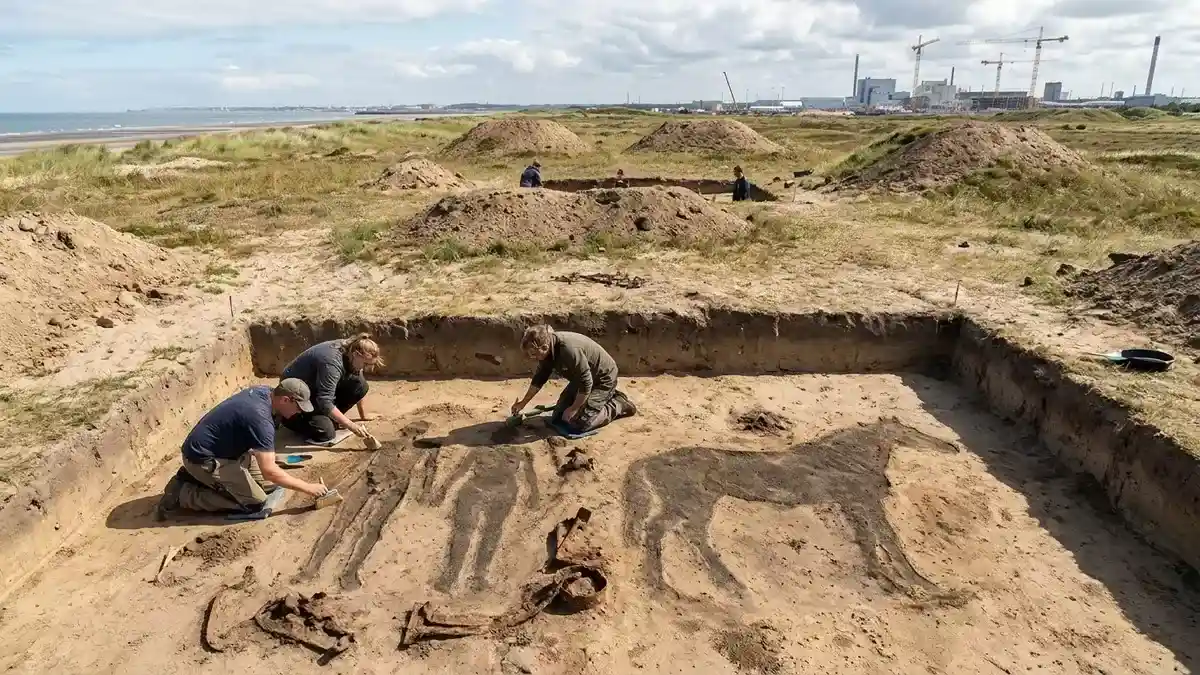
One of the most striking aspects of the discovery is how the site has been preserved. Due to the highly acidic and sandy soil of the Suffolk coast, organic remains—including human and animal bones—have long since disintegrated. However, the unique chemical and physical properties of the environment have left behind “sand silhouettes.”

These ghostly outlines preserved the exact positions of the deceased and their burial offerings, allowing archaeologists to reconstruct the scenes of 1,500 years ago with surprising precision. Among the most evocative finds are the outlines of a pair of individuals buried side-by-side and a nearby silhouette of a horse, complete with its original equipment.
Elite Rituals and Sacrificial Practices
The wealth and quality of the grave goods found within these mounds mark the individuals interred there as members of the societal elite. The paired burial contained significant weaponry, including swords and a spear, accompanied by personal items such as metal bowls and cups, signifying high status.
The horse burial is particularly telling of the ritual complexity of the era. The animal was interred with its full riding gear, including copper alloy decorations, bridle fittings, and an iron bit still positioned in its mouth. This intentional inclusion of a saddled horse suggests a ritual sacrifice, a practice intended to honor the status of the deceased and provide for them in the afterlife, mirroring elite funerary traditions observed at world-famous sites like Sutton Hoo and Snape.

Contextualizing the Suffolk Coast
Researchers view this site as a crucial addition to our understanding of early medieval England. By comparing the burial customs, mound construction, and grave goods to other high-status cemeteries such as Prittlewell and Sutton Hoo, historians can better map the reach and influence of the regional leadership groups that dominated eastern England during the early Anglo-Saxon period.
The cemetery did not exist in isolation. Excavations in the immediate vicinity have revealed traces of domestic activity, including loom weights and the remains of structures, indicating that the burial mounds were situated in close proximity to daily living spaces. This reflects a culture that maintained a tight, symbolic, and physical connection between the living community and their ancestors.
A Landscape of Deep History
The significance of the Sizewell excavations extends far beyond the Anglo-Saxon period. The 200 specialists working across 70 sites in the 500-acre project area have uncovered a palimpsest of human history spanning thousands of years:

Prehistoric and Iron Age: The team recovered a rare, remarkably well-preserved Iron Age oak ladder and evidence of Bronze Age cremation practices.
Roman Era: The site revealed extensive evidence of Roman occupation, including a pottery kiln and traces of large-scale salt production.
Medieval and Modern: Alongside medieval ovens, the site includes World War II defensive structures, reflecting the coastline’s strategic importance through the centuries.
A Hidden Treasure: In 2023, the same project area yielded a hoard of over 300 eleventh-century silver coins, wrapped in lead and cloth—a clear example of personal wealth hidden away during a time of political instability.
As the archaeological work continues, these findings are being processed for archival and museum storage. The Sizewell discoveries demonstrate that even in areas slated for modern development, the landscape remains a rich, interconnected record of human experience, from the prehistoric foragers of the Stone Age to the powerful Anglo-Saxon lords of the Suffolk coast.
Frequently Asked Questions (FAQ)
1. What was discovered near the Sizewell nuclear site?
Archaeologists uncovered a planned early medieval (sixth to seventh century) Anglo-Saxon cemetery containing at least 11 burial mounds, including elite graves with weaponry and a sacrificed horse.
2. How are the burials visible if the bones have disappeared?
The acidic, sandy soil caused the bones to decay completely. However, the remains left “sand silhouettes”—chemical and physical outlines in the soil—that preserve the exact shape, posture, and placement of the bodies and grave goods.
3. What indicates that these people were “elite”?
Their high social rank is evidenced by the burial mounds themselves, the presence of prestige weapons (swords and spears), luxury items like metal bowls, and the ritualized burial of a saddled horse.
4. Why is the horse burial significant?
The horse was found with its bridle, bit, and harness fittings still in place. This indicates it was a sacrificial ritual, a practice reserved for the most elite members of Anglo-Saxon society to signify wealth and status.
5. What other historical periods are represented at the site?
The area has been occupied for thousands of years. Discoveries include Iron Age artifacts (like a rare wooden ladder), Roman pottery kilns and salt-production sites, Bronze Age farming traces, medieval ovens, and 11th-century coin hoards.