
**Pompeii Equids Reveal Last Moments of Vesuvius Eruption**
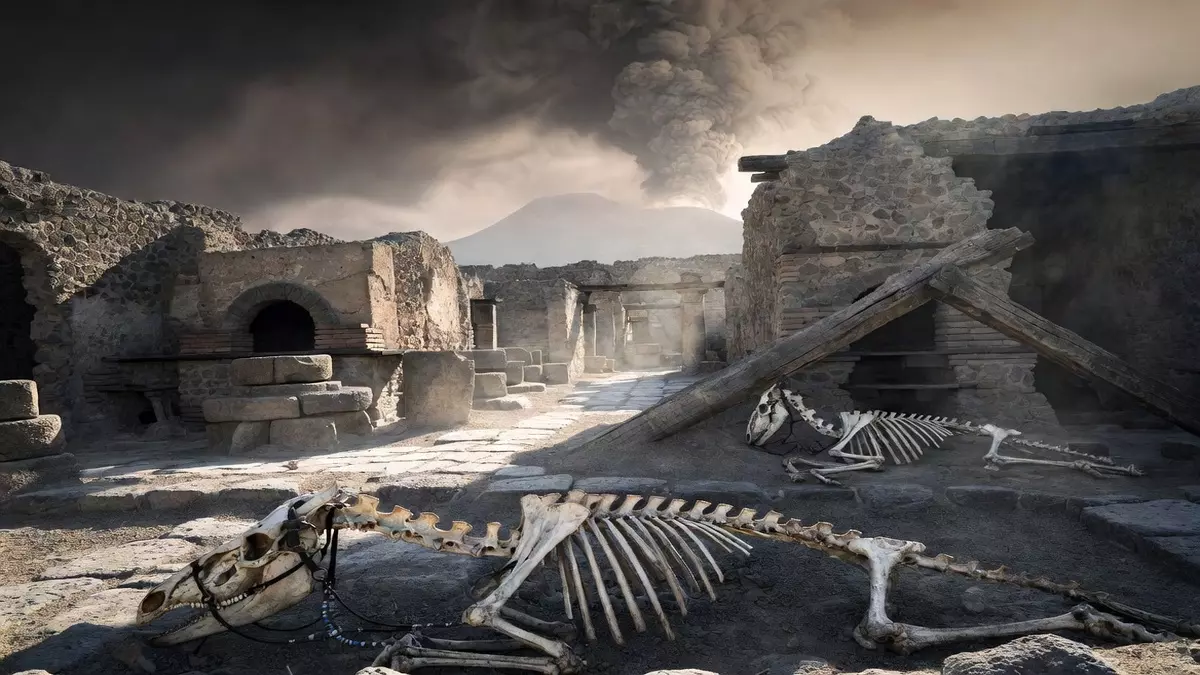
Archaeologists in Pompeii have uncovered the well-preserved skeletons of two working equids beneath the collapsed remains of an ancient bakery, offering a haunting window into the final hours before Mount Vesuvius buried the Roman city in 79 CE. The discovery in the House of the Chaste Lovers adds emotional depth to our understanding of everyday life and the human-animal bonds that existed in one of history’s most famous doomed cities.
These animals, likely horses, donkeys, or mules, were caught in the chaos of renovation work when the volcano erupted. Their story highlights the dramatic sequence of events during the disaster and the vital role of working animals in Roman daily life.
Pompeii Equids Reveal Last Moments of Vesuvius Eruption
### Rediscovering the House of the Chaste Lovers
The finds emerged during a careful re-examination and cleaning project in an area first excavated in the late 20th century. In a room adjacent to the bakery’s large ovens, researchers removed a layer of untouched soil and revealed the two large herbivore skeletons pressed against a wall.
The House of the Chaste Lovers is one of Pompeii’s most significant sites. It includes a fully equipped bakery with ovens, storage spaces, milling areas, and living quarters. Earlier digs had already identified stables and other equids used for grinding grain and hauling supplies essential for bread production—the staple food of Roman society.

### A Snapshot of Pre-Eruption Renovations
Evidence suggests the two newly discovered animals had been temporarily relocated to this room while repairs were underway elsewhere in the complex. The bakery showed signs of ongoing renovation triggered by damage from earlier earthquakes that shook the region before the catastrophic eruption.
The room itself measured approximately 6.3 by 3.45 meters. It was no longer used for baking at the time. A large worktable once occupied the space, supported by limestone blocks, but it had been removed, leaving open floor area that served as makeshift housing for the animals.
One skeleton, designated RP1, belonged to an older animal estimated at 10 to 12 years old based on dental and skeletal analysis. The second, RP2, was younger, roughly 3.5 to 6 years old. Scientists have not yet confirmed the exact species, with further biometric measurements and DNA testing planned to determine whether they were horses, donkeys, or mules.
### Personal Touches: Harness and Decorative Beads
A particularly moving detail came from the neck area of the older equid (RP1). Archaeologists recovered two iron rings that were part of a harness system. Nearby lay three glass-paste beads—one blue and two white—still clustered together. These likely decorated a collar or strap on the animal’s harness. No such ornaments were found with the younger animal.
The presence of these decorative elements suggests a level of care and attachment beyond mere utility. The older equid appears to have been treated with some affection, reflecting the close relationships Romans sometimes formed with their working animals in the bustling urban environment of Pompeii.
### The Eruption Sequence Captured in the Bones
Geological clues provide critical timing for the tragedy. No lapilli—the small pumice stones that rained down in the initial phase of the eruption—were found around or beneath either skeleton. This indicates the animals perished before the heavy fallout of volcanic debris began filling interior spaces.
A large wooden beam, identified as maple, lay across the skeletons. It had burned and was later buried under ash layers. Researchers believe tremors or the early stages of the eruption caused part of the upper floor to collapse, crushing the animals beneath the debris. Fragments of wickerwork and thick ash deposits surrounded the remains, with evidence showing fire burned for some time before hot gases and falling ash smothered further combustion.
This sequence paints a vivid picture of the sudden and terrifying moments as Vesuvius unleashed its fury on Pompeii and nearby Herculaneum.
### Life in a Pompeii Bakery
Bakeries were central to Pompeii’s economy and daily routines. Bread was produced on a massive scale, with equids powering mills to grind wheat and barley. The animals transported grain, flour, and finished loaves through the city’s narrow streets. Finding their remains inside a working bakery complex offers rare direct evidence of these essential but often overlooked laborers.
The temporary stabling of the equids during renovations shows how the community continued normal operations and maintenance right up until the disaster. Earthquakes had weakened structures, but life—and business—went on until the mountain exploded.
### Multidisciplinary Science Brings the Past to Life
The excavation involved a collaborative team of archaeologists, archaeozoologists, archaeobotanists, and forensic experts. Their combined expertise allows for a comprehensive reconstruction of both daily routines in the bakery and the precise timeline of the eruption’s impact on this specific location.
Ongoing laboratory work focuses on the animals’ health, diet, workload, and possible injuries from years of labor. These studies will reveal more about the welfare of working equids in ancient Roman cities and how they contributed to urban food production.
### Why This Discovery Matters for Pompeii Studies
Pompeii continues to yield new insights nearly 2,000 years after its destruction. While human victims often capture public attention, animal remains provide equally valuable information about the economic and social fabric of the city. Equids were indispensable for transport, agriculture, and industry, yet their stories are harder to recover due to poorer preservation of organic materials.
This find enriches our knowledge of the final days before the eruption. It shows a city in the midst of recovery from seismic activity, with residents investing in repairs and maintaining essential operations. The decorative beads humanize the narrative, reminding us that these were living, cared-for creatures caught in an unimaginable catastrophe.
The House of the Chaste Lovers itself is famous for its preserved frescoes and intimate glimpses into Roman domestic and commercial life. Adding the equid skeletons deepens the site’s significance as a time capsule of ancient daily existence.
### Broader Context of the Vesuvius Eruption
Mount Vesuvius’s eruption in 79 CE was one of the most devastating natural disasters of the ancient world. Pliny the Younger’s famous eyewitness account described the towering plume of ash and the panic that ensued. Pompeii and surrounding settlements were buried under meters of volcanic material, preserving a unique snapshot of Roman life.
Previous discoveries in Pompeii have included plaster casts of human victims in their final poses, as well as many animal remains. However, finds like this one—with precise contextual details about the building’s use and the eruption’s progression—remain especially valuable for refining scientific models of the disaster.
Modern archaeological techniques, including careful stratigraphic analysis and advanced laboratory testing, continue to extract more information from these sites than was possible in earlier excavations.
### Ongoing Research and Future Insights
The Pompeii Archaeological Park supports extensive conservation and study efforts. Projects like this one not only uncover new artifacts but also help protect the site for future generations. The equids’ remains will contribute to broader research on Roman animal husbandry, veterinary practices, and the role of non-human labor in ancient economies.
As genetic and isotopic analyses progress, scientists hope to learn about the animals’ origins, breeding, and life histories. Such data helps paint a fuller picture of the diverse population—both human and animal—that made Pompeii a thriving commercial center.
### Conclusion: Voices from the Ashes
The discovery of two equids beneath the collapsed bakery in Pompeii’s House of the Chaste Lovers brings fresh drama and humanity to the story of Vesuvius’s eruption. These working animals, one adorned with simple decorative beads, remind us that the ancient city was filled with living beings going about their routines when disaster struck without warning.
Through meticulous excavation and scientific study, archaeologists continue to recover these poignant details. They deepen our connection to the past and highlight the resilience, ingenuity, and everyday relationships that defined Roman society. Nearly two millennia later, Pompeii still has powerful lessons and emotional stories to share about life, labor, and the sudden power of nature.
This find stands as a testament to the enduring value of archaeological work in one of the world’s most important historical sites. As research continues, we can expect even more revelations about the final moments of Pompeii and the creatures that shared its streets.
### FAQ: Equids Discovery in Pompeii
**What kind of animals were found in the Pompeii bakery?**
The skeletons belong to two equids—likely horses, donkeys, or mules. Exact species identification is pending further genetic and biometric analysis.
**Why were the animals in the bakery room?**
They had been moved there temporarily during renovation work on the bakery complex, which was damaged by earlier earthquakes. The room was no longer used for baking at the time.
**How do we know when the animals died during the eruption?**
No pumice lapilli were found beneath or around the skeletons, indicating they died in the early stages before heavy volcanic fallout. A collapsed maple beam and ash layers confirm they were crushed during initial building failure.
**What special items were found with the older equid?**
Two iron harness rings and three glass-paste beads (one blue, two white) were recovered near its neck, suggesting it wore a decorated collar that reflected personal care from its owners.
**Why is this discovery important for understanding Pompeii?**
It provides rare evidence of working animals’ lives, the city’s pre-eruption repair efforts, and the precise sequence of events during the Vesuvius disaster, enriching our knowledge of Roman daily life.
**Will more studies be done on these remains?**
Yes. Ongoing laboratory research by archaeozoologists and other specialists will examine the animals’ age, health, diet, and role in the bakery operation.